
Digital sins · Interactive self-check
See what has been pulling your attention.
A profile of the last two weeks: what redirects focus before the task is finished.
30 questions · about 5 minutes · free
No account. No card. Nothing is sent. Not a clinical test.
Your digital pattern map
Example profile12 patterns · 0–10 scale · illustrative values · ★ = patterns in this lens

01
Attention Manipulation
How many times today?
Your phone was unlocked before you finished this thought.
Find out which of the twelve pulls has the strongest grip on you — in five quiet minutes.
What you'll get
A named profile, not a vague feeling.
Five minutes of answers turn into one page you can actually use.
Your control kept
SLC (Subjectivity Loss Coefficient) across five areas of agency, shown as a battery.
Your 12-pattern map
Every pattern scored 0–10 on one radar, with the strongest marked.
A personal AI reading
A short, cautious summary of what stands out — labelled AI-generated, not a diagnosis.
A 14-day plan
One 7-day experiment with dated steps, then a week of follow-up observation.
01
Attention Manipulation

02
Manufacturing False Reality

03
Digital Narcissism

04
Algorithmic Addiction

05
The Dopamine Economy

06
Information Obesity

07
The Cult of Productivity

08
Empathy Degradation

09
Simulation of Personality

10
Cognitive Outsourcing

11
Hyperreality

12
Fragmented Identity
Your attention is valuable
Someone is already measuring your attention. Measure it yourself.
Platforms track every tap. This check gives the picture back to you — and nothing leaves your browser.

Created by
Dr. Alex Zolotov
Author of “The Sins That Come Looking for Us” and the Triadic Intelligence™ approach. About the author →
Private by design
- ✓ No account, no email needed
- ✓ Your answers stay in this browser
- ✓ Reflection, not a diagnosis
20%
control kept
example · not a score
Continue the same profile
The next statement adds the next vector.
Same page, same pattern. No account between this reading and the next answer.
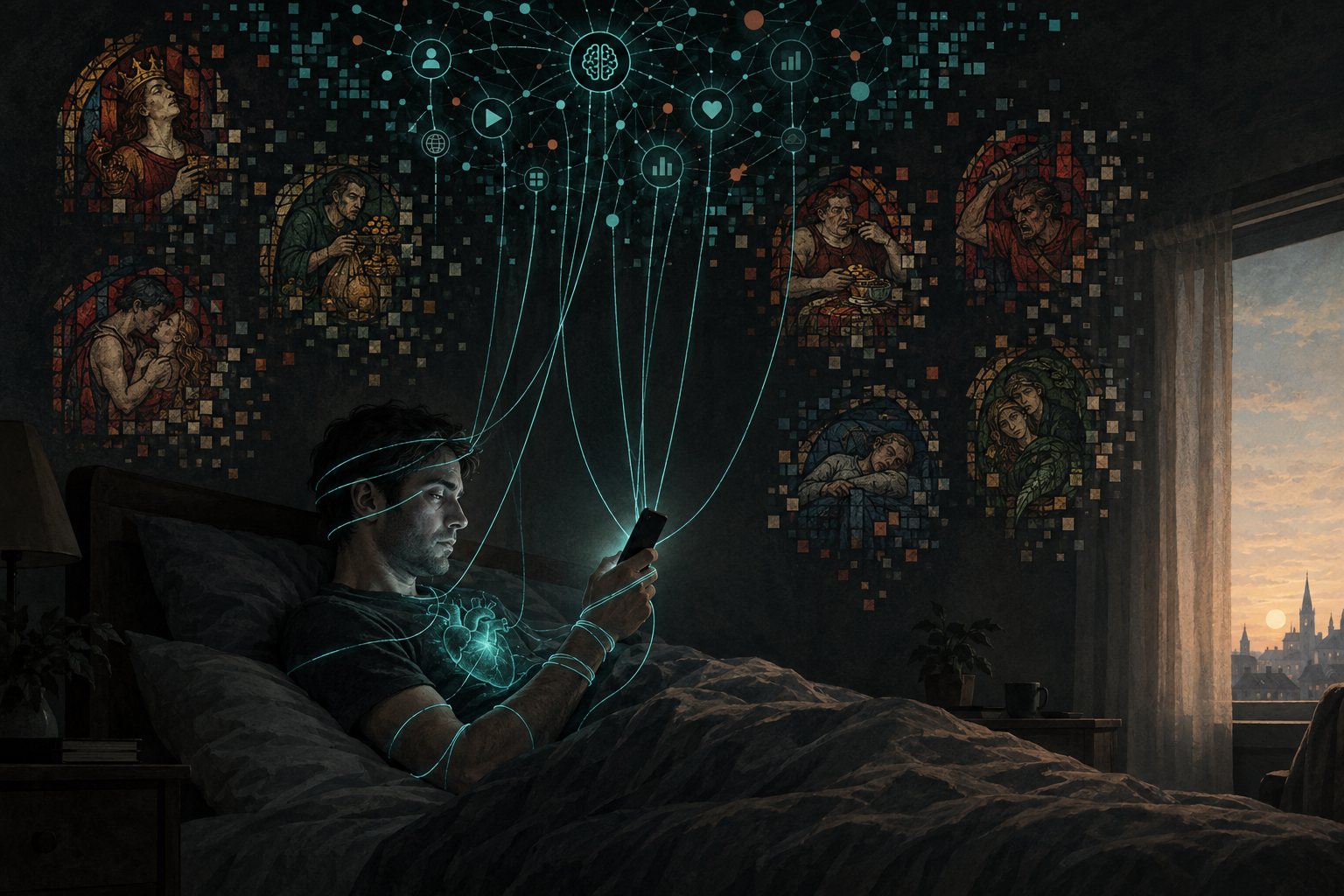
The essay behind this check
The Sins That Come Looking for Us
Why the twelve digital patterns work on attention, judgment and sense of self — and what it takes to keep your own direction.
Read the article →One honest look
Not a verdict. A mirror you can actually use.
See where you still steer and where the feed steers you — then choose one small experiment for the next 7 days.
Keep exploring
See yourself from another angle
Not now?
Take a free guide with you
Short practical guides from Dr. Zolotov — read them whenever you have a quiet moment.
Get a free guide →Sample reading is illustrative, not a score. A reflection tool based on the article — not a clinical diagnosis or a validated psychological test.