
TRIADIC INTELLIGENCE
The Sins That Come Looking for Us
How the seven deadly sins moved into the smartphone — and why the defining sin of the 21st century threatens not the soul, but the sovereignty of consciousness
By Dr. Alex Zolotov PhD
THIS ARTICLE IS BASED ON THE BOOK
Dr. Alex Zolotov, Ph.D.
Triadic Intelligence: Designing Reality With the Lens Triad
A systems-based approach to thinking, transformation, and reality design. Available on Amazon.
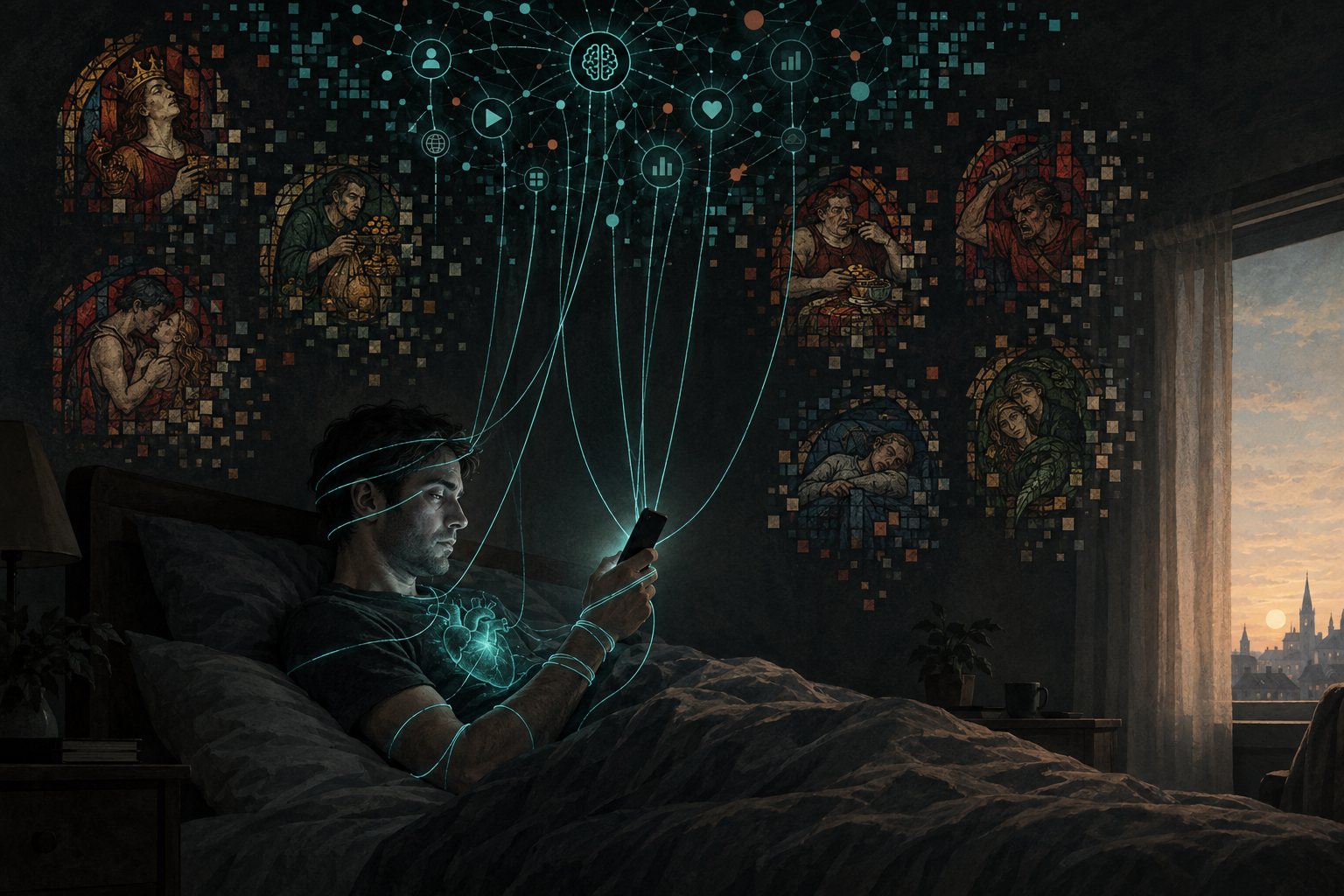
View the book on Amazon (opens in a new tab)Andrei woke up at 6:47.
The alarm hadn't gone off yet.
His hand reached for the phone on its own.
He didn't decide to do it.
He didn't even notice that he had.
Forty minutes later he was still in bed: three news stories that made him angry, two videos that made him laugh, one photo of a former classmate on a yacht that stung. And not a single thought he could call his own.
Nothing terrible had happened.
No one had taken anything from him.
Except for one thing — the first forty minutes of his day, his mood, and his attention.
Fifteen centuries ago, the monks of the Egyptian desert would have described this state precisely: the thoughts had taken possession of the man. Today we would call it something else. But the mechanism is strikingly similar.
There is only one difference.
In the past, people went looking for temptation.
Now temptation comes looking for people.
From Matter to Information: where the center of gravity of sin has shifted
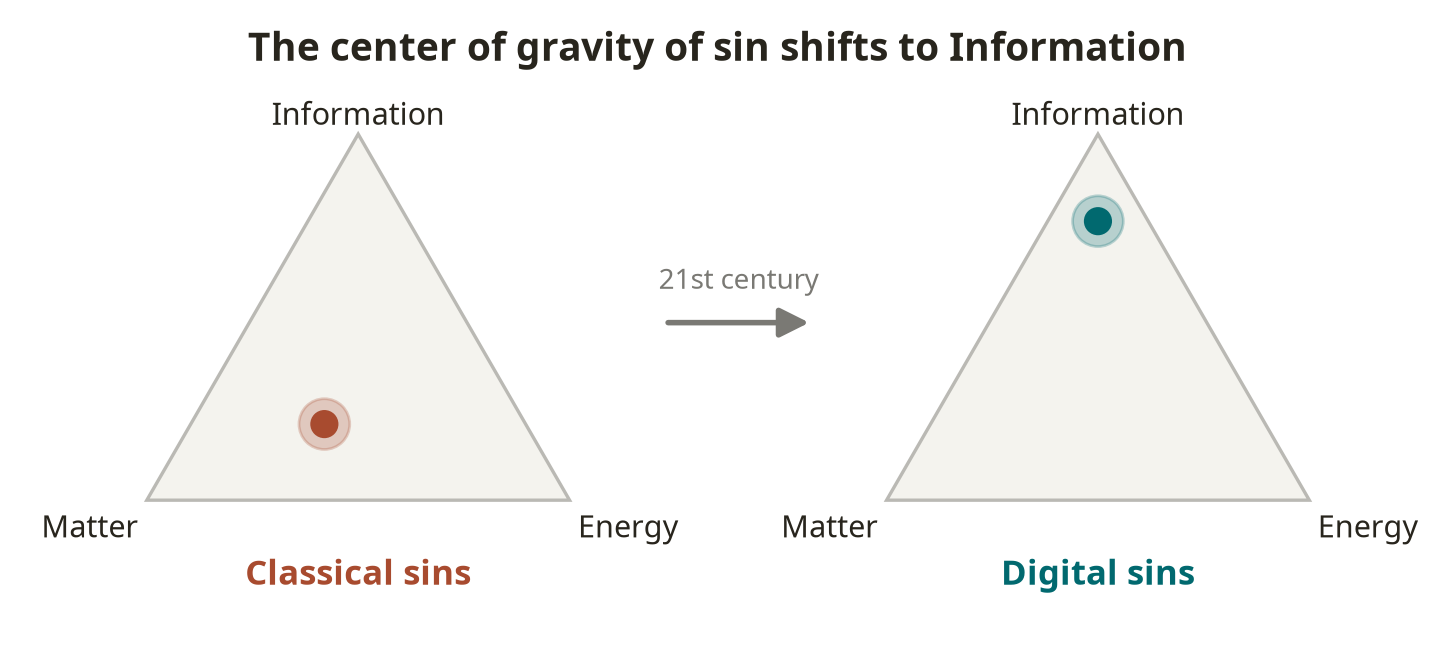
The transition from the classical seven deadly sins to the digital sins of the 21st century is not merely a change of scenery. It is a fundamental shift in the evolution of human vulnerabilities.
Within the framework of Triadic Intelligence, this process is described as a shift of sin's "center of gravity" from the domains of Matter and Energy into the domain of Information.
Gluttony was about the body.
Wrath was about energy unleashed on another person.
Pride was about one's place among other people.
Digital sins barely touch the body. They live where our thoughts, desires, and decisions are born.
Three key differences between digital and classical sins
1. A shift in the dominant MIE profile. Classical sins were mostly bodily (Matter: Gluttony, Lust) or socio-energetic (Energy: Wrath, Pride). Digital sins have moved almost entirely into the sphere of Information [710–713, 737].
2. The architecture of temptation. In the past, sin was an "event" — an encounter with an object of desire. Today sin is infrastructure. Where people once sought out temptation themselves, algorithms now seek out people, studying their weaknesses on an industrial scale. Every click, every pause on a video, every late-night scroll becomes data about exactly where you are vulnerable.
3. Three new risk amplifiers. Digital sins are more dangerous than classical ones because of algorithms (automated searching for "pain points"), scale (simultaneous impact on billions of people), and speed (addiction forms in days, not years).
For a medieval person to fall into gluttony, a feast was required.
For a modern person to fall into dopamine gluttony, all it takes is a free finger.
How we look at sin: the Triadic Intelligence approach
Before examining the digital sins, it is worth saying a few words about the lenses through which we view them.
Triadic Intelligence starts from a simple idea: any complex phenomenon becomes understandable when it is viewed from several perspectives at once. Not from one "correct" perspective, but from three interconnected ones.
We use three lenses.
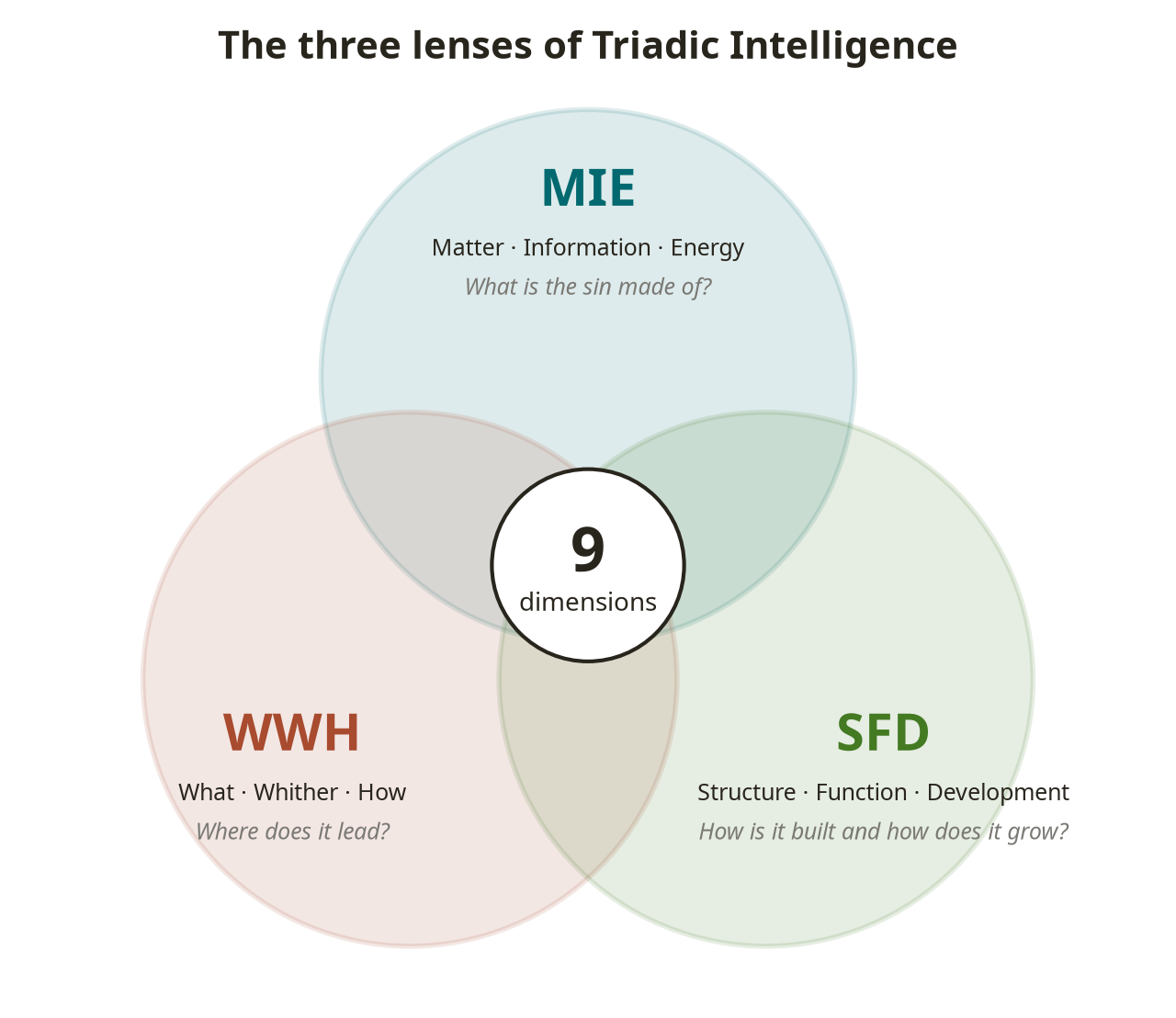
MIE — Matter, Information, Energy. The ontological lens. It answers the question: what is the sin made of? Where does it live — in the body, in meaning, or in the emotional force that pushes a person to act?
WWH — What, Whither, How. The lens of direction. What does a person truly want? Whither — where does that desire lead? How — by what means and mechanisms is it realized?
SFD — Structure, Function, Development. The systemic lens. How is the sin structured within the personality? What function does it serve — what pain does it protect against, what need does it substitute? And how does it develop — from a light habit to a stable addiction?
Each lens on its own offers a useful but incomplete view.
Together they form a nine-dimensional cognitive space — a coordinate system in which any sin can be not only condemned, but described, measured and, most importantly, understood.
This is the main difference in our approach.
The classical tradition asked: is this sinful?
Psychology asks: why does a person do this?
Triadic Intelligence asks: how is this vulnerability structured, what feeds it, and where does it lead?
In this view, sin is not a moral stain but an imbalance: one element of a triad begins to dominate and subordinates the others. When information crowds out living energy and bodily presence, when "how" eclipses "whither," when a function (getting a like) destroys a structure (an integrated self) — what we call a digital sin emerges.
For quantitative assessment we use a set of indices — for example, the Cognitive Corruption Index (CCI), the Addiction Index (ADI), the Sinfulness Index™, the Agency Index™, and the Harmony Coefficient™. They make it possible to compare sins with one another and see which are the most destructive to the personality.
TRIADIC INSIGHT
A classical sin was something a person committed. A digital sin is something that happens to a person. That is why the old tools — repentance, willpower, moral condemnation — work much less well against it. First it must be seen. And to see it, you need a map.
Twelve digital sins: the anatomy of a new vulnerability
Below is an analysis of twelve digital sins: what they are, what they look like in real life, and why they are destructive to the personality.

1. Attention Manipulation
Digital sin 1 of 12
ESSENCE
The systematic redirection of a person's focus in the interests of external systems — social networks, platforms, advertising networks.
EXAMPLES
• You open your phone to check the weather. Twenty minutes later you're watching a video about someone renovating a kitchen in another country — and you can't remember how you got there.
• A red dot with the number "3" on an app icon. You know there's probably nothing important there. But your finger has already tapped it.
• A family dinner. Four people at the table. Four screens. Not a single conversation.
WHY IT IS HARMFUL
Whoever controls attention controls behavior. Attention is the energy of consciousness. By giving it away, a person gives away the most valuable thing they have. The result is a critical loss of agency.
ANTIDOTE — MINDFUL ATTENTION
Decide where to look before you pick up the phone. Turn off all notifications except messages from real people. Remove social media from your home screen. Adopt a simple "one intention" rule: when I open an app, I silently name why. When the goal is reached, I close it.

2. Manufacturing False Reality
Digital sin 2 of 12
ESSENCE
Preferring a convenient digital illusion — fakes, filter bubbles, echo chambers — over an inconvenient truth.
EXAMPLES
• For years a man reads only channels that confirm his views. One day he is genuinely surprised: how can "anyone at all" think differently?
• An AI-generated photo of a "disaster" gets a million reposts in an hour. The correction, a day later, is seen by a few thousand people.
• An elderly woman forwards to her family a "proven remedy" for a serious illness from a video in which the "doctor" is a deepfake.
WHY IT IS HARMFUL
This sin has the highest Cognitive Corruption Index (CCI: 95), because it destroys the very mechanism of perceiving reality accurately. When the compass breaks, it doesn't matter how fast you're walking.
ANTIDOTE — EPISTEMIC HYGIENE
The "three sources" rule: before you believe or forward something, find confirmation in three independent places. Once a week, deliberately read people you disagree with. Be especially careful to check anything that triggered a strong emotion — that kind of content is the most likely to be false.

3. Digital Narcissism
Digital sin 3 of 12
ESSENCE
A mutation of Pride. A drive for constant "visibility," in which likes become a form of psychological nourishment.
EXAMPLES
• A young woman deletes a post if it doesn't get a "normal" number of likes in the first hour. For her it isn't a statistic — it's a verdict.
• A beach vacation spent searching for "the" perfect angle. Forty takes of one sunset. The sunset itself goes unnoticed.
• A man checks who viewed his stories more often than he calls his parents.
WHY IT IS HARMFUL
The personality falls into complete dependence on external approval and loses its inner foundation. Self-esteem stops being an inner quality and becomes a metric on someone else's server.
ANTIDOTE — AN INNER FOUNDATION
Before posting, ask yourself: "Would I do this if no one saw it?" Hide like counts if the platform allows it. Keep a small journal in which you evaluate yourself. Live important moments for yourself first — and only then, if you wish, for the camera.

4. Algorithmic Addiction
Digital sin 4 of 12
ESSENCE
Addiction not to a substance but to an intelligent environment that knows your weaknesses better than you do.
EXAMPLES
• "One more video and then bed." One a.m. Two. The feed is endless because it was designed that way.
• An app "senses" your sadness from the way you scroll and serves up exactly the content that will keep you there longer.
• A teenager feels real anxiety when the phone battery runs down — not because he's expecting an important call, but because he's "dropping out" of the stream.
WHY IT IS HARMFUL
It has an extreme Addiction Index (ADI: 98). The mechanism of variable reinforcement — an unpredictable reward behind every swipe — turns a person into an object of external control by algorithms.
ANTIDOTE — REGAINING CONTROL OVER YOUR ENVIRONMENT
Willpower works poorly against systems designed to bypass it. So change not yourself but your environment: app timers, the phone outside the bedroom, grayscale mode, autoplay turned off. Set a "stopping point" in advance — a time or a number of videos.

5. The Dopamine Economy
Digital sin 5 of 12
ESSENCE
A mutation of Gluttony. Consuming emotional "microdoses" of pleasure through short videos, notifications, likes, and endless feeds.
EXAMPLES
• A person can't watch a full-length film without a phone in hand — it's "boring."
• The book he dreamed of reading has been on the nightstand for three months. In the same time he has watched several thousand 15-second clips.
• A line, an elevator, a red light — any pause longer than five seconds is immediately "snacked on" with a screen.
WHY IT IS HARMFUL
Constant stimulation of the reward system depletes willpower and makes a person emotionally controllable. Ordinary life begins to seem bland — like food without salt after a month of fast food.
ANTIDOTE — A DOPAMINE FAST AND SLOW PLEASURES
Regularly set aside periods without fast stimulation — at least an hour a day. Bring back pleasures that take time: a book, a walk, a whole album, an unhurried conversation. Learn to tolerate boredom: that is where your own thoughts are born.

6. Information Obesity
Digital sin 6 of 12
ESSENCE
Accumulating data without integrating or making sense of it.
EXAMPLES
• Two hundred saved articles to "read later." Not one has been read.
• A man has listened to dozens of podcasts about healthy living but has never gone out for his first run.
• Before an important decision he studies one more review, one more opinion, one more comparison chart — and in the end decides nothing.
WHY IT IS HARMFUL
Knowing more does not mean understanding better. Information obesity leads to cognitive paralysis, when an abundance of information blocks the ability to act. Unprocessed information becomes not knowledge but ballast.
ANTIDOTE — AN INFORMATION DIET
Consume less, digest more. The "one idea, one action" rule: from every article you read, take one thought and apply it. Clean out your "read later" list regularly. Before a decision, set a limit: three sources, one evening, then choose.

7. The Cult of Productivity
Digital sin 7 of 12
ESSENCE
A mutation of Greed. Measuring a person's worth exclusively by results and efficiency.
EXAMPLES
• Trackers for sleep, steps, tasks, and habits. A person rests "on schedule" and feels guilty if a day off was "unproductive."
• A father half-listens to his son while answering work messages. He "gets everything done." Except his son.
• A hobby that once brought joy turns into a "project" with goals, metrics, and monetization.
WHY IT IS HARMFUL
"Being" is replaced by "doing." This leads to burnout and a loss of identity. A person no longer knows who they are unless they are being measured by results.
ANTIDOTE — THE RIGHT SIMPLY TO BE
Set aside time that doesn't have to produce anything: no goals, trackers, or reports. Give your hobby back its original meaning — joy, not results. Ask yourself not only "what did I do today?" but also "how did I live today?"

8. Empathy Degradation
Digital sin 8 of 12
ESSENCE
A mutation of Wrath. Losing the sense of a "living person" behind the screen, which breeds bullying and hate.
EXAMPLES
• Under a post about someone's misfortune — hundreds of cruel jokes. Most of their authors would never say anything like that to a person's face.
• A schoolboy is bullied in the class group chat. Most classmates "just stay silent" — they add reactions but don't intervene.
• A manager who is polite and calm at the office writes insulting comments under an anonymous username in the evenings.
WHY IT IS HARMFUL
It lowers the threshold of moral restraint, fostering dehumanization and social polarization. The screen works like anesthesia: another person's pain stops being felt.
ANTIDOTE — DIGITAL EMPATHY
The "face" rule: before writing a comment, imagine saying it while looking the person in the eye. Take a 10-second pause before a reply written in the heat of emotion. If you see bullying, one sympathetic word in defense of the victim changes more than it seems.

9. Simulation of Personality
Digital sin 9 of 12
ESSENCE
A gap between the real self and the digital brand or image. A person spends energy on "appearing" rather than "being."
EXAMPLES
• A blogger who sells "mindful living" actually lives in chronic stress from the need to always look calm.
• The family in the photo is perfect and happy. A minute after the shot, everyone goes off to separate rooms.
• A person catches himself experiencing an event already "in post format" — choosing a caption before he has even felt the emotion.
WHY IT IS HARMFUL
It leads to an existential crisis and inner emptiness, when the image finally replaces the personality. A mask worn too long grows into the face.
ANTIDOTE — CONGRUENCE
Narrow the gap between who you are and how you appear. Post less often but more honestly. From time to time, live through events no one will ever see. Ask yourself: "Is this image an extension of me or a replacement for me?"

10. Cognitive Outsourcing
Digital sin 10 of 12
ESSENCE
A mutation of Sloth. Handing over the functions of thinking and decision-making to artificial intelligence and digital services.
EXAMPLES
• A student submits an excellent essay written by AI but can't answer a single question about its content.
• A driver who has used GPS navigation for years gets lost in his own neighborhood when his phone dies.
• A person asks a chatbot to write a birthday message to his mother, an apology to a friend, and a declaration of love. All three texts are flawless. None of them contains him.
WHY IT IS HARMFUL
It weakens the intellectual apparatus. A person loses epistemic autonomy — the ability to determine for themselves what is true. Thinking, like a muscle, atrophies without exercise.
ANTIDOTE — "MYSELF FIRST."
Before turning to AI, formulate your own answer or at least a hypothesis. Use AI as a conversation partner and critic, not as a replacement for thinking. Keep for yourself the tasks that make you human: personal letters, important decisions, confessions. Now and then, drive without navigation.

11. Hyperreality
Digital sin 11 of 12
ESSENCE
Choosing an enhanced digital version of the world over reality.
EXAMPLES
• A filtered face in the phone camera seems "real," while one's own reflection in the mirror seems "bad."
• Virtual relationships with an AI companion that always understands, never gets tired, and never argues become preferable to relationships with living people.
• A tourist who has come to a famous waterfall is disappointed: "It looked better in the photos."
WHY IT IS HARMFUL
Complete detachment from physical reality leads to a loss of life's bearings and a substitution of goals. Reality, inevitably losing out in comparison with a perfect copy, begins to cause irritation.
ANTIDOTE — GROUNDING IN REALITY
A daily "unfiltered" experience: nature, the body, living faces, physical work. Look at yourself in the mirror more often than in a camera with effects. Remember: reality doesn't have to be prettier than the copy — its value lies in being real.

12. Fragmented Identity
Digital sin 12 of 12
ESSENCE
The disintegration of an integrated self into many profiles across different networks.
EXAMPLES
• On a professional network — an ambitious expert; on one social network — an ironic cynic; on another — a caring parent; on an anonymous account — someone else entirely. Which one is real?
• A teenager keeps a "main" account for parents and a "second" one for friends, and gradually becomes confused about who he is.
• After a day of switching between dozens of chats and roles, a person in the evening cannot answer a simple question: "What do I want?"
WHY IT IS HARMFUL
The loss of a unified personality makes a person maximally manipulable and unstable. Someone made up of many fragments has no center to hold on to.
ANTIDOTE — GATHERING THE SELF
Regularly ask yourself: "What values unite all my roles?" Reduce the number of profiles to the ones you truly need. Find a practice that restores wholeness — journaling, meditation, a long walk, a conversation with someone close. The center of the personality is not a profile but one's values.
The Meta-Sin of the 21st Century: the loss of sovereignty of consciousness
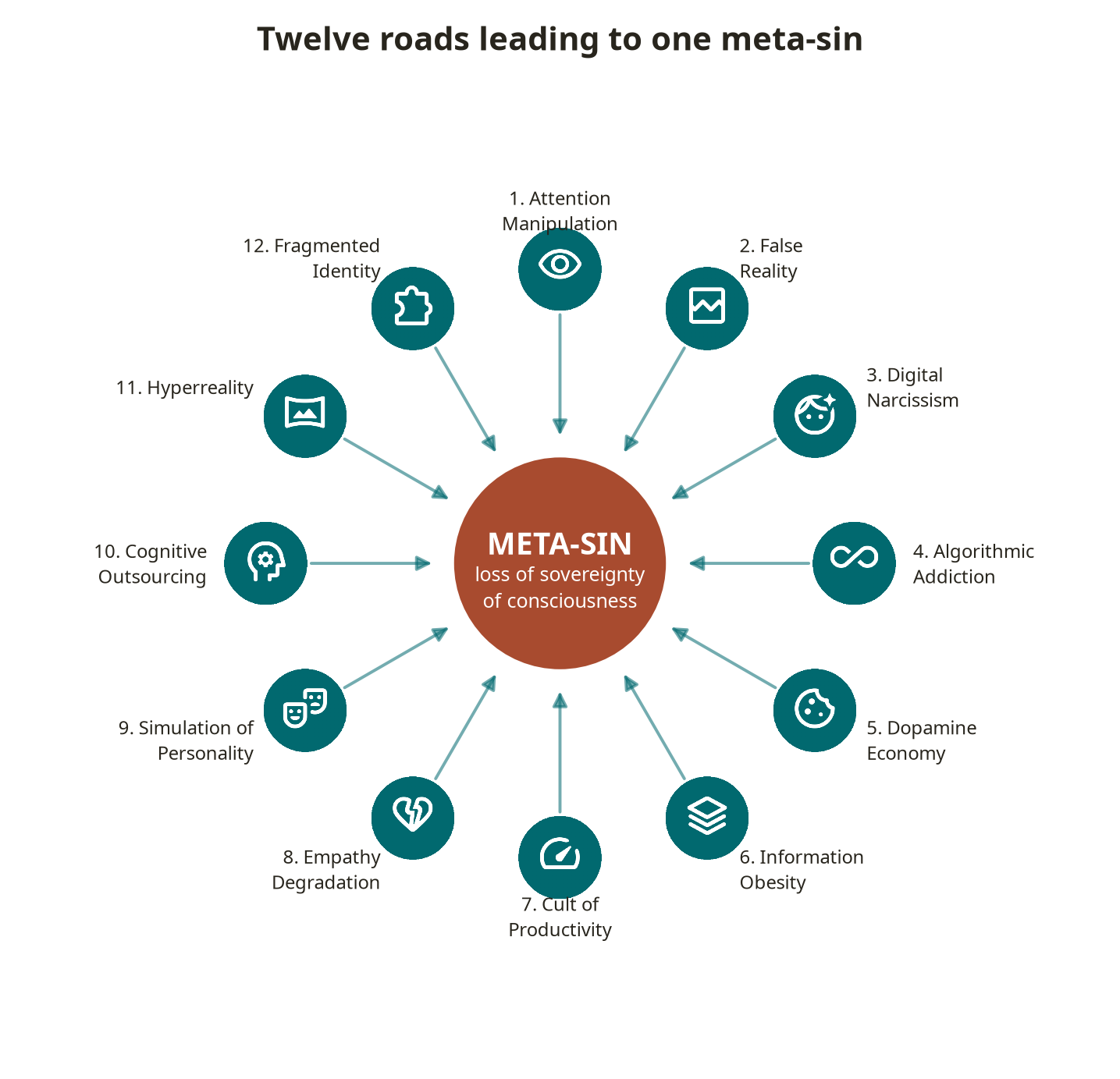
Twelve digital sins are not twelve separate troubles.
They are twelve roads leading to the same place.
We call that place the meta-sin.
The main danger of all the digital sins converges into one — the complete loss of autonomy of consciousness. If in the Middle Ages the greatest threat was considered the loss of the soul, in the 21st century it becomes the transfer of control over your attention, thinking, and values to external technological systems.
Why "meta"
The meta-sin is not the thirteenth sin on the list.
It is what happens when all twelve are working at once.
Each digital sin takes one thing: attention, self-esteem, the ability to think, the integrity of the self. The meta-sin is their sum. The point at which a person goes on living, working, communicating, and making decisions, but is no longer the author of their own life.
They are its reader.
Sometimes its spectator.
More and more often, a character in someone else's script.
The meta-sin through the three lenses
Triadic Intelligence makes it possible to see exactly how this loss takes place.
Through the MIE lens. Information subordinates Energy and Matter. Attention — the energy of consciousness — drains into the feed. The body stops being a source of signals: a person fails to notice fatigue, hunger, or tension because their eyes are fixed on the screen. Sleep, movement, and face-to-face encounters — the material foundation of life — become a resource "eaten up" by the information stream.
Through the WWH lens. All three supports of direction are lost. What I want is suggested by a recommendation system. Whither I am going is determined by an algorithm that shapes my feed, my purchases, and even my social circle. How I act is dictated by an interface designed to keep me in it as long as possible. A person still feels that they are choosing. But the menu of choices was not written by them.
Through the SFD lens. The structure of the personality breaks down into fragments of profiles. The functions of thinking, memory, and judgment are handed over to external systems. Development is replaced by optimization: a person grows not toward their potential but toward where they are more "engaged," predictable, and profitable.
When all nine coordinates shift at once, the Agency Index falls to critical levels. The person does not disappear. They simply stop being the one at the wheel.
Four stages of losing sovereignty
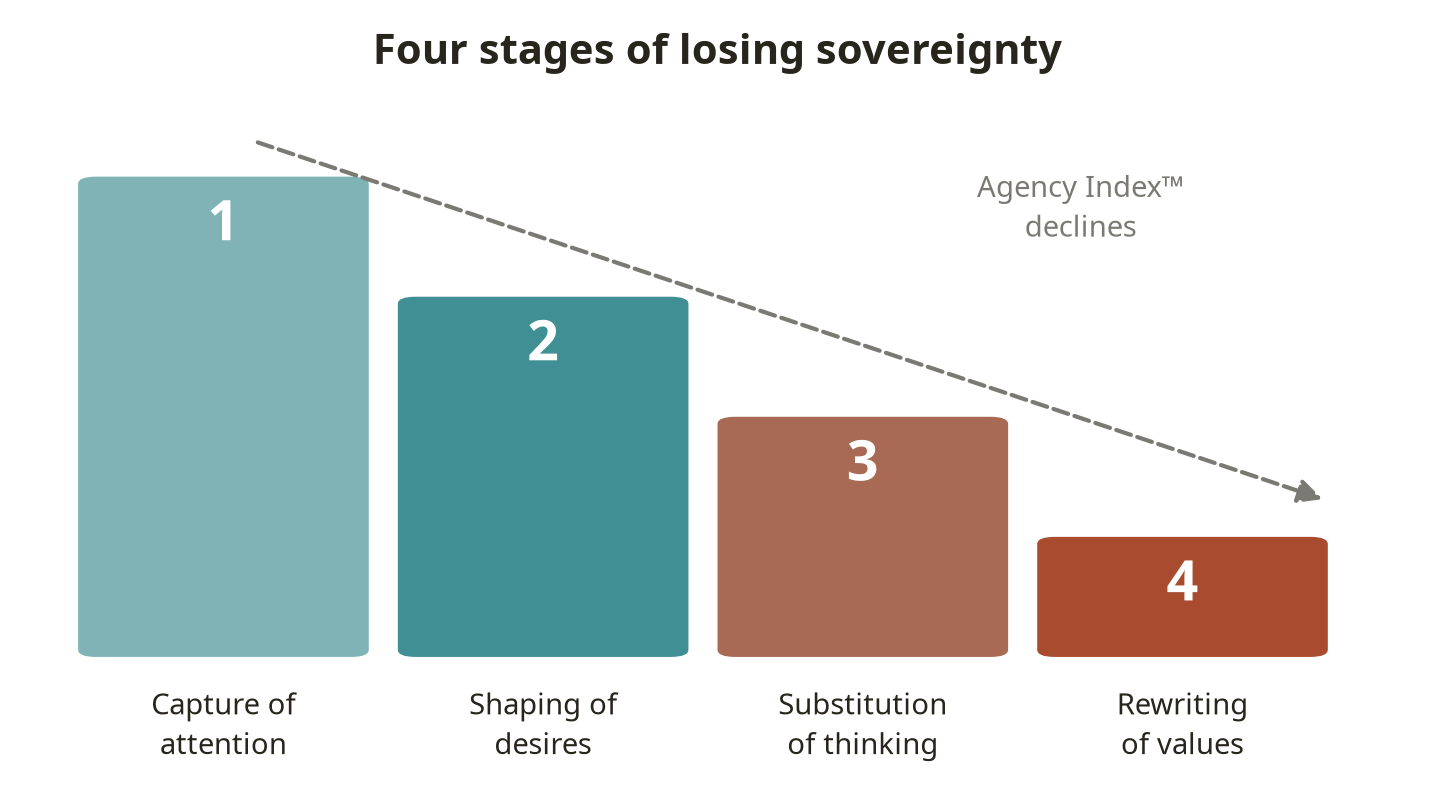
The meta-sin does not arrive suddenly. It develops gradually, almost imperceptibly — and that is its strength.
1. Capture of attention. First, a person's focus is taken. They increasingly look where they are called to look, not where they wanted to look.
2. Shaping of desires. Then what they want gradually changes. Their desires increasingly match what they have been shown, and less and less what they feel.
3. Substitution of thinking. Next, they stop thinking independently: opinions are formed by the feed, conclusions by a chatbot, evaluations by the number of likes.
4. Rewriting of values. Finally, what matters to them changes. Values shaped by family, experience, and reflection are quietly replaced by values optimized for someone else's metrics.
At every stage, a person keeps the illusion of freedom. That is exactly why the meta-sin is so rarely recognized from within.
A sin without a moment of choice
In the classical tradition, sin always had a moment of choice. A person could stop at the edge. Could say "no." Could repent.
The meta-sin has almost no such moment.
There is no decision to "give up one's freedom."
There are thousands of small, pleasant, meaningless movements of a finger.
Each one is innocent on its own.
Together they change the person.
In addition, responsibility for the meta-sin is diffuse. Who is to blame? The platform that designed the endless feed? The engineer who optimized engagement? The advertiser? Or the person who opens the app again and again? The answer of Triadic Intelligence: responsibility is distributed, but only the person bears the consequences. That is why they are the one who needs the map.
How to recognize the meta-sin: self-diagnostic questions
From the standpoint of psychotherapeutic practice, the meta-sin most often shows up not as a vivid symptom but as a background state. Here are some signs worth paying attention to:
• You pick up your phone without deciding to pick it up.
• You find it hard to spend 15 minutes alone with yourself, without a screen, a book, or a conversation.
• You increasingly can't remember where a particular opinion of yours came from.
• Your mood noticeably depends on the reactions to your posts.
• You notice that your desires — to buy, to travel, to look a certain way — are remarkably similar to what you recently saw in your feed.
• You find it hard to answer the question "what do I really want?" without a prompt from outside.
If you recognized yourself in several of these, it is not a reason for self-condemnation. It is a reason for attention. The first step toward regaining sovereignty is simply to notice.
Regaining sovereignty
If the meta-sin is the loss of authorship of one's own life, then the antidote is regaining it. In the logic of the three lenses, it too is built on three levels:
• MIE: restore balance. Return the energy of attention to yourself and restore the material foundation of life — sleep, the body, movement, face-to-face contact. Information should serve life, not replace it.
• WWH: restore direction. Regularly ask yourself what I want, whither I am going, and how I am getting there — and notice where the answers to these questions were given by someone else.
• SFD: restore wholeness. Gather the fragments of the self into a single structure, keep the functions of thinking and judgment for yourself, and choose development over optimization for someone else's metrics.
This is not a call to give up technology. It is a call to stop being its resource and to become its user once again.
TRIADIC INSIGHT
Medieval people feared losing their soul because they believed the soul was what made them themselves. In the 21st century, that role is played by a consciousness able to choose for itself what to look at, what to think about, and what to value. Perhaps the main spiritual challenge of our time sounds not like "save your soul," but like "remain the author of your own life."
Pause for a minute
Answer three questions for yourself.
Which of the twelve digital sins did you recognize in yourself first?
What decision in the past week was made not by you, but by your feed?
What will you do tomorrow morning in the first ten minutes after waking up — before you pick up your phone?
Write down your answers.
Perhaps this is where regaining your sovereignty will begin.
INTERACTIVE SELF-DIAGNOSIS CHECKLIST
Check yourself against each of the twelve digital sins and discover your personal vulnerability profile.
Take the Digital Sins checklist at alexz.us
Explore your own digital profileLearn more about the approach in the book Dr. Alex Zolotov, Ph.D., Triadic Intelligence: Designing Reality With the Lens Triad