
Triadic Intelligence™ · Essay on Personal Harmony
Three Strings of Attunement
Why a life that has everything can still sound out of tune, and how to tune it
By Dr. Alex Zolotov, Ph.D.

 |
THIS ARTICLE IS BASED ON THE BOOK Dr. Alex Zolotov, Ph.D. Triadic Intelligence: Designing Reality With the Lens Triad A short version of the article “Measure and Consonance” from the Triadic Intelligence series · ALEXZ.US. |
|---|
Over the years of my practice, I have heard this phrase dozens of times, in different words and from very different people: “I have everything. There is just no harmony.”
Let us gather these people into one character and call him Victor. He is forty-four, he runs an IT department, he is valued, and his projects are delivered on time. His family is intact, and the mortgage is almost paid off. If you broke his life down into the boxes of a questionnaire, you would get a model of success. But he sleeps badly, he forgot the way to the gym long ago, he talks to his children “about business,” and on Saturday mornings he opens the work chat before he has even had time to wake up.
Victor is not ill, and he is not in crisis. By all outward signs, his life is well arranged. From the inside, it resembles an expensive instrument that has not been tuned for a long time. This is exactly the gap we will try to understand: why success does not always bring agreement with oneself, and what can be changed without yet another project of turning oneself into an ideal person.
The word “harmony” comes from Greek, where ἁρμονία meant “fastening, joining, agreement”: first in the work of a carpenter joining boards, then in music, where it came to mean a mode, an agreement of sounds. Even this first meaning contains an important idea: harmony is not a separate part, but the way the parts hold together.
 |
WORKING DEFINITION Psychological harmony of personality is the coherence of the main sides of a person’s life (body, feelings, meanings), when they are sufficiently filled and supported by resources; proportionate to one another and to the circumstances of life; and in line with the personal measure that this particular person needs, while the coherence itself is maintained and restored as life changes. In our model, we view personality harmony first of all within Triadic Intelligence, as a system with its own internal structure. |
|---|
Three strings are a convenient metaphor. Behind it stand quite down-to-earth questions: Is there enough support? Is one part of life crowding out the others? Does the way I live actually suit me?
Harmony is not “more of everything,” but “a place and a measure for each thing.”
This article is about what personality harmony, or attunement, is, why it breaks down even in the most successful people, and how to restore it. It will contain not a single formula; instead, it offers four portraits, a map of nine states, Victor’s story, and one simple exercise you can do as early as this evening.
In the book Triadic Intelligence, we propose looking at a complex phenomenon through several lenses stacked on top of one another, so that its internal structure shows through behind a general word. In this article, we apply this method to personality harmony: we review what psychology, sociology, philosophy, and other sciences know about it, and we propose three dimensions of harmony and an instrument that makes it possible to measure them.
How to Tell Attunement From a Picture of Well-Being
In the vacation photo, everyone is smiling. Off-camera, the father is answering an email, the mother is worrying about expenses, and the teenager is waiting for the moment he can leave. The beautiful picture happened; the shared vacation has not happened yet.
This is exactly how easy it is to make a mistake about harmony: to take a pleasing outward appearance for the quality of inner connections. The word “harmony” is often confused with neighboring concepts. The differences matter: if we mix them up, it is easy to start “optimizing” the wrong thing. Let us look at some concepts that are often associated with harmony or attunement.
| Next to Harmony | What Is Important to Distinguish |
|---|---|
| Happiness | Joy and pleasure can accompany attunement. But a person is capable of maintaining inner coherence even in sadness. |
| Beauty | The experience of the aesthetic value of a form, an image, or a sound. Harmony can be a source of beauty, but beauty can also be disturbing and tragic; an attractive image does not prove inner well-being. |
| Satisfaction | This is an assessment of how well life meets expectations. One can be satisfied with one’s career and dissatisfied with the price one pays for it. |
| Balance | It helps coordinate demands. Equal shares of time and energy are far from always needed: the parent of an infant and a student before exams face different tasks. |
| Norm | The group average serves as a comparison. Personal measure answers a different question: what is enough and manageable for me, right now. |
| Neutrality | In the approach of this series, it is the ability to take a stable observing position. It helps us see discord, but by itself it does not yet put life in order. |
| Calm | The absence of tension can be rest, or it can be numbness. Living harmony allows for effort, disagreement, and change. |
This idea has a long history. The Pythagoreans looked for agreement in numerical relations; Plato, in the coherence of the parts of the soul; Aristotle, in the fitting measure between deficiency and excess. The Confucian tradition adds agreement while preserving differences. Researchers of the 21st century add flexibility and measurability. None of these ideas cancels the others. That is why, in our view, a model of harmony should be not a single formula but a system of several mutually complementary perspectives [1; 2; 10].
|
THE COHERENCE HEURISTIC Harmony is living agreement, not motionless perfection. There is room in it for tension, difference, and even a little imperfection. Its sign is not the absence of contradictions, but the ability of the parts of life to sound together and to return to agreement after life has put them “out of tune.” |
|---|
Why Harmony Often Seems Beautiful
Imagine walking into a room where every object is beautiful on its own: a carved table, a bright carpet, a large painting, an unusual chandelier. Sometimes, together, they argue so loudly that you want to leave. In another room there are only a few simple objects, and it is easy to breathe. We are drawn not only to things, but also to the relationships between them.
Beauty here we will call the experience of the aesthetic value of a form, an image, or a sound. Harmony is the coherence of elements within a whole. Such coherence can evoke a sense of beauty, but beauty can also be disturbing, tragic, or built on sharp contrast. That is why these concepts are related but not identical. Let us look at examples from painting, architecture, and music.
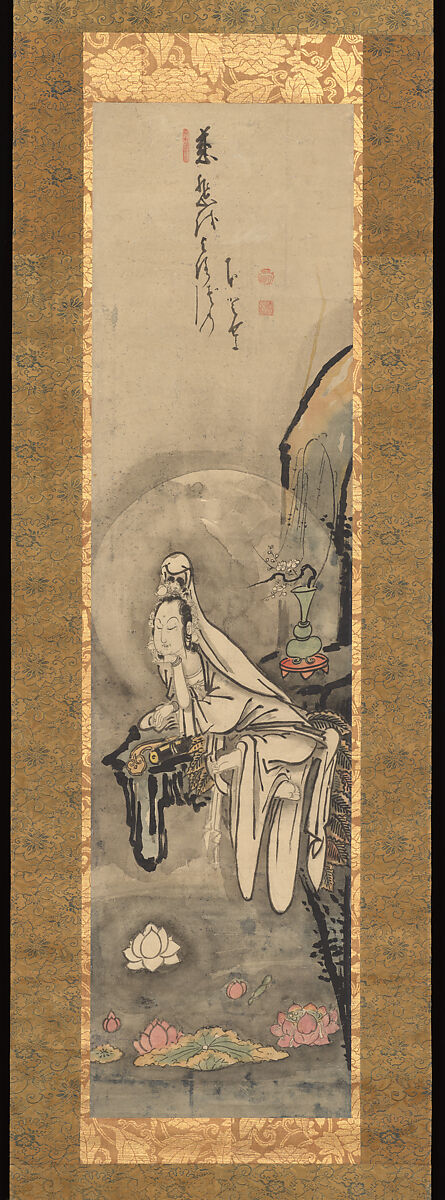 |
PAINTING: ROOM FOR DIFFERENCES In a painting, the relationships of color, light, line, and empty space matter. Filling the whole canvas evenly does not yet mean creating a composition. In Hakuin Ekaku’s “Kannon by a Lotus Pond,” the inscription is deliberately asymmetrical: the difference between its columns echoes the pose of the figure. The museum commentary notes this device explicitly [4]. The different lengths of the inscription’s lines and the empty space take part in the composition together with the figure. The differences create relationships rather than disappearing. Coherence can include inequality. Hakuin Ekaku“Kannon by a Lotus Pond”1750s The Metropolitan Museum of Art, 2025.91. Public Domain. |
|---|
In architecture, Frank Lloyd Wright’s Fallingwater makes the same idea visible. Stone, horizontal terraces, water, and forest form a connected composition; the building responds to the place where it stands [5].
|
|---|
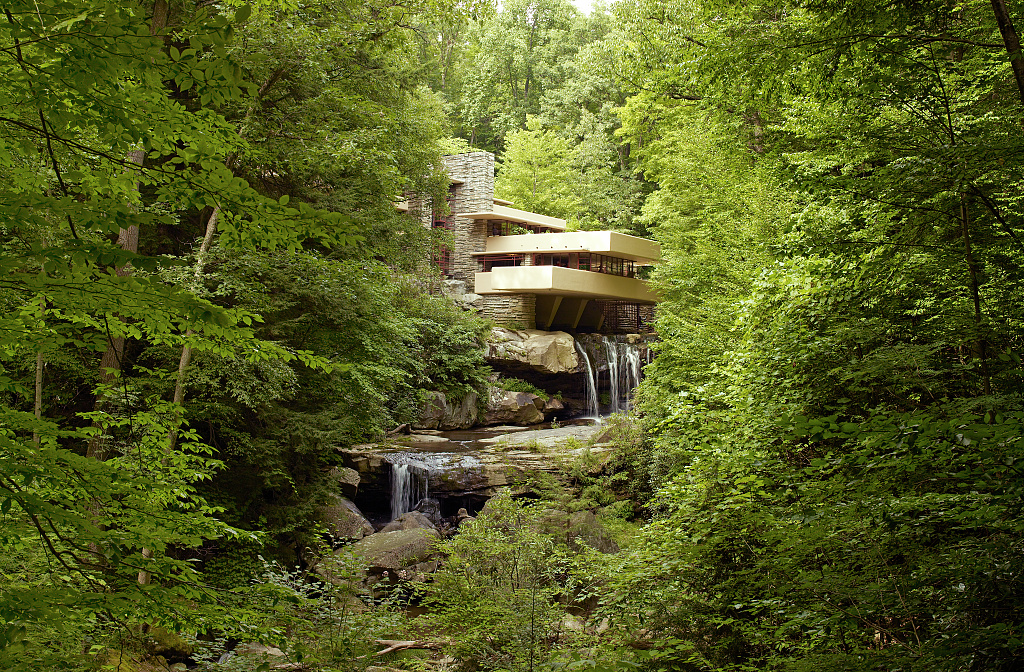
For a person, the parallel is useful: a way of life should take into account one’s own “landscape”: age, body, responsibilities, surroundings. At the same time, the aesthetic expressiveness of a house does not in itself prove that it is comfortable, just as an attractive way of life does not prove that it brings well-being.
In music, a melody needs rhythm and pauses. The tension of a chord can prepare a resolution; in other traditions, musical development is arranged differently. Studies of perception treat tension and resolution as important aspects of the experience of harmony [6]. Research on the psychophysics of harmony shows that the sense of harmony in classical music cannot be reduced to the sum of individual intervals and is largely determined by combinations of three tones, that is, triads: the pleasing effect of a chord is greater than the sum of its parts [23]. For our topic, this is a beautiful metaphor. A harmonious life resembles not one pure note but a triad in which all three voices can be heard: body, feeling, and meaning. And, as in music, tension is not the enemy of harmony; what matters is that it can resolve.
A well-placed pause makes a melody more expressive. In life, too, it can return meaning to what we do
More Does Not Mean Better
We live in a culture of counters. Steps, followers, projects, books per year, hours of self-development. Almost everything is measured by one principle: the more, the better. But harmony works differently, and people knew this long before us.
Aristotle called virtue the mean between deficiency and excess, and the mean is different for each person, “relative to us” [1]. Courage lies between cowardice and recklessness. Generosity lies between stinginess and extravagance. There can be too much of a good thing, and then it stops being good.
The Beauty of Relationships and Human Health
Cultures hold different ideas of good agreement: through order, reciprocity, freedom, restraint, expressiveness. Even within one family, silence may mean closeness to one person and distance to another. Durkheim examined the risks of both weak and excessive social integration and regulation [3]. This is a historical hint about two extremes, not a rule that “health always lies in the middle.”
Agreement does not require sameness. In a family, people can love different activities; in a team, people can evaluate a decision differently. Amy Edmondson’s research links a team’s psychological safety to its learning behavior [7]. For our topic, the conclusion is important: being able to ask questions and discuss a mistake is often more useful than a flawless appearance of unanimity.
 |
WHEN SILENCE PROVES NOTHING A married couple hardly ever argue, but they also do not share what matters. The absence of quarrels says nothing about how proportionate their life is. They can start with a simple question: “What have we long wanted to talk about but keep putting off?” Calm is worth assessing together with the liveliness of contact. |
|---|
In psychology, Carl Rogers linked congruence to the coherence of experience, awareness, and expression. In an everyday example, a person notices fatigue, acknowledges it, and is able to say: “Today I will not take on another task.” This does not promise an easy life, but it reduces the gap between inner experience and outward behavior [8].
Health requires particular precision. Flexibly coordinating workload, sleep, recovery, and support can help well-being. But harmony does not guarantee health, and illness is not evidence of inner failure. A person with a chronic illness can live in agreement with their values; an outwardly healthy person can constantly exhaust themselves.
Art can become one source of support: singing together offers contact, drawing offers a way to express an experience, and dance offers movement and participation.
A WHO review examines the evidence on the role of the arts in health and well-being [9]. These are diverse practices with different evidence bases, not a universal cure “by beauty.”
|
THE PRICE HEURISTIC Look at what a beautiful result is paid for with. If impressive productivity systematically requires giving up sleep, closeness, or necessary help, that price is worth examining. |
|---|
What Psychology Can Already Explain
Harmony can be studied while respecting human complexity. Oscar Kjell and colleagues developed the Harmony in Life Scale (HILS), which complements the measurement of satisfaction and addresses balance and flexibility [10]. It shows that the topic is open to scientific study. However, the existence of a validated scale does not make every new model of harmony validated.
As early as 1897, Émile Durkheim showed that people are threatened both by too weak a bond with society and by too strong a bond; both by too few rules and by rules that are too rigid [3]. Health lies not at a pole, but in the middle.
Ryan and Deci’s self-determination theory identifies autonomy, competence, and relatedness to others [11]. For self-inquiry, this offers a useful hint: achievements can support a sense of competence while leaving the need for closeness unmet. One strong side cannot explain the whole picture.
Here are some examples from modern psychology on our topic.
 |
FLOW: WHEN BALANCE IS A TRAP Mihaly Csikszentmihalyi showed that full engagement, “flow,” arises when challenge and skill are balanced and both are high enough. If both are low, the result is not harmony but apathy [12]. Even does not mean good. An even emptiness is still emptiness. |
|---|
|
PASSION: WHEN THERE IS TOO MUCH OF A GOOD THING Robert Vallerand distinguished harmonious and obsessive passion. The first coexists with the rest of life. The second crowds it out: the person cannot stop, and rest brings feelings of guilt [13]. A beloved activity that has grown too large begins to destroy the very things it was pursued for. |
|---|
|
THE IDEAL SELF AND THE OUGHT SELF: DIFFERENT EDGES Higgins described discrepancies between the actual, the ideal, and the ought self [14]. This is a reminder to check our reference points: “I want” and “I am obliged to want” can lead in different directions. |
|---|
|
THE TRIAD OF THE SENSE OF COHERENCE Antonovsky proposed a triad of the sense of coherence: comprehensibility, manageability, and meaningfulness. It helps us ask whether I understand what is happening, whether I see available supports, and for the sake of what I keep acting [15]. |
|---|
|
HARMONY THROUGH FORMATION, BALANCE, AND INTEGRATION Russian studies describe harmony through the formation, balance, and integration of the spheres of personality [16]. García’s research examines its links with character and personality traits; such links do not mean that a single type of “harmonious person” has been found. Harmony is linked above all to the maturity of character, not to a “lucky temperament” [17]. |
|---|
What, then, is personality disharmony? It is when one or several spheres of personality are seriously depleted or overloaded. Care is needed, and possibly the help of a specialist. Burnout is the most recognizable example of our time. Since 2019, the World Health Organization has called it an “occupational phenomenon” [21], and Christina Maslach describes its three sides: exhaustion, detachment, and the feeling that you can no longer do anything [18]. According to Gallup, in 2025 40% of employees worldwide reported experiencing stress during a lot of the previous day [22]. Almost every second person.
|
THE KEY POINT Burnout almost never starts with something “bad.” It starts with something good that has become too much: work you love, responsibility you are proud of. An excess in one place is quietly paid for by a deficit everywhere else. |
|---|
 |
ON FALSE HARMONY There is a state that looks like harmony from the outside but is its opposite on the inside: everything is even, everything is under control, but there is no life in it. This is false harmony, akin to the false neutrality from the article “The Quiet Center.” Its signs are high fullness with a noticeable excess (life “worn out, but beautiful”) or a perfect measure with very low expectations (“I don’t need anything”). In the map of states below, false harmony has its own cells. |
|---|
The Triadic Intelligence Approach
Triadic Intelligence is a way of thinking about complex things in which a phenomenon is examined not through one “correct” point of view but through several lens triads laid over one another. Each lens consists of three interrelated questions that together capture the phenomenon more fully than any one of them alone. When the lenses are stacked, a grid of cells appears, and in each cell a precise question can be asked.
 |
THE METHOD IN BRIEF A lens is three mutually complementary views of one phenomenon. Lens stacking (Stacking Lens) is placing several lenses on top of one another. Three lenses of three views each give 3 × 3 × 3 = 27 cells of analysis. The book’s core lenses: Matter – Information – Energy (what the phenomenon is made of); What – Where – How (its content, direction, and manner); Structure – Functioning – Development (how it is built, how it works, and how it grows). The aim is not to sort a person into neat boxes, but to see the connections that usually slip away. |
|---|
In the articles of this series, we have already applied this approach to psychological neutrality, psychological charge, digital temptations, uncertainty, and the model of the soul. In the article on the Soul Crystal, the lenses were adapted for self-inquiry: Body – Feeling – Meaning (the human reading of the Matter – Energy – Information lens) and Structure – Functioning – Development. Their intersection produced nine components, and the What – Where – How lens became the source of clarifying questions for each of them.
For the topic of harmony, we use an adaptation: the body as material support, meaning as the realm of values and reference points, and feelings as emotional dynamics. The order “Body–Feeling–Meaning” is convenient for presentation; feelings are not equated here with physical energy.
| Sphere | Structure: support | Functioning: everyday life | Development: change |
|---|---|---|---|
| Body | B1. Bodily Foundation: how far the body serves as an available support | B2. Supportive Rhythm: sleep, nutrition, movement, rest | B3. Bodily Development: strengthening available capacities |
| Feeling | F1. Emotional Foundation: acceptance and support | F2. Emotional Life: experiences, contact, self-regulation | F3. Emotional Development: understanding and expressing feelings |
| Meaning | M1. Foundation of Meaning: values and reference points | M2. Meaning in Action: coherence of one’s activities with what matters | M3. Growth of Understanding: a new view of oneself and of life |
These are the nine components of the Soul Crystal. The columns describe different sides of life, not ranks of worth: stable habits and development are needed in different ways at different periods.
|
WHAT – WHERE – HOW Each component can be approached through three more questions. What is happening here? Where do I want to arrive? How is the current order maintained, and how can it be changed? This creates a space of 27 questions. It helps clarify the situation but does not require filling in everything at once. |
|---|
For example, bodily everyday life: “What?” Sleep is interrupted by late-evening messaging. “Where?” Toward a more restorative rhythm. “How?” Agree on response times and turn off work notifications at night.
Three Strings
Imagine a lyre with three strings. Plato, incidentally, described the just soul in exactly this way: its three parts sound in agreement, like three notes of one mode [1]. And researchers of music perception have shown that the sense of harmony arises not in a single interval but in the combination of three tones, in a triad [23].
In our model, the three strings of life are Body, Feeling, and Meaning. And to understand whether they sound together, it is enough to ask yourself three questions about Fullness, Proportionality, and Measure. Let us return to the examples from different sciences. Almost every discord we have discussed comes down to one of three disturbances: something is too scarce (apathy, exhaustion), the parts are out of proportion (skew, burnout), or there is a mismatch with personal measure (obsessive passion, self-discrepancies). Hence the three dimensions of harmony.
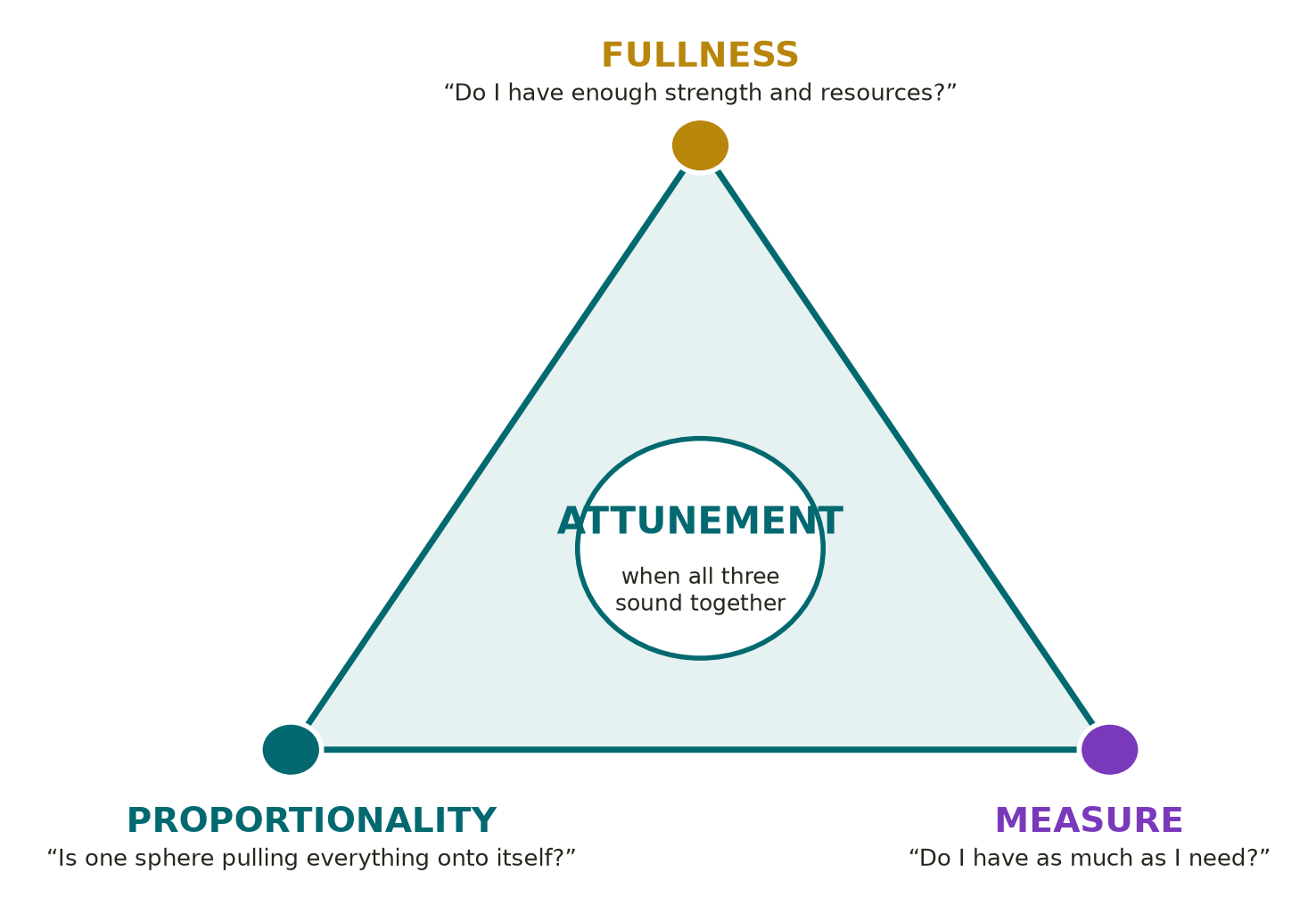
Fig. 1. Three questions about attunement. Harmony arises only when all three are answered with a “yes.”
| Question | What it checks | How the false note sounds |
|---|---|---|
Fullness “Do I have enough strength?” |
Whether the sphere has resources: energy, experience, support. | The string has gone slack: there is almost no sound. |
Proportionality “Is one sphere pulling everything onto itself?” |
Whether there is a sharp skew between the parts. | One string drowns out the others. |
Measure “Do I have as much as I need?” |
Whether what I have matches what I in particular need. | The string is overtightened or undertightened, even if it sounds loud. |
Table 1. The three dimensions of attunement.
Fullness is how available supports, abilities, and experiences are in the sphere in question. The question “Is there something to lean on?” matters more than a demand to be cheerful all the time. Proportionality is how well the parts coexist without destructive crowding out. Measure is how well current life matches the level that is sufficient and manageable for this particular person.
Each dimension has a blind spot. Fullness does not show the price of achievements. Evenness does not distinguish sufficiency from an equal shortage. Matching expectations can mean either mature contentment or giving up important needs. That is why we consider them together.
Sphere harmony combines these three views for the body, feelings, or meaning. The Personality Harmony Index (PHI) summarizes the three spheres. In such a summary, it is important to keep vulnerable sides visible: strong results in one place do not cancel a lack of support in another.
The most unexpected thing here is measure. We are used to comparing ourselves with a norm, with the average, with a colleague in the office. But measure is not a norm. For one person, three workouts a week are too few; for another, too many. One person needs a lot of social contact; for another, two close people are enough. That is why we ask not “How should it be?” but “How much of this do you need in order to live in attunement, no more and no less?”
Another dimension of harmony is flexibility: the ability to notice changing conditions and to restore coherence. It reveals the dynamics of harmony and unfolds over time. And clearly, a single profile is not enough to judge real recovery after a difficult period.
 |
WHY ALL THREE QUESTIONS ARE NEEDED Each question catches what the others miss. Fullness does not notice skew. Proportionality does not notice emptiness: three equally low ratings look “perfectly even.” Measure does not notice the overall level: a person who “needs nothing” formally lives in measure. Only together do they give an honest and complete picture. |
|---|
Four Portraits
To feel the difference, look at four hypothetical people. For each of them, we see how much strength they have now in the three spheres and how much they need.
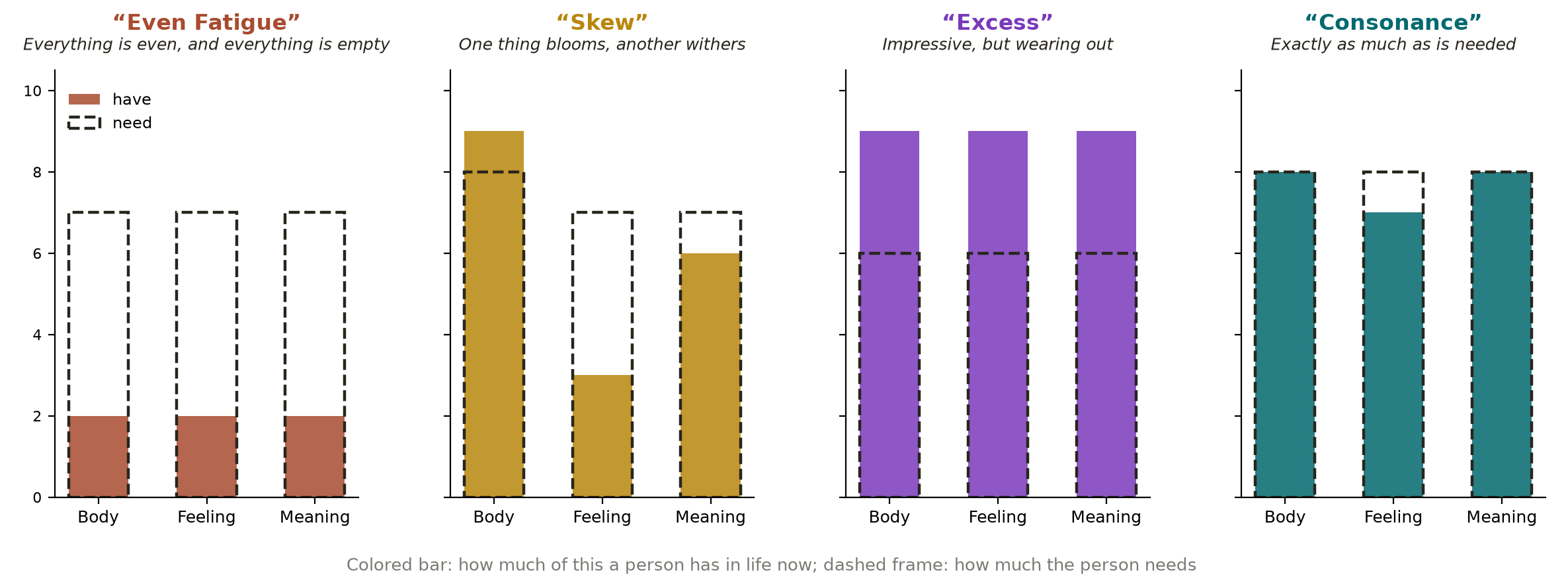
Fig. 2. Four portraits. The colored bar shows how much a person has; the dashed frame shows how much they need.
“Even Fatigue.” Everything is distributed perfectly evenly, with no skews. If you look only at proportions, this is a model of harmony. But there is little strength everywhere, and much more is needed. This is not harmony but quiet exhaustion, which is easy to mistake for calm.
“Skew.” The body is in excellent shape, even better than needed. But the feelings are almost empty. A familiar picture: a person who runs marathons so as not to meet their own sadness.
“Excess.” There is a lot of everything, more than needed. From the outside, this looks like success and energy. From the inside, it is life on the verge of wearing out. This is the most insidious picture, false harmony: all indicators are high, and that is exactly why the person does not notice that they sound like an overtightened string.
“Consonance.” Not the maximum and not an ideal. Simply as much of each thing as is needed. One sphere falls slightly short, and that is normal: in living harmony, there is always room to grow.
|
A SHORT SCENE FROM PRACTICE A young woman says, “Work is my passion.” She arrives first, leaves last, and is proud of it. Her friends have “gone somewhere,” and vacations make her anxious. If she were answering the question “How much work do you have?” the answer would be “A lot, and that’s good.” To the question “How much do you need?” she fell silent for a long time. That was the first step. |
|---|
The Golden Section Hypothesis: Testing Instead of Believing
The golden section is one of the most beautiful ideas in the history of science. It describes dividing a whole into two parts so that the whole is to the larger part as the larger part is to the smaller. The resulting number is denoted by the Greek letter φ (“phi”): φ ≈ 1.618. Supporters of the “structural harmony of systems” suggest that harmonious systems, from a crystal to a personality, gravitate toward this proportion. Among the vast body of material on this topic, we want to single out the Belarusian philosopher Eduard Soroko, who even formulated a “law of structural harmony of systems,” according to which harmonious systems gravitate toward a whole family of “golden” proportions [19]. In his book Structural Harmony of Systems, he proposed treating the family of generalized golden sections as reference points of self-organization and showed the golden-section proportions for a triadic structure [19]. In this tradition, “nodes” denote presumed areas of stability, and “antinodes” denote the areas between them, associated with instability.
The idea is beautiful, and psychology has an interesting fact: when describing acquaintances using pairs of qualities (“kind – unkind,” “strong – weak”), people choose the positive pole in about 62% of cases [24]. But when researchers tested whether the 62 to 38 ratio is an ideal balance point, no confirmation was found [25]. The fact that a proportion occurs does not yet mean that it is a standard.
Studies of personality ratings have discussed how close the shares of positive and negative characteristics are to the golden proportion. But frequency of occurrence does not prove optimality. A review of claims about the golden section and facial beauty also finds no convincing basis for a universal ideal [20]. An aesthetic hypothesis does not become a psychological norm without separate testing.
A beautiful proportion can turn out to be a portrait of overload.
For personality psychology, Soroko’s law has never been tested, so we treat it as a source of hypotheses, not as a proven norm.
 |
OUR CONCLUSION We do not reject the golden section as a possible numerical measure of harmony. However, we treat it as a hypothesis that can and must be tested, not as a norm to which life should be adjusted. A detailed analysis of Soroko’s approach and an attempt to test empirically whether the golden section can be applied to our data are presented in the full version of our article, “Measure and Consonance.” The results of our experiments are still in progress and will be published. |
|---|
Nine States of Attunement
One number rarely tells the truth about a person. That is why we
combined two triads, as is customary in Triadic Intelligence: the
level of attunement (high, medium, discord) and the
direction (something is lacking, everything is in
measure, something is too much). The result is a map of nine states.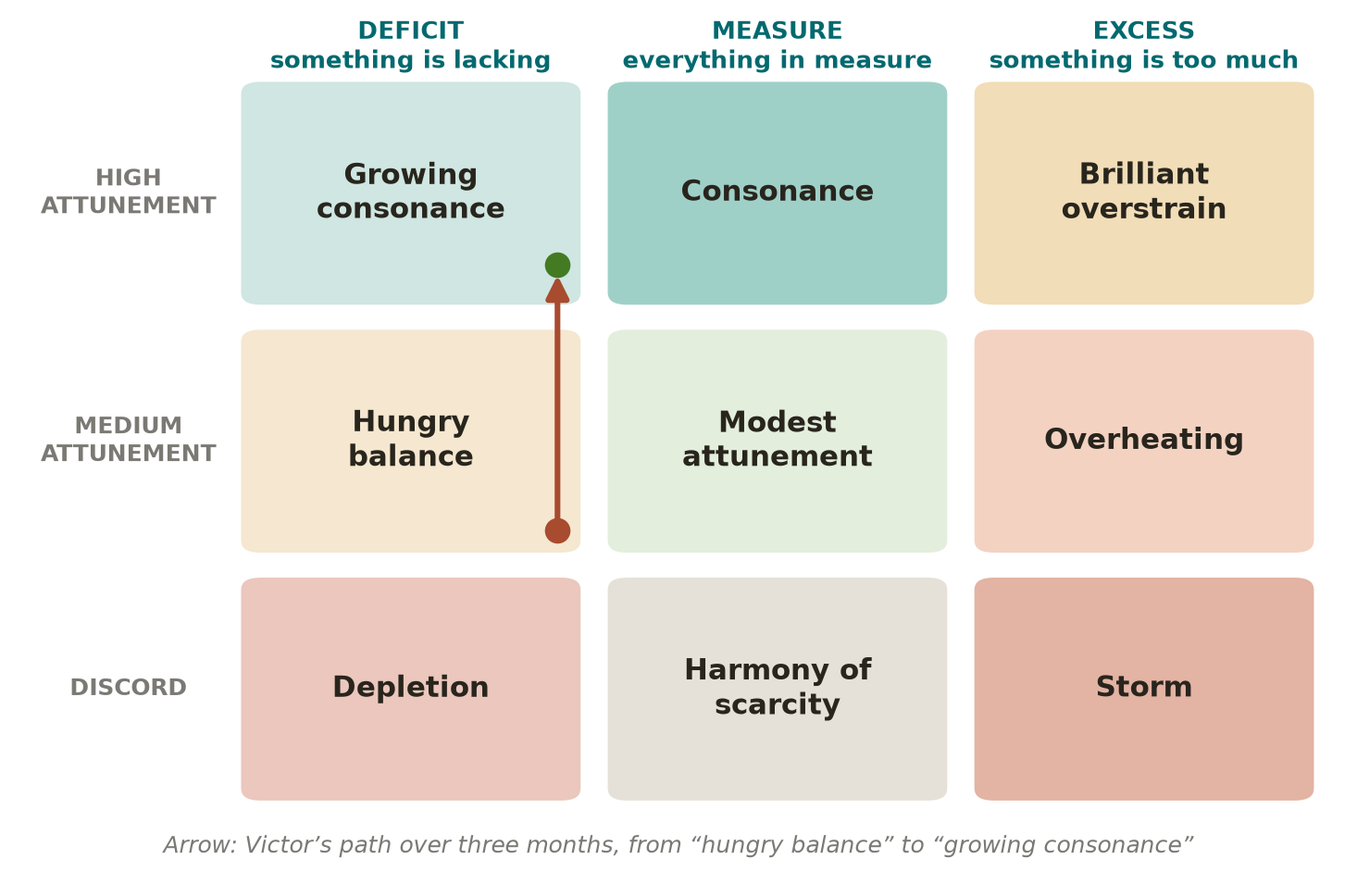
Fig. 3. The map of nine states of attunement. Try to recognize yourself in it.
| State | How it feels |
|---|---|
| Consonance | “There is enough of everything, and nothing superfluous.” Life sounds. |
| Growing consonance | “I feel good, but I want more.” A healthy aspiration. |
| Brilliant overstrain | “Everything works out, but I am at my limit.” Success on the outside, wear and tear on the inside. |
| Hungry balance | “I have everything, but there is no harmony.” Stable, but much is lacking. |
| Modest attunement | “I need little, and I have it.” Wisdom, or a narrowing of life. |
| Overheating | “Too much of everything.” It is already tiring, but not yet breaking. |
| Depletion | “Almost everything is lacking.” Time to take care of the basics. |
| Harmony of scarcity | “I don’t need anything.” There are no gaps, but there is little life. |
| Storm | “Everything is falling apart.” A pause and support are needed. |
Table 2. Nine states. These are figurative labels for talking with oneself, not diagnoses.
For each component, we compare “how it is” and “what is enough for me”. A negative gap indicates a deficit, a positive gap a possible excess, and a match means correspondence with the chosen measure. An excess needs clarifying: too much of what, exactly? Of self-care, or of rigid demands on one’s own routine?
|
TWO CELLS THAT ARE EASY TO MISS “Brilliant overstrain,” because it looks like success and is praised by others. “Harmony of scarcity,” because it looks like calm. In both cases, a person may go for years without noticing that their instrument is out of tune. Sometimes the path to attunement begins not with fulfilling desires but with bringing them back. |
|---|
Let us recall that disharmony in our model is a substantial mismatch between the parts of life and needs.
And false harmony is an impression of well-being in which costs or the loss of important opportunities go unnoticed. The map combines overall coherence and the direction of the gaps.
Victor’s Story
Victor rated nine sides of his life: his bodily foundation, everyday care of his body, and bodily development, as well as the same three sides for feelings and for meaning. For each one, he answered two questions: how much of this I have and how much I need. Here is what came out.
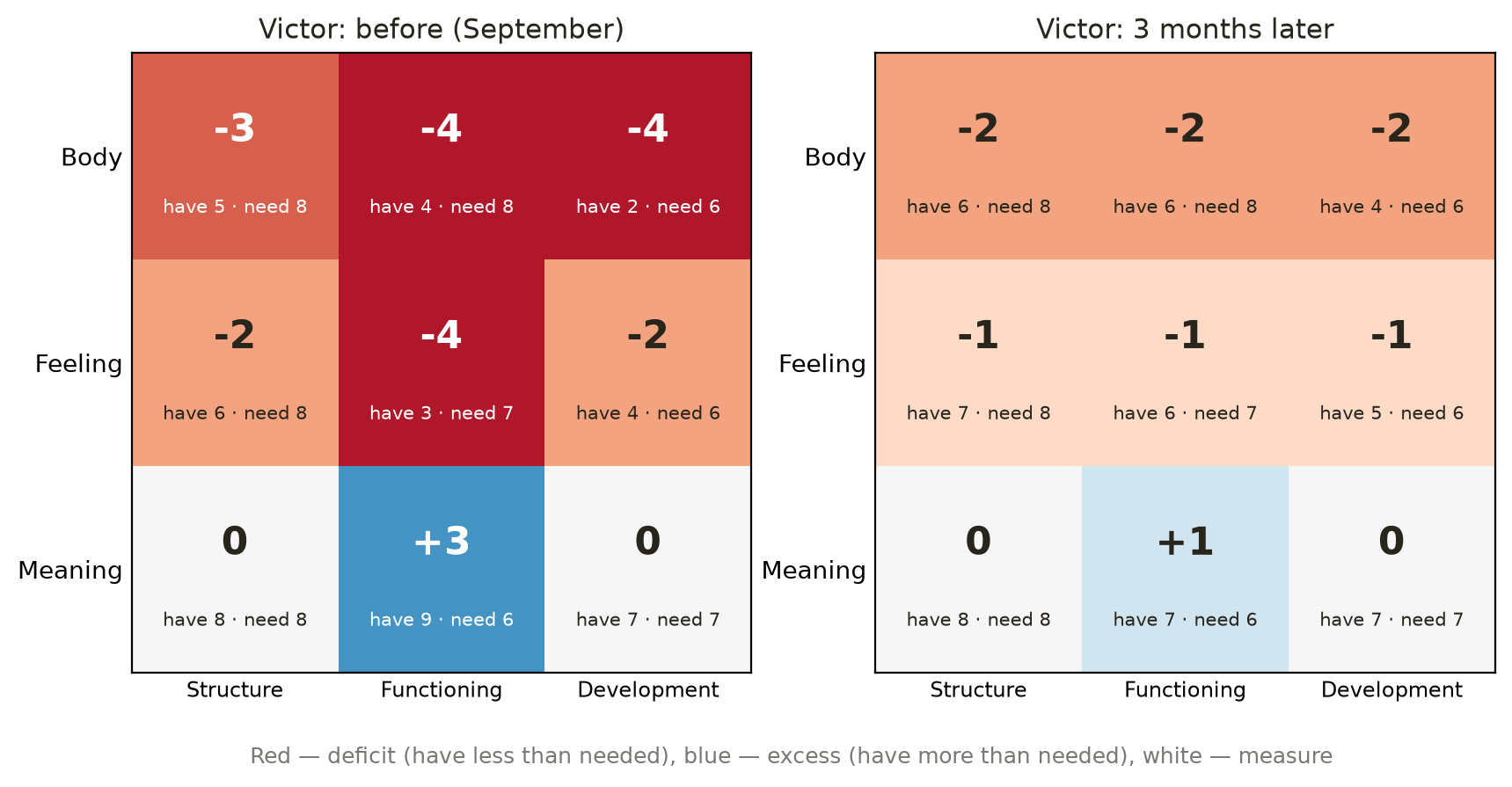
Fig. 4. Victor’s measure map. Red shows what is lacking; blue shows what there is more of than needed. Left: September; right: December.
The September picture can be read almost without words. Body and feelings are in the red zone: there is not enough sleep, movement, joy, or warmth at home. Meaning is in order except for one cell, “meaning in action,” which is colored blue. Victor has more of the work that fills his life with meaning than he himself needs.
On the map of states, this is “Hungry balance,” an exact portrait of the phrase “I have everything, but there is no harmony.”
|
A CONVERSATION THROUGH THREE QUESTIONS We did not give Victor a “result.” We asked three questions about the blue cell. • What is there? “Work that really matters to me. But there is so much of it that meaning has turned into duty.” • Where is this energy directed? “To be honest, toward not letting anyone down.” • How is it maintained? “Evening chats, weekends, the feeling that without me everything will collapse.” And then Victor himself saw the main thing: an excess in one cell feeds the deficit in six others. |
|---|
He decided to change very little. The work chat only until eight in the evening. One day off completely free of work. Sleep before midnight five days a week. Half an hour of walking. One evening with the children without phones. The pool, not for results but for pleasure.
Three months later, the map grew lighter. The red turned pink, and the blue almost disappeared. Victor moved into the state of “Growing consonance”: life sounds, although the body still has room to grow. And the most interesting thing happened in the sphere of meaning: there was less work, and more attunement in it.
Sometimes harmony grows not from what we add, but from what we let go.
The other side matters too. A mother who works and cares for her loved ones at the same time cannot always simply “set boundaries.” Her first step may be to look for help or to change how responsibilities are distributed. Personal tuning includes real conditions, not just one’s attitude toward them.
Attunement Around Us
The three strings sound not only inside one person. The same logic, fullness, proportionality, measure, works in a family, in a team, in an organization. Here are a few short examples.
|
FAMILY: “EVERYTHING IS FINE WITH US” A couple have been together for twenty years, the children have grown up, and daily life runs smoothly. There are no quarrels. But they talk only about practical matters and spend their evenings in different rooms. Proportionality is perfect, conflicts are zero, but the fullness of feelings has almost disappeared. This is a family “harmony of scarcity.” The first step is not to “solve problems” but to bring back desire: “What would we want from each other if we weren’t afraid to ask?” |
|---|
|
TEAM: “WE ARE THE BEST BY THE NUMBERS” The department has exceeded its plan for the third quarter in a row. The manager is proud. But two strong employees have quit, and the rest have stopped asking questions at meetings. Amy Edmondson showed that teams learn and work better where people are not punished for a question or a mistake [7]. The excess in results here is paid for by a deficit of trust: “brilliant overstrain” at the group level. |
|---|
|
A PERSON AND TIME: “I HAVE NO TIME TO LIVE” A mother of two works, studies, and takes care of her elderly parents. Each of the three roles is important, and none can be abandoned. Her problem is not laziness or weakness, but measure: in total, life demands more than she has strength for. What she needs is not motivation, but an honest answer to the question “What can be done less, less perfectly, or with someone else’s help here?” |
|---|
|
TEENAGERS: “SOMEONE ELSE’S MEASURE” Anya is 15. She is a straight-A student who goes to music school, competes in academic olympiads, and volunteers, and she sleeps five hours a night. She decides how many activities she needs according to the demands of her parents, her school, and her social media feed, not according to herself. The lesson of this example: adolescence is the time when a person first learns to feel their own measure. The first step is to ask: “Which of these would you have chosen yourself?” |
|---|
|
TEENAGERS: “THE SCREEN HAS REPLACED EVERYTHING” Dima is 14. In games, he has both meaning and feelings, but his body gets almost nothing. That is why simply banning the screen would take away his only source of meaning and social contact. It is better to find where else he can get the same things, but this time with his body involved. |
|---|
|
RETIREES: “SUDDENLY EVERYTHING WENT QUIET” For forty years, Nikolai Petrovich was a chief engineer, and his work always held even more meaning than he needed. When he retired, this sphere emptied within a week. His state is not laziness and not old age, but an abrupt change of measure: if nothing is done, it can freeze into a “harmony of scarcity.” A precise question helps: “What exactly did my work give me, and where can I get it now?” For Nikolai Petrovich, the answer was mentoring at a technical college and a workshop in his garage. |
|---|
In all these stories, people went a long time without seeing the discord, because one of the strings sounded loudly and drowned out the silence of the others. Discord rarely shouts. More often, it quietly plays out of tune. And that is exactly why it is so important to be able to notice it in time.
Why Attunement Cannot Be Checked Just Once
Every musician knows that an instrument is tuned not once in a lifetime but before every performance. Strings stretch, wood responds to humidity, and a concert hall sounds different from a rehearsal room. Tuning is not an event but a practice.
The same thing happens with the harmony of life. It is put out of tune by illness, a move, a new position, the birth of a child, a loss, or even just a long winter. Harmony researchers emphasize that one of its important aspects is flexibility: the ability to return to attunement after life has disrupted it [10]. And flexibility cannot be seen from a single snapshot.
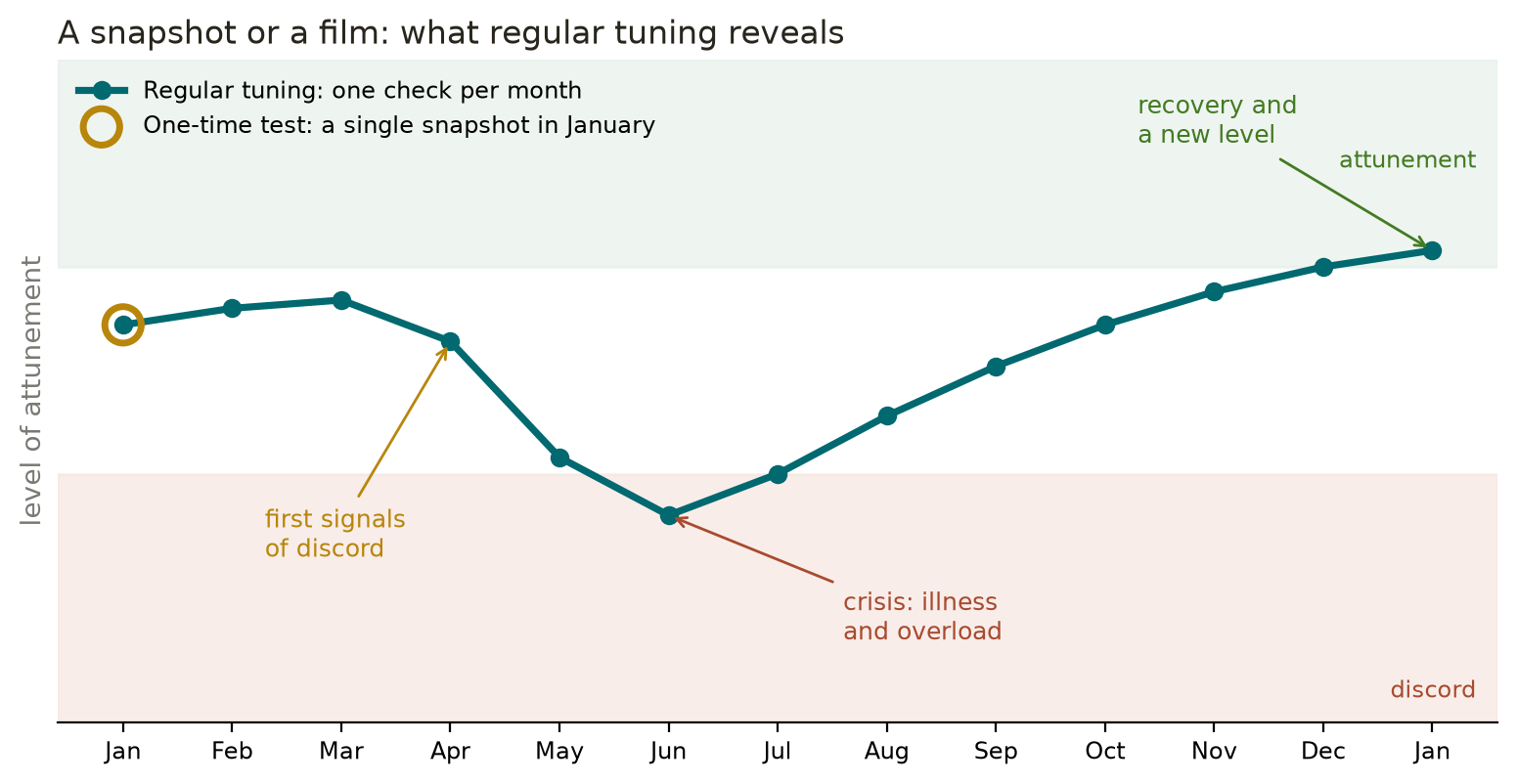
Fig. 5. A one-time test shows a single point. Regular tuning shows the path: the first signals of discord, the crisis, and the recovery. The profile is illustrative.
Look at the chart. If a person took the test only once, in January, they would learn that “everything is fine.” They would not notice how a quiet shift began in April or how a crisis arrived in June, and they would not see that by the following winter they had not simply recovered but reached a new level. The most valuable thing about harmony is not a point, but a trajectory.
 |
WHAT REGULAR TUNING GIVES YOU • Early signals. Discord almost always begins quietly, with one or two cells. They are easy to adjust before they turn into a storm. • Visible progress. Small steps are hard to notice from the inside. On the map they become visible, and this sustains motivation. • Understanding your flexibility. You learn how quickly you return to attunement after difficult periods, and therefore what you can rely on. • Precise rather than general advice. Not “Rest more,” but “This cell, this step, and we will look again in a month.” |
|---|
Five Ways of Gentle Tuning
The word “optimization” must be used carefully when it comes to harmony. We do not “fix” a person or force them to fit a formula. It is more like tuning an instrument: a musician does not change its nature but gives each string back its sound. The five strategies below correspond to different tuning pictures.
.
|
FILL When support is lacking, look for an available source of support: restorative rest, the involvement of a loved one, manageable activity, help with tasks. The initial task is to add what truly supports you. For example, agree on one free evening rather than immediately signing up for three self-development courses. |
|---|
|
REBALANCE When one activity crowds out another important part of life, try redistributing time and attention. Not necessarily equally. Before an important deadline, the workload may temporarily increase; it is useful to decide in advance when and how you will recover. |
|---|
|
LET GO OF THE SURPLUS When an excess of workload is confirmed, cut back, delegate, or simplify. What should be reduced is a specific demand, not the quality of life. A person may need fewer mandatory meetings and, at the same time, more genuine closeness. |
|---|
|
CHECK YOUR REFERENCE POINTS If “I need” sounds like “I always must,” clarify where the expectation comes from. If you want almost nothing, explore whether this is free contentment or the result of fatigue, lost opportunities, or a difficult condition. Ratings by themselves do not establish the cause. |
|---|
|
PROTECT YOUR ATTUNEMENT If the chosen measure fits on the whole, keep the habits that work and watch for early signals: what changes first under overload? For one person, it is sleep; for another, irritability with others. Noticing a signal is more useful than demanding consistently high scores. |
|---|
Start with one component. If the gaps are equal, choose the one that is more important right now and easier to change. No more than three directions at once is a practical rule of moderation, not a scientifically established limit. And take a repeat measurement after 4–12 weeks.
The Harmony Tuning Fork and the Path Over Time
A musical instrument responds to conditions; human life does so all the more. A new job, a move, an illness, or a loss can change the rhythm that suits us. Development here means a change in coherence over time; recovery means the return of lost supports after a decline. It is important to see both the extent of the changes and the time they took.
A single result does not show recovery. Recovery requires information about one’s state before the difficult period, during the decline, and after it. Even a noticeable rise in self-ratings may reflect mood or a reinterpretation of the questions. We look at repeated measurements together with life events, without declaring every fluctuation to be proven progress.
|
TWO QUESTIONS FOR A REPEAT MEASUREMENT What has changed in my life relative to my previous measure? Does this measure itself suit me today? It is important to keep these questions separate: sometimes a person has truly restored their support, and sometimes they have only lowered their expectations. Revising one’s needs can be a wise decision, but it should be seen separately. |
|---|
For practical use, we offer the Harmony Tuning Fork tool at ALEXZ.US. It is based on the author’s THI-18: nine components, each with two ratings, “have / enough.” For support and everyday life, the last two weeks are considered; for development, the last three months. Short follow-up questions help distinguish the quality of life from the amount of workload. This is a description of a proposed tool, not an announcement that it is ready.
| On the screen | What it is for |
|---|---|
| Map with two outlines | Seeing the current state and one’s own measure across all nine components |
| Gap matrix | Distinguishing deficit, match, and presumed excess; keeping missing answers as missing |
| Interactive crystal | Opening a component and its “What–Where–How” questions |
| Brief interpretation and experiment | Understanding the basis of the conclusion and choosing one manageable step for seven days |
| Profile history | Comparing changes in life, reference points, and conditions |
The first profile should be useful on its own; continuing through Membership provides a history, repeated observations, and ongoing support. With the person’s consent, other tools in the series can help clarify charge, uncertainty, or digital habits. Their indicators should not be automatically added up into a single “score of the person.”
Harmony Tuning Fork: The Resulting Radar
An example of the resulting radar shows both ratings for each component. Personal measure is a person’s own reference point at a given stage, not a universal ideal.
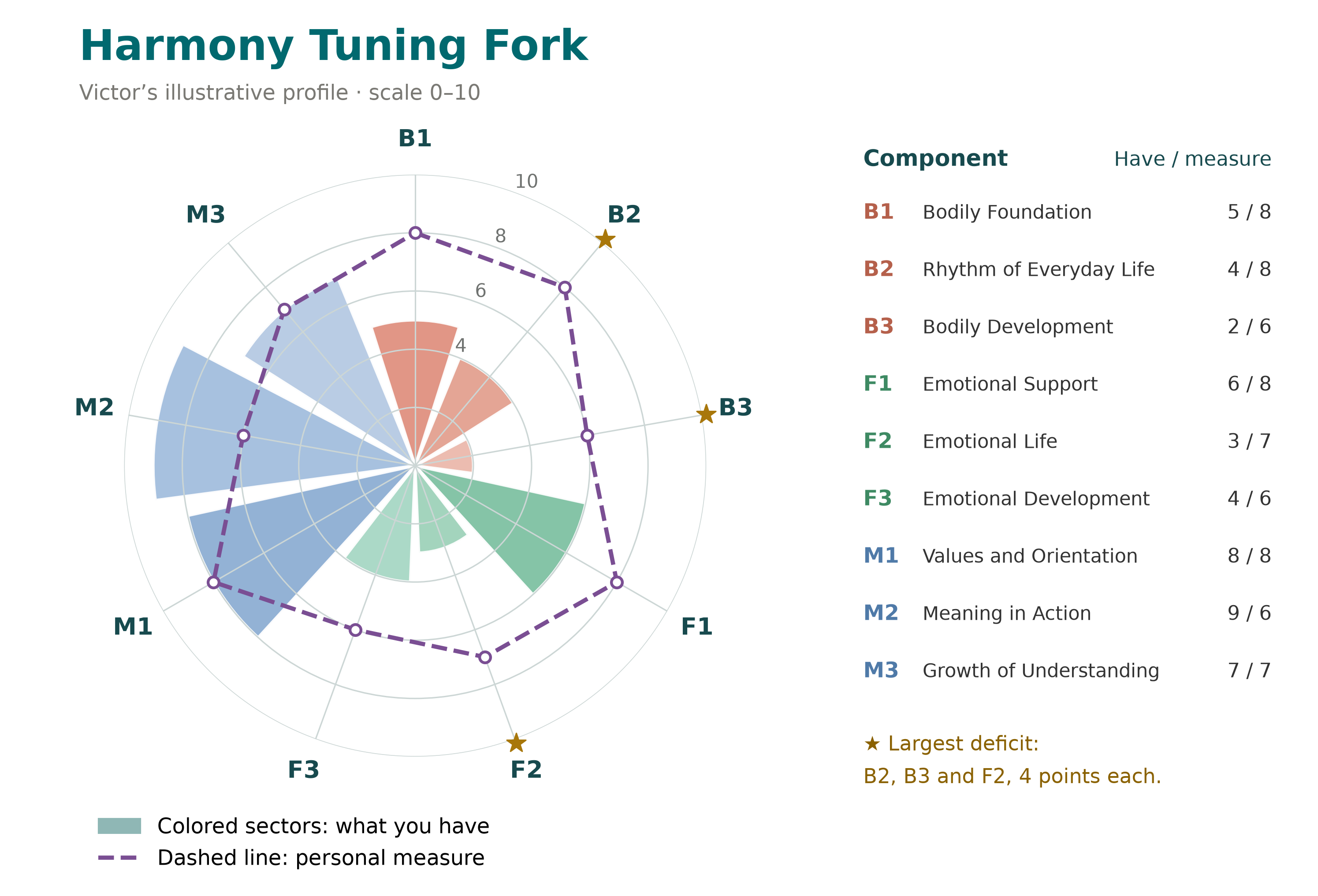
Demonstration data: Victor’s illustrative profile before the changes. This is an illustration of the proposed interface, not the result of an assessment of the reader.
How to Read This Profile
In B2, B3, and F2, the current rating is four points below the personal measure. These components are marked with stars as possible starting points. M1 and M3 match the reference point. In M2, the rating is above the chosen measure; by itself, such a gap does not yet explain the cause or prove overload.
In our interactive tool, clicking a sector will open the original answers, follow-up questions, and a possible seven-day experiment. The person will be able to choose a different priority.
Try It Right Now
While the tool is being prepared, here is an exercise that takes ten minutes and almost always reveals something.
 |
TEN MINUTES OF TUNING • 1. Take a sheet of paper and write down three words: Body, Feeling, Meaning. • 2. For each one, give two ratings from 0 to 10: how much of it you have now in your life and how much you need to live in attunement. Not ideally, not maximally, but exactly what you need. • 3. Find the largest gap. It may be a deficit (you have less than you need) or an excess (you have more). • 4. Ask yourself three questions: What is happening here? Where is this energy going? How is this maintained from day to day? • 5. Choose one small step for the coming week. If this sphere has an excess, the step should be “less,” not “more.” Repeat in a month. Compare. You will see not only where you are, but also where you are heading. |
|---|
|
WITH CARE This exercise is for self-knowledge, not for making diagnoses. If you see “depletion” or “storm” in yourself, this is a good reason to talk with a psychologist or a doctor. |
|---|
A good tuning fork helps you hear your life. The decision about how to tune it remains yours.

Harmony is not a state reached once and for all, but music that we tune again and again.
Victor said, “I have everything. There is just no harmony.” Now we know why this happens. Fullness without proportionality produces skew. Proportionality without fullness produces an even emptiness. And both together without measure produce brilliant overstrain. Attunement is born when all three strings sound, and each is tightened exactly as much as you in particular need.
The good news is that tuning is a skill. It can be learned. It can be practiced. And like every musician, you will certainly have your own tuning fork.
Sources and Further Reading
The numbers in the text refer to this list. Scientific studies, philosophical parallels, and the author’s model have different status.
[1] Plato. Republic, Book IV: the coherence of the parts of the soul. Aristotle. Nicomachean Ethics, Book II, Chapter 6: measure relative to the person. Perseus Digital Library
[2] Confucius. Analects, 13.23: agreement while preserving differences.
[3] Durkheim É. Suicide, 1897: integration and regulation in social life. Philosophical and sociological parallels do not prove the validity of the THI-18.
[4] The Metropolitan Museum of Art. Hakuin Ekaku. Kannon by a Lotus Pond, 1750s. Commentary on the composition. Source
[5] Western Pennsylvania Conservancy. Designing Fallingwater: organic architecture and the natural setting. Source
[6] Chan P. Y., Dong M., Li H. The Science of Harmony: A Psychophysical Basis for Perceptual Tensions and Resolutions in Music. Research, 2019, 2369041. Source
[7] Edmondson A. Psychological Safety and Learning Behavior in Work Teams. Administrative Science Quarterly, 1999, 44(2), 350–383. Source
[8] Rogers C. R. On Becoming a Person. 1961: congruence and personal growth.
[9] Fancourt D., Finn S. What is the evidence on the role of the arts in improving health and well-being? A scoping review. WHO Regional Office for Europe, 2019. Source
[10] Kjell O. N. E. et al. The Harmony in Life Scale Complements the Satisfaction with Life Scale. Social Indicators Research, 2016, 126, 893–919. Source
[11] Ryan R. M., Deci E. L. Self-determination theory and the facilitation of intrinsic motivation, social development, and well-being. American Psychologist, 2000, 55(1), 68–78. Source
[12] Csikszentmihalyi M. Flow: The Psychology of Optimal Experience. New York: Harper & Row, 1990.
[13] Vallerand R. J. et al. Les passions de l’âme: On obsessive and harmonious passion. Journal of Personality and Social Psychology, 2003, 85(4), 756–767. Source
[14] Higgins E. T. Self-discrepancy: A theory relating self and affect. Psychological Review, 1987, 94(3), 319–340. Source
[15] Antonovsky A. Unraveling the Mystery of Health. 1987: comprehensibility, manageability, meaningfulness.
[16] Pazekova G. E., Elivanova N. E. Psychological harmony of personality as a determinant of health. Simbirsk Scientific Bulletin, 2011, No. 1(3) [in Russian]. Source of the original article. sciup.org
[17] Garcia D. The Big, the Dark, and the Biopsychosocial Shades of Harmony. Behavioral Sciences, 2024, 14(10), 873. Source
[18] Maslach C., Leiter M. P. Understanding the burnout experience. World Psychiatry, 2016, 15(2), 103–111. Source
[19] Soroko E. M. Structural Harmony of Systems. Minsk: Nauka i Tekhnika, 1984 [in Russian]. A theoretical source of hypotheses, not a validated personality standard.
[20] Naini F. B. The golden ratio—dispelling the myth. Maxillofacial Plastic and Reconstructive Surgery, 2024, 46, 2. Source
[21] World Health Organization. Burn-out an “occupational phenomenon”: International Classification of Diseases, 2019. who.int
[22] Gallup. Global Indicator: Employee Wellbeing (2025 data on employee stress). gallup.com
[23] Cook N. D., Fujisawa T. X. The Psychophysics of Harmony Perception: Harmony is a Three-Tone Phenomenon. Empirical Musicology Review, 2006. SciSpace
[24] McWhinnie H. J. A Review of Research on the Golden Section Hypothesis in Art and Design, 1990 (reviews studies by Benjafield, Adams-Webber, and others). ERIC ED368623. ERIC
[25] A doctoral dissertation on a model of the balance of positive and negative cognitions (a test of the “golden” point 0.62). St. John’s University. scholar.stjohns.edu
 |
READ MORE Dr. Alex Zolotov, Ph.D. Triadic Intelligence: Designing Reality With the Lens Triad The full version, with the model, formulas, the THI-18 questionnaire, and an analysis of the golden-section hypothesis, “Measure and Consonance: Mastering Personality Harmony Through the Stacking Lens Triad Method,” will be offered as a training course. |
|---|
All profiles and stories in this article are illustrative. This material does not replace psychological or medical care.