
Triadic Intelligence™ · Essay
The Charge That Holds Us
How the Stacking Lens Triad Method helps us see, measure, and optimize the psychological charge of personality
By Dr. Alex Zolotov, Ph.D.
 |
THIS ARTICLE IS BASED ON THE BOOK Dr. Alex Zolotov, Ph.D. Triadic Intelligence: Designing Reality With the Lens Triad A systems-based approach to thinking, transformation, and reality design. Available on Amazon. |
|---|
Oleg is sitting in his car in the office parking lot.
The engine is off. The meeting starts in eight minutes.
He doesn't get out.
Not because he's late. And not because he doesn't want to go to work. He simply doesn't have the strength to open the door.
Last night he went to bed at half past one, "just checking email." This morning he had two coffees. He'll have another in the elevator. It will help for an hour.
He is 44. He leads a project he genuinely loves. He has a good family. He isn't ill. And yet he feels like a phone with a red battery bar that, for some reason, won't charge no matter how long it stays plugged in.
Tonight his wife will say, "You need a vacation."
He will take one. A week after he gets back, everything will be the way it was.
Tiredness is cured by rest. Depletion is not. Depletion is cured by understanding where the charge is going.
This article is about psychological charge: what it is, what it is made of, why it is so easy to lose today, and how Triadic Intelligence can turn a vague "I have no energy" into a map of sources, leaks, and directions.
What psychological charge is
In everyday speech we say: "I'm charged up," "I'm running on empty," "that person drains me," "after talking with her I feel recharged." Behind these metaphors lies a very real experience: the sense of available energy that we can put to use.
 |
DEFINITION Psychological charge (Ψ) is a multidimensional, dynamic resource of the personality: the energy of body, mind, and emotions available to a person, which they can generate, retain, and direct toward adaptation, thinking, relationships, and movement toward their goals. |
|---|
There are three verbs in this definition, and each one matters.
Generate: charge has sources, such as sleep,
movement, food, meaning, and close people.
Retain: charge has leaks, such as stress, rumination,
endless notifications, and conflict.
Direct: charge has a vector. Energy can serve a
person's values, or it can be spent fighting threats.
So charge is not simply "how much energy I have." It is more like an electrical system: the capacity of the battery, the incoming current, the leaks, and the wiring that carries energy to the load.
 |
WHAT CHARGE LOOKS LIKE IN REAL LIFE • A teacher comes home "empty" after six lessons. But if a lively conversation with her students happened in class, she comes home tired yet full. Same workload, different charge. • A programmer writes code in a state of flow for six hours and gets up from his desk refreshed. Another spends an hour answering messages in a work chat and feels wrung out. • An older man, after retiring, gets a full night's sleep for the first time in forty years, yet becomes sluggish and irritable. Plenty of energy, but no direction. • The mother of a small child sleeps four hours a night but says, "I've never felt so alive." Her charge rests on meaning, even though her body is working at its limit. |
|---|
These stories show the main point: the amount of energy and its quality are different things. And this is exactly where the triadic approach begins.
Scientific foundations
The term "psychological charge" does not appear in classical textbooks. But it does not come out of nowhere. It is an integrative concept that brings several well-studied research traditions together into one model.
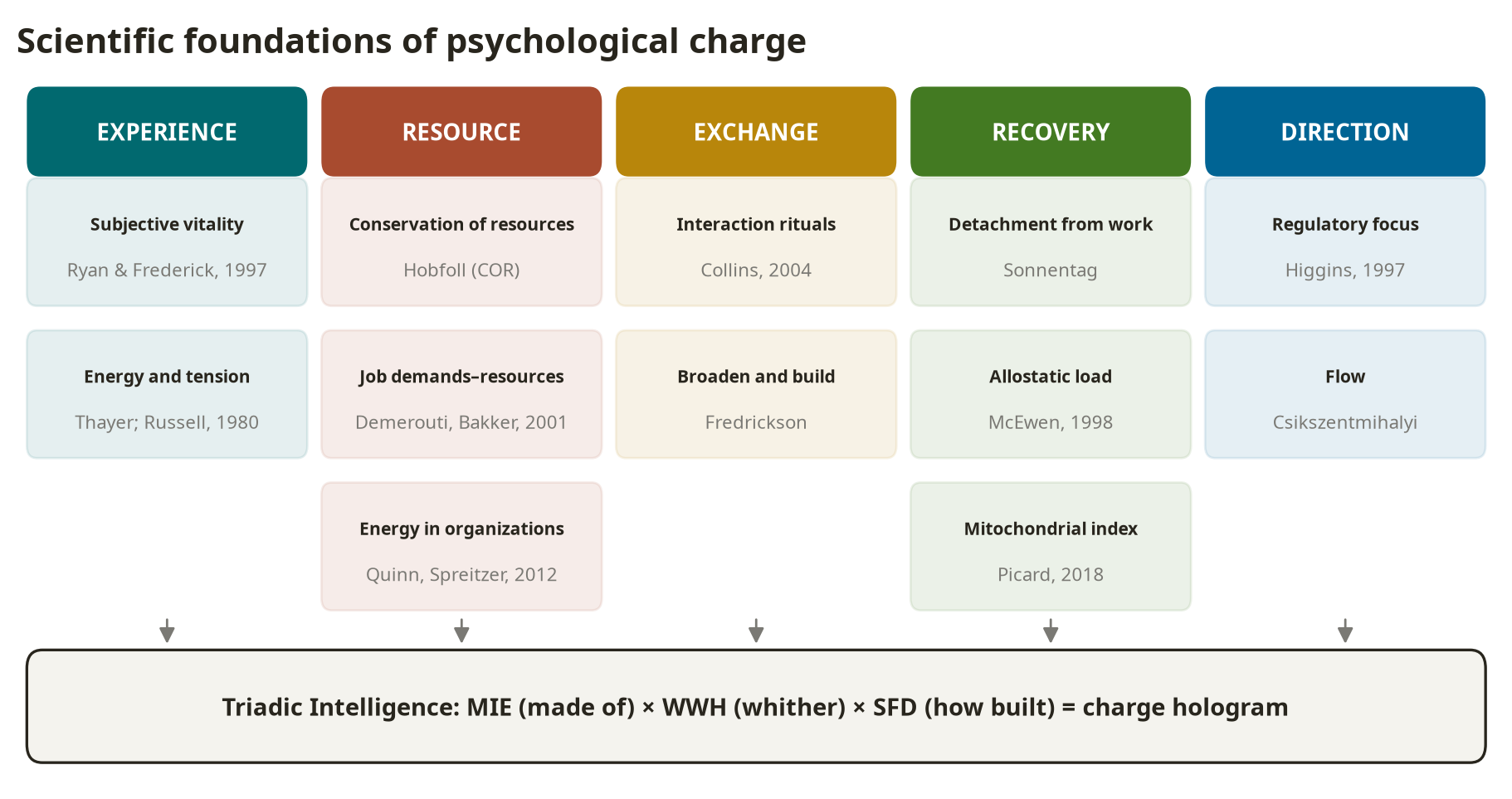
Fig. 1. Scientific foundations of the psychological charge model: each tradition covers its own part of the triad
Energy as a subjective experience
Subjective vitality. In 1997 Richard Ryan and Christina Frederick proposed a scale of subjective vitality: the feeling of living energy available to the self. Their seven items showed high internal consistency and links to physical and psychological well-being (Oxford Academic). Later, Ryan and Deci showed something important: self-control under pressure does deplete energy, while self-chosen activity does not, and can even replenish it (Ryan & Deci, 2008).
Energy and tension. Robert Thayer described mood along two independent axes, energy and tension. Their combination yields four states: calm energy, tense energy, calm tiredness, and tense tiredness. In calm energy, tasks feel easier; in tense tiredness, they feel harder (Garrosa et al., 2008). James Russell's circumplex model of affect follows a similar logic: emotions are arranged along the axes of arousal and valence (Russell, 1980).
Energy as a resource
Conservation of resources theory. Stevan Hobfoll showed that losing resources affects us more strongly than gaining them, and that it triggers "loss spirals": the fewer resources we have, the harder it is to make up for the next loss (Sonnentag, 2024).
The job demands–resources model. Evangelia Demerouti, Arnold Bakker, and colleagues showed that exhaustion is linked primarily to high job demands, and disengagement to a lack of resources (PubMed). The opposite pole of burnout is engagement, and one of its key features is vigor: high levels of energy and mental resilience at work (Schaufeli).
Human energy at work. Ryan Quinn, Gretchen Spreitzer, and Chak Fu Lam proposed a model in which energy can be either a scarce or a renewable resource, depending on how the work is organized (Quinn, Spreitzer & Lam, 2012).
Manage energy, not time. Tony Schwartz and Catherine McCarthy described four sources of energy (body, emotions, mind, and spirit) and showed that each can be systematically expanded and renewed (HBR).
Energy as a flow between people
The emotional energy of interaction rituals. Sociologist Randall Collins showed that successful interactions "pump up" participants with emotional energy, while failed ones drain it. He considers the pursuit of emotional energy one of the main motivating forces in human life (Princeton University Press).
Positive emotions as building material. Barbara Fredrickson showed that positive emotions broaden our repertoire of thoughts and actions and, over time, build lasting personal resources (PMC).
Energy as a process of recovery
Psychological detachment. Sabine Sonnentag described detachment from work during off-hours, the ability to mentally "leave the office," as a key mechanism of recovery (Wiley).
Allostatic load. Bruce McEwen showed that the body's physiological stress responses protect us in the short term but, when chronically activated, accumulate "wear and tear" (McEwen, 1998).
Mitochondria and mood. Martin Picard and colleagues developed a mitochondrial health index and showed that it is sensitive to mood and to the stress of caring for a sick family member (PMC).
Energy as direction
Regulatory focus. Tory Higgins distinguished two motivational modes: a promotion focus (moving toward ideals and growth) and a prevention focus (protecting against losses and threats) (Higgins, 1997). Both modes mobilize energy, but they spend it differently.
Flow. Mihaly Csikszentmihalyi described flow as an optimal state of consciousness in which energy is fully absorbed in the activity and is not wasted on inner struggle (PMC).
 |
WHAT WE TAKE FROM SCIENCE AND WHAT WE ADD Each of these traditions sees its own part of the picture: vitality sees the experience, resource theory sees the balance, Collins sees the exchange between people, Higgins sees the direction. Triadic Intelligence does not replace these models. It offers a coordinate system in which they can be seen together: what charge is made of (MIE), where it is directed (WWH), and how it is built and how it changes (SFD). |
|---|
|
AN IMPORTANT SCIENTIFIC CORRECTION Popular literature still repeats the idea that willpower "runs on glucose" and gets used up like a muscle. A large multi-lab replication with 2,141 participants did not confirm this effect: its size turned out to be close to zero (PubMed). That is why, in our model, charge is not a "fuel tank" but a system with sources, leaks, and direction. What matters is not only how much energy there is, but how it is spent. |
|---|
Why this matters especially today
Burnout has become the official diagnosis of our era. In 2019 the World Health Organization included burnout in the International Classification of Diseases (ICD-11) as an occupational phenomenon: a syndrome resulting from chronic workplace stress that has not been successfully managed (WHO).
Stress has become the background. According to Gallup, 41% of employees worldwide report experiencing "a lot of stress" (Gallup, 2024).
Attention has become scarce. Gloria Mark's research shows that the average time of continuous focus on a single screen has shrunk to 47 seconds (Gloria Mark). Every switch is a small leak of charge.
The boundary between work and rest has disappeared. The smartphone has turned rest into "work from a different chair." Psychological detachment, which Sonnentag considers the main mechanism of recovery, has become rare.

Oleg is a typical example. He doesn't have one big problem. He has a thousand small leaks. None of them is dangerous on its own. Together they create a battery that won't hold a charge.
The Triadic Intelligence approach
Triadic Intelligence starts from a simple idea: any complex phenomenon becomes understandable when it is viewed from several sides at once. Not from one "correct" side, but from three interconnected ones.
We use three lenses.
MIE: Matter, Information, Energy. What is the situation made of? Where does it live: in resources and the body, in knowledge and meaning, or in emotions and motivation?
WWH: What, Whither, How. What is happening now? Where am I heading? By what means am I getting there?
SFD: Structure, Function, Development. What holds everything up? How does it work right now? How is it changing and growing?
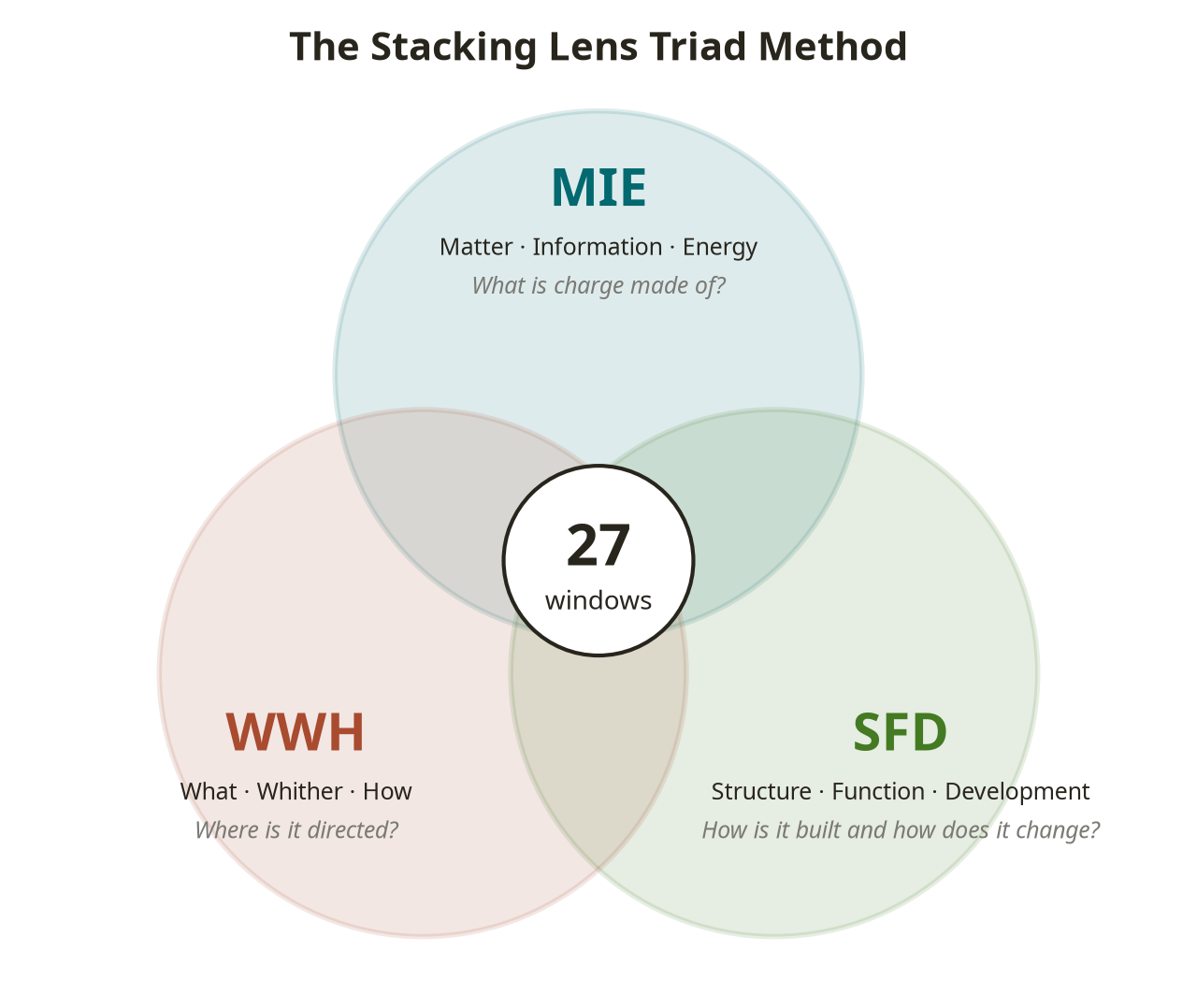
Fig. 2. The three lenses of Triadic Intelligence form a nine-dimensional cognitive space
Each lens on its own gives a useful but incomplete view. When the lenses are stacked on top of one another (hence the name of the method, the Stacking Lens Triad Method), we get a cube of 3 × 3 × 3 = 27 cells. Twenty-seven "windows" through which any life situation can be viewed.
The key concept of the method is harmony. A system is stable when its components are in balance and none of them suppresses the others. In our series of articles we have applied this approach to digital sins and to life's uncertainty. Here we apply it to the energy that powers the whole system.
 |
TRIADIC INSIGHT The usual question is: "How much energy do I have?" Triadic Intelligence asks three questions instead of one: "What is my charge made of? Where is it directed? How is it built: where are the sources, where are the leaks, and how is the capacity changing?" As long as energy is simply "I have strength" or "I don't," it cannot be managed. Once it has coordinates, it can be optimized. |
|---|
Three lenses turned on charge
MIE: what charge is made of
The first lens shows that charge has three sources, corresponding to the three components of the triad.
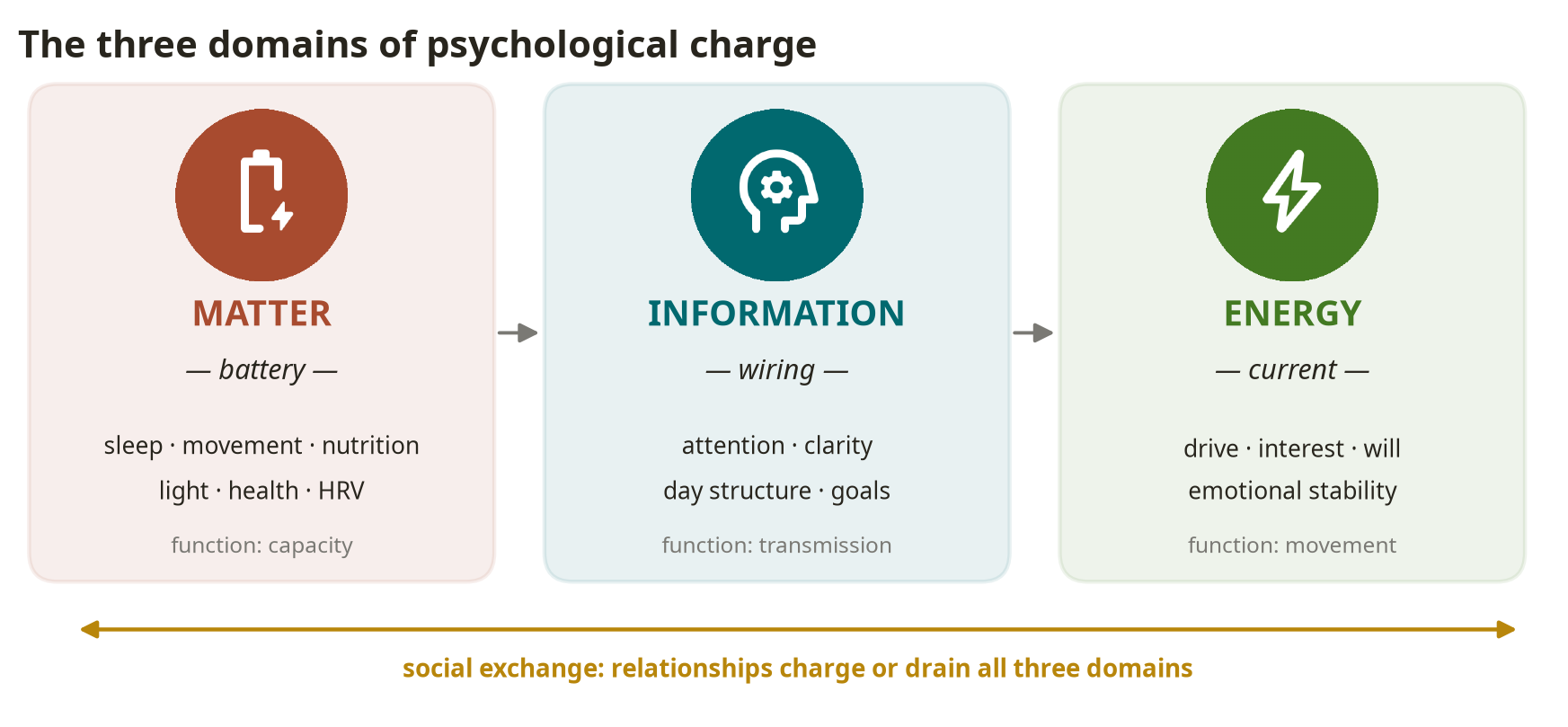
Fig. 3. The three domains of charge through the MIE lens: battery, wiring, and current
 |
MATTER: THE BATTERY Bodily charge. Sleep, movement, food, light, health, autonomic balance. This is the capacity and the physical foundation: how much energy the body can store at all. |
|---|
 |
INFORMATION: THE WIRING Cognitive charge. Clarity of thinking, attention, the ability to hold focus, the structure of the day, clear goals. This is the system that carries energy to tasks, or loses it in the short circuits of distraction. |
|---|
|
ENERGY: THE CURRENT Emotional and motivational charge. Drive, interest, will, emotional resilience, enjoyment of activity. This is what sets the system in motion. |
|---|
But where is social energy? Early versions of the model treated it as a separate, fourth domain. We propose a different view: social energy is not a domain but an exchange. Relationships charge or drain a person in all three domains at once: the body calms down next to someone close, the mind clears up in a good conversation, emotions rise with recognition. As in physics, charge passes from one body to another through contact. That is why social exchange has its own place in our model: the relationship map.

WWH: where charge is directed
The second lens shows the vector of charge.
• What: what charge do I have right now?
• Whither: what is it directed toward, my values or protection from threats?
• How: how do I spend it, in a focused way or by scattering it?
Here Higgins's distinction comes into play. Promotion energy ("I want to build a great product") and prevention energy ("if only I don't miss the deadline") can be equally strong. But the first feels like inspiration and the second like tension. The first is replenished by the activity itself; the second is used up by it.
SFD: how charge is built
The third lens shows the level of the system.
• Structure: the capacity of the battery, meaning temperament, health, basic habits, stable traits.
• Function: the day-to-day balance, meaning how much charge comes in and goes out each day.
• Development: how the capacity changes. Is the system being trained and growing more resilient, or is the battery "degrading" over the years?
How to read the formulas in this article
Before we go further, let's pause for a minute.
Formulas will appear in the sections that follow. For many people, this is the moment they want to turn the page. Letters, symbols, Greek characters: it all feels like a school exam, not a conversation about one's own life.
We want it to be different. The formulas here are not math for the sake of math. They are simply a short way of writing down what we already understand intuitively. For example, the sentence "the less energy comes in and the more goes out, the faster I run down" is already a formula, just written in words.
So we will go through every formula the same way, in four steps:
1. When you need it: the life situation in which the calculation is useful.
2. The formula itself, decoded: what every letter and every symbol means, in plain words.
3. Step-by-step calculation: using Oleg as the example, with a comment on each step.
4. What the result means: how to read the number you get and what to do with it.
If a symbol shows up again, we will remind you what it means. You won't need to flip back.
 |
A GLOSSARY OF THE SYMBOLS YOU WILL MEET IN THIS ARTICLE • × means "multiply." 5 × 2 = 10. • / means "divide." 10 / 2 = 5. Sometimes the same thing is written as a fraction. • √ means "square root": the number that, multiplied by itself, gives the original number. √25 = 5, because 5 × 5 = 25. • ² means "squared," that is, a number multiplied by itself. 3² = 3 × 3 = 9. • Σ (the Greek letter "sigma") means "add up everything on the list." • |…| means "the size of a number, ignoring its sign": both +5 and −5 give 5. In this article the symbol means "how large the deviation is," no matter in which direction. • min(…) means "take the smaller of the numbers"; max(…) means "take the larger." • ≈ means "approximately equal to" (after rounding). • Ψ (the Greek letter "psi," the first letter of the word "psyche") is our symbol for psychological charge. • Δ (the Greek letter "delta") means "difference, deviation." • λ (the Greek letter "lambda") is the rate at which energy naturally "evaporates." • Small letters at the bottom, as in Ψₜ, are simply labels: "charge on day t," that is, today; Ψₜ₋₁ means "charge yesterday." |
|---|
A formula is not a verdict and not a diagnosis. It is a way to ask yourself a precise question and see the answer in numbers.
Charge as a vector: level, quality, direction
This is the central idea of the article.
When someone says "I have no energy," they usually mean a single number, like the battery indicator on a phone: 80%, 30%, 5%. But Oleg's experience shows that one number is not enough. His reserves seem "average," yet he lives as if his battery were nearly empty.
So we describe psychological charge not with one number but with three. Just as an arrow has length, sharpness, and a direction of flight, charge has three characteristics.
 |
THE THREE COMPONENTS OF CHARGE L, level. A scale from 0 to 100. It answers the question: how much energy do I have? This is the familiar "battery percentage." Q, quality. A scale from 0 to 1. It answers the question: is this energy calm or tense? Q = 1 means the energy is completely calm; Q = 0 means the person is "wound up," and all their energy rests on tension. A, alignment. A scale from 0 to 1. It answers the question: is my energy working for what matters to me? A = 1 means everything I do is connected to my values; A = 0 means all my energy goes to other people's tasks and to fighting threats. |
|---|
Why does L go up to 100 while Q and A only go up to 1? It is convenient. We are used to seeing level as a percentage. Quality and alignment, on the other hand, work as reducing factors: they show what share of the level actually goes into action. More on this below, in the formula for effective charge.
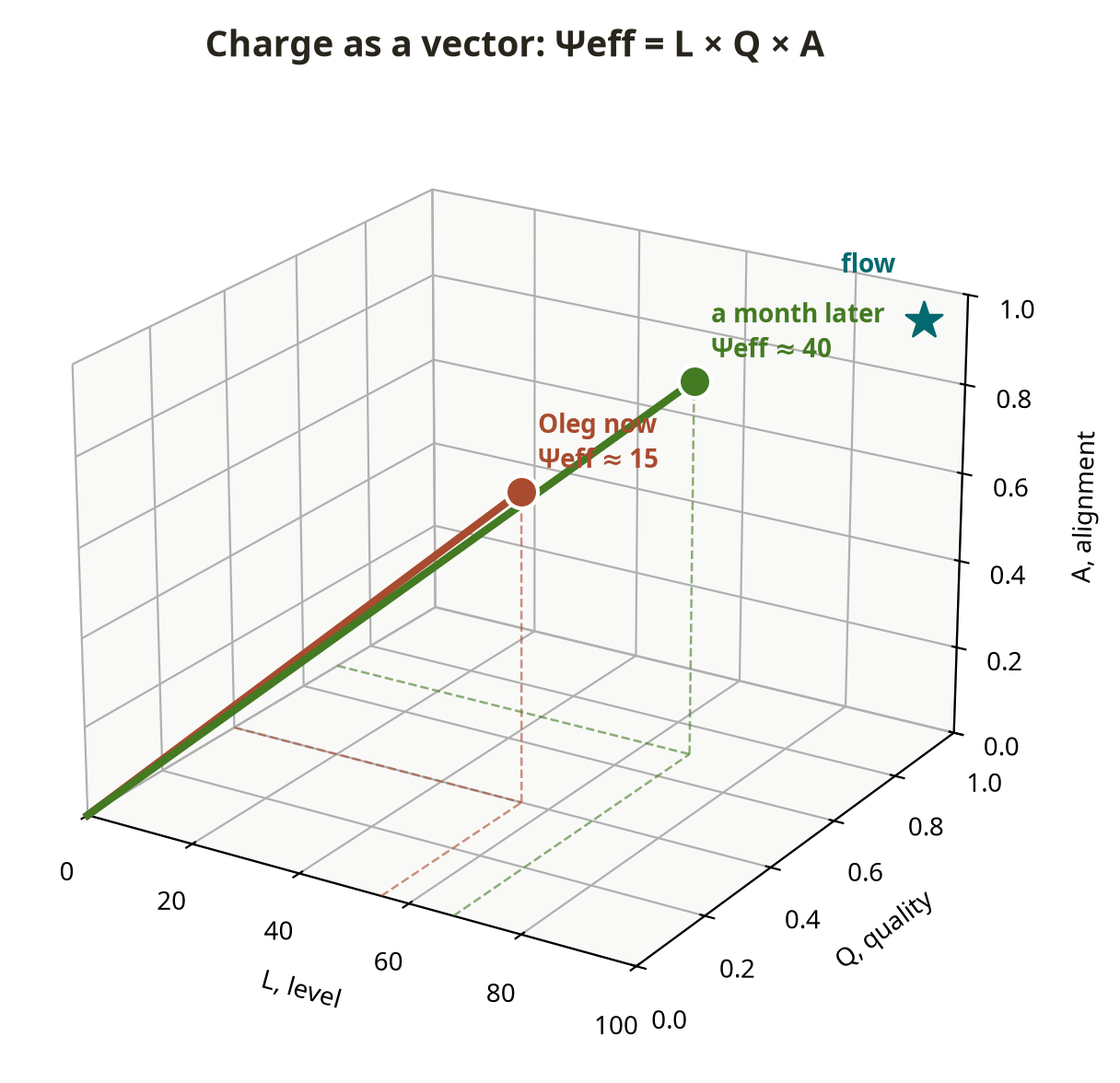
Fig. 4. The space of charge: level, quality, and alignment form a three-dimensional vector. The red dot is Oleg at the start, the green dot is Oleg one month later
In the figure, each dot is a person's state. The farther a dot is from the lower-left corner and the closer it is to the "flow" star, the better the charge works for life. Oleg's red dot sits low on the quality axis: he has energy, but it is tense.
Where the numbers come from: the Ψpheno psychological charge questionnaire
The natural question is: where do we get L, Q, and A? You can't measure them with a ruler. But you can estimate them with a short questionnaire.
We call it the Ψpheno questionnaire (pronounced "psi-pheno"). Ψ is the symbol for psychological charge, and "pheno" comes from "phenomenological," meaning based on how a person experiences their own state. It is not a blood test or an instrument; it is an honest answer to yourself.
The questionnaire has six blocks of two questions each. You answer each question with a number from 0 to 10, where 0 means "not at all" and 10 means "yes, completely." The block score is the average of the two answers: add them up and divide by two.
| Block | Questions | Domain |
|---|---|---|
| V: vitality | 1. Do I wake up refreshed without caffeine? 2. Do I have lively interest and readiness to act during the day? | Matter |
| RS: recovery | 3. Do I recover overnight after a hard day? 4. Can I switch off from work in my free time? | Matter |
| AP: attention | 5. Can I work for 45 minutes without getting distracted by my phone? 6. Is my head clear? | Information |
| ES: emotional stability | 7. Do I stay calm when things go wrong or I'm criticized? 8. Do I notice irritation before it breaks out? | Energy |
| SP: sense of purpose | 9. Do I see meaning in what I do every day? 10. Do my goals give me support when things are hard? | WWH: "Whither" |
| SO: social exchange | 11. Are there people around me who leave me feeling energized? 12. Do I have few relationships that systematically wear me out? | Exchange |
Note the right-hand column. Each block is tied to one of the lenses of Triadic Intelligence. That is why the questionnaire gives not only an overall score but also a profile: where the charge is stronger and where it is weaker.
In addition to the twelve questions, there is one separate question about tension: "How wound up am I right now, from 0 to 10?" We denote the answer with the letter T (for Tension).
 |
WHEN YOU NEED IT The questionnaire is the starting point for all the work. Fill it out when you feel you have "no energy" but don't understand why. Then repeat it every one or two weeks to see how the picture is changing. |
|---|
|
HOW TO GET L, Q, AND A FROM THE ANSWERS Ψpheno = (V + RS + AP + ES + SP + SO) / 6 × 10 Ψpheno is the overall charge index from the questionnaire, from 0 to 100. It is the level L. V, RS, AP, ES, SP, SO are the scores of the six blocks (each from 0 to 10). / 6 means we divide by six, because there are six blocks: this gives the average score. × 10 means we multiply by ten to turn a "0 to 10" scale into the familiar "0 to 100." Q = 1 − T / 10 Q is the quality of charge (from 0 to 1). T is the answer to the tension question (from 0 to 10). The stronger the tension, the lower the quality. A = SP / 10 A is alignment (from 0 to 1). SP is the score of the "sense of purpose" block. We divide by 10 to get a fraction. |
|---|
 |
STEP-BY-STEP CALCULATION: OLEG FILLS OUT THE QUESTIONNAIRE Step 1. Answers to the questions. Oleg answers honestly, without trying to "look better." • Block V: "refreshed without coffee," 4; "lively interest," 4. Average V = 4. • Block RS: "recover overnight," 3; "can switch off," 5. Average RS = 4. • Block AP: "45 minutes without my phone," 5; "clear head," 7. Average AP = 6. • Block ES: "calm when things go wrong," 6; "notice irritation," 6. Average ES = 6. • Block SP: "see meaning," 7; "goals give support," 7. Average SP = 7. • Block SO: "people give me energy," 7; "few draining relationships," 5. Average SO = 6. Step 2. Add up the block scores. 4 + 4 + 6 + 6 + 7 + 6 = 33. Step 3. Find the average. 33 / 6 = 5.5. This means: "on average across all areas of life, slightly above the middle." Step 4. Convert to a 0–100 scale. 5.5 × 10 = 55. So Ψpheno = L = 55. Step 5. Quality. To the question "how wound up am I?" Oleg answers 6. So Q = 1 − 6 / 10 = 1 − 0.6 = 0.4. Step 6. Alignment. The "sense of purpose" score is 7. A = 7 / 10 = 0.7. |
|---|
 |
WHAT THE RESULT MEANS A level of 55 is a moderate charge. By itself it doesn't look like a disaster: a little more than half a battery. But the other two numbers tell us something important. A quality of 0.4 says that more than half of this energy rests on tension. Oleg is not so much energized as "wound up." An alignment of 0.7 is a good sign: Oleg generally understands what he is working for. He has not lost his sense of meaning. And there is one more clue in the answers: the lowest scores are in blocks V and RS, that is, in Matter, the body and recovery. Let's keep this in mind; we will come back to it. |
|---|
The four states of charge
Now that we have level L and quality Q, we can combine them into a simple map. Imagine a sheet divided into four parts: horizontally, how much energy; vertically, how tense it is. This gives four very different states. The American psychologist Robert Thayer described them well.
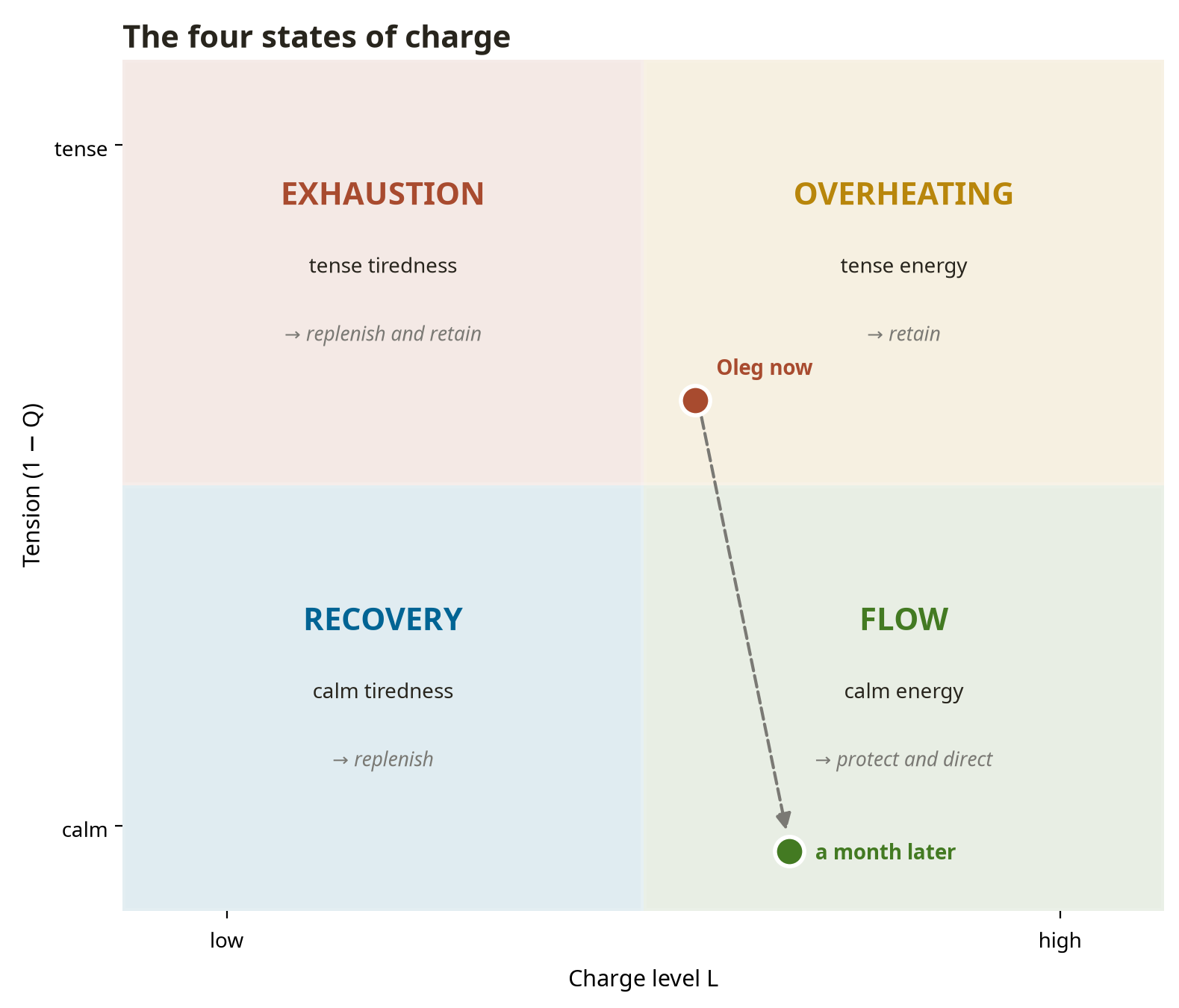
Fig. 5. The L × Q matrix: the four states of charge and the main task for each
The red dot is Oleg now: medium level, high tension. He is in the overheating zone, not far from the border with exhaustion. The green dot shows where he will be one month later.
Each of the four states feels different and calls for its own main task. The table below brings this together: find the row that resembles your current state and look at the right-hand column.
| State | Level L | Quality Q | How it feels | Main task |
|---|---|---|---|---|
| Flow | high | high | Calm energy, clarity, interest | Protect and direct |
| Overheating | high | low | Agitation, anxiety, "wound up," hard to stop | Retain: lower the tension, close the leaks |
| Recovery | low | high | Calm tiredness, a pleasant heaviness after work well done | Replenish: allow yourself rest |
| Exhaustion | low | low | Tense tiredness, irritation, emptiness | Replenish and retain, and only then direct |
|
A PSYCHOTHERAPIST'S COMMENT The most treacherous state is overheating. From the outside, the person looks energetic and productive. They may believe they have "everything under control." But their energy rests on tension, not on resources. It is a loan at a high interest rate. It is from overheating that people most often fall into exhaustion, abruptly, "out of nowhere," even though the process had actually been going on for months. |
|---|
Effective charge
We now have three numbers. Can we combine them into one to see the overall picture? Yes, and this is perhaps the most important formula in the article.
|
WHEN YOU NEED IT When it seems you have enough energy but little to show for it: the day passes in a rush, and you never get to what matters most. Effective charge shows what share of your energy actually reaches what you value. |
|---|
|
EFFECTIVE CHARGE Ψeff = L × Q × A Ψeff (pronounced "psi-eff," for "effective") is the part of energy that actually works for a person's life. Scale from 0 to 100. L is the level of charge (0–100): how much energy there is. Q is quality (0–1): what share of that energy is calm rather than tense. A is alignment (0–1): what share goes to what matters to me. × means multiply. Each successive factor "cuts off" the part of energy that is lost. Charge % = min(100, Ψeff ÷ 85 × 100) Because all three factors are almost never at their maximum together, Ψeff rarely exceeds 85 in practice. So 85 counts as a full charge (100%). Charge % zones: 0–20 drained, 21–40 on the edge, 41–60 in the middle, 61–80 close to charged, 81–100 charged. |
|---|
Why multiply instead of add? Imagine carrying water in a sieve. L is how much water was poured in. Q is how much did not leak out along the way because of tension. A is how much was delivered to exactly the right place. If even one link is close to zero, almost nothing reaches the goal, no matter how much water there was at the start.
|
STEP-BY-STEP CALCULATION: OLEG Step 1. Level. L = 55. Out of a possible hundred, Oleg has 55 "units" of energy. Step 2. Account for quality. 55 × 0.4 = 22. Of the 55 units, only 22 are calm. The other 33 rest on tension and are spent on "holding himself together." Step 3. Account for alignment. 22 × 0.7 ≈ 15.4. Of the 22 calm units, about 15 go to what Oleg considers important. Result: Ψeff ≈ 15. Of 55 units of energy, only 15 work for his project and his family. Charge % = 15.4 ÷ 85 × 100 ≈ 18% (drained). |
|---|
|
STEP-BY-STEP CALCULATION: THE SAME OLEG ONE MONTH LATER Oleg fills out the questionnaire again: L = 68; tension T = 3, so Q = 1 − 0.3 = 0.7; sense of purpose 8.5, so A = 0.85. Step 1. 68 × 0.7 = 47.6: calm energy. Step 2. 47.6 × 0.85 ≈ 40.5: directed toward what matters. Result: Ψeff ≈ 40. Charge % = 40.5 ÷ 85 × 100 ≈ 48% (in the middle). |
|---|
|
WHAT THE RESULT MEANS Compare the two calculations. The energy level rose from 55 to 68, by about a quarter. That's good, but not impressive. Effective charge, however, rose from 15 to 40, 2.6 times. Where does the difference come from? The main gain came not from "more energy" but from less tension (Q rose from 0.4 to 0.7) and a more precise direction. This is one of the model's most practical findings: it often pays more to stop losing the energy you already have than to produce new energy. |
|---|
What matters is not only how much energy you have. What matters is how much of it reaches what you value.
The triad of strategies: replenish, retain, direct
If charge is lost in three places (there is too little of it, it is tense, it goes to the wrong place), then there are three ways to work with it. Each component of the MIE triad has its own strategy.
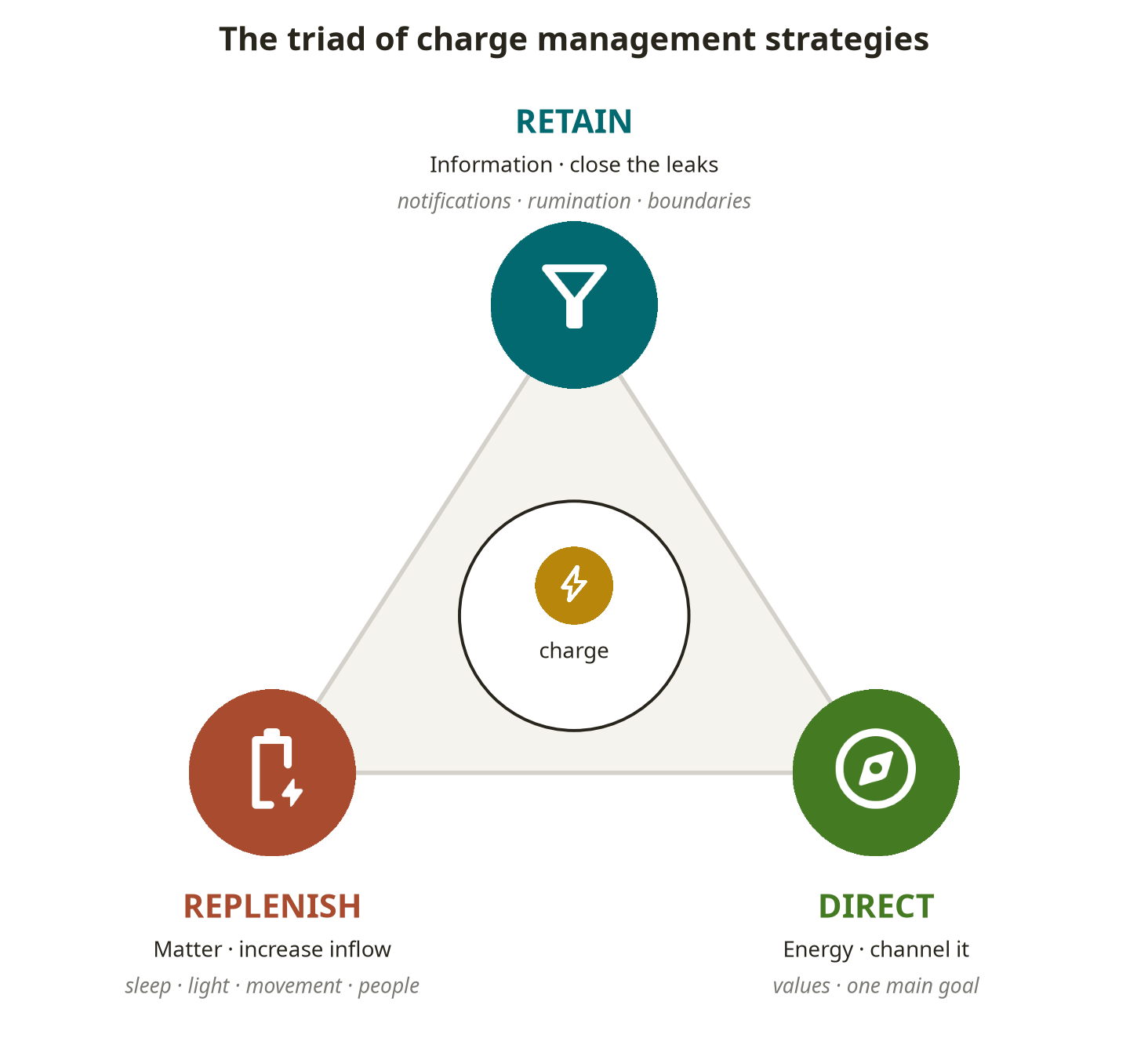
Fig. 6. The triad of strategies for managing charge
|
MATTER: REPLENISH Increase the inflow. Sleep, morning light, movement, food, nature, live contact with loved ones. This is what people usually call "rest." |
|---|
 |
INFORMATION: RETAIN Close the leaks. Notifications, multitasking, rumination, no boundary between work and home, conflicts that keep replaying in your head. Most leaks today are informational. |
|---|
 |
ENERGY: DIRECT Channel the charge. Connect daily activities to values, shift from "prevention" energy to "promotion" energy, choose one main direction instead of ten. |
|---|
The main mistake is strategy asymmetry. Most people try only to replenish: more coffee, more weekends, another vacation. But if the battery has holes and the wiring short-circuits, no amount of recharging will hold. That is exactly why Oleg's vacation "wears off" a week after he gets back.
The charge hologram: sources and leaks
So far we have looked at charge as a whole. But in real life, energy comes and goes in very specific places: in sleep, in the work chat, at the family dinner table, in meetings. To see these places, let's bring all three lenses together.
The MIE lens gives three domains (Matter, Information, Energy). The WWH lens gives three questions (What, Whither, How). The SFD lens gives three levels (Structure, Function, Development). Combining each with each gives 3 × 3 × 3 = 27 cells. We call this construction the charge hologram: just as a hologram shows an object from all sides, it shows charge from all sides at once.
For example, the cell "Matter – How – Function" answers the question: how does my body recover in everyday life? For Oleg, that is sleep and daily routine. And the cell "Information – How – Function" asks: how do I handle my attention every day? For Oleg, that is the work chat and notifications.
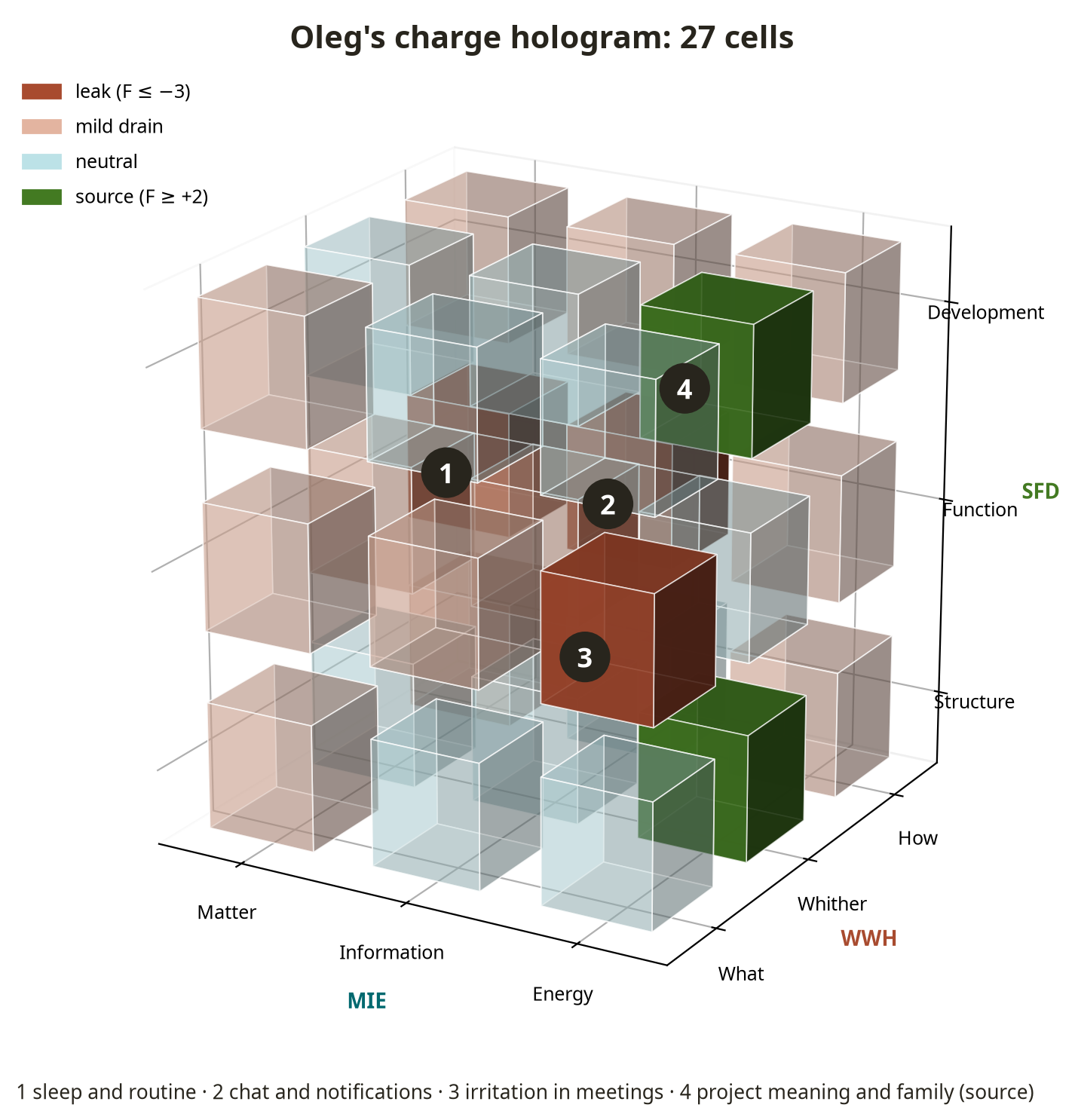
Fig. 7. Oleg's charge hologram in 3D: 27 cells of MIE × WWH × SFD. Green cells are sources, red cells are leaks
Two ratings for each cell
For each of the 27 cells, a person answers two simple questions.
|
TWO SCALES FOR EACH CELL L, the level of charge in this zone, from 0 to 10. Question: how much energy do I have here? 0 means completely empty, 10 means full. F, flow, from −5 to +5. Question: does this zone charge me or drain me? Plus means it charges, minus means it drains, zero means neutral. The larger the number, the stronger the effect. |
|---|
These are different things, and it is important not to confuse them. L is "how much water is in the vessel right now." F is "whether water is flowing in or out." A vessel can be almost full but have a hole in the bottom. Or it can be almost empty but sitting under a running tap.
Combining these two ratings gives four types of cells. The table below is a kind of "map legend": it will tell you how to read each cell of the hologram.
| Cell type | Level L | Flow F | What it means | Strategy |
|---|---|---|---|---|
| Source | high | + | Energy is here and keeps coming in | Rely on it, expand it |
| Melting reserve | high | − | There is still plenty of energy, but it is draining away | Retain: close the leak before it's too late |
| Recovery | low | + | There is little energy, but it is coming in | Don't interfere, give it time |
| Leak | low | − | There is little energy, and it keeps draining | Replenish and retain, as a first priority |
Which cell to start with: the priority index
Twenty-seven cells is a lot. You can't work on all of them at once. You need to understand which ones matter most right now.
|
WHEN YOU NEED IT When you have filled out the hologram and see several red zones but don't know what to tackle first. The priority index helps you pick the two or three cells where work will have the greatest effect. |
|---|
|
THE CELL PRIORITY INDEX P = (10 − L) + 2 × max(0, −F) + PO P is priority. The higher the number, the more important it is to work on the cell. The maximum is 30. (10 − L) is the deficit: how much is missing to reach a full ten. If L = 3, the deficit is 7. max(0, −F) is the drain strength. The symbol max means "take the larger of the two numbers." If the flow is negative, say F = −4, then −F = 4, and we take 4. If the flow is positive (the cell charges you), then −F is less than zero, and we take 0: there is no drain. 2 × means we multiply drain strength by two so that it weighs as much as the deficit (both parts then run from 0 to 10). PO is the leverage potential, from 1 to 10. Question: how much will a change in this cell change everything else? For example, sleep affects almost everything, so its potential is high. |
|---|
A cell is considered critical if two conditions are met at the same time: P ≥ 20 and F < 0. The second condition matters: it filters out cells where energy is low but already flowing in. They need time, not intervention.
|
STEP-BY-STEP CALCULATION: OLEG'S "SLEEP AND ROUTINE" CELL Oleg rates it: L = 3 (he rarely gets enough sleep), F = −4 (sleep deprivation drains him heavily), PO = 9 (sleep affects everything: mood, attention, patience). Step 1. Deficit. 10 − 3 = 7. Step 2. Drain strength. −F = 4; max(0, 4) = 4; multiply by 2 → 8. Step 3. Add the potential. 7 + 8 + 9 = 24. Step 4. Check the conditions. 24 ≥ 20: yes. F = −4 is less than zero: yes. The cell is critical. |
|---|
|
WHAT THE RESULT MEANS P = 24 out of a possible 30 is a very high priority. The "sleep and routine" cell is empty, keeps draining, and affects everything else. So this is exactly where to start. Oleg's full hologram and all his critical cells appear in the demo case below. |
|---|
Formulas: harmony, dynamics, risk
The hologram shows where energy is lost. The next formulas answer three other questions: is my charge balanced?, where is it heading over time?, and how dangerous is my state? Each can be read on its own, so pick the one that answers your question.
Charge harmony
|
WHEN YOU NEED IT When you want to know whether there is a "tilt": for example, your mind is working perfectly while your body is at its limit. Or the reverse: physically you are in shape, but emotionally empty. Harmony shows how evenly charge is distributed between body, mind, and emotions. |
|---|
First you need a charge profile across the three MIE domains. It is easy to get from the Ψpheno questionnaire:
• Matter = the average of blocks V and RS (vitality and recovery);
• Information = the score of block AP (attention);
• Energy = the score of block ES (emotional stability).
For Oleg: Matter = (4 + 4) / 2 = 4, Information = 6, Energy = 6.
|
CHARGE HARMONY GRADE (HG) |Δ| = √[(x₁ − 33.3)² + (x₂ − 33.3)² + (x₃ − 33.3)²] HG = 100 × (1 − |Δ| / 81.65) HG is the Harmony Grade, from 0 to 100. 100 means perfect balance. x₁, x₂, x₃ are the shares of Matter, Information, and Energy in the total charge, as percentages. For example, if the domains are rated 4, 6, and 6, the total is 16, and the share of Matter is 4 out of 16, that is, 25%. 33.3 is the "ideal" share of each domain if they are equal: 100% / 3. |Δ| is the overall deviation from balance: how "lopsided" the profile is. We take the difference for each domain, square it (so that minuses don't cancel out pluses), add them up, and take the square root. 81.65 is the largest possible deviation: when all charge is concentrated in one domain (100% / 0% / 0%). Dividing by it turns the deviation into a share of the maximum. |
|---|
Don't be put off by the root and the squares: this is simply the "distance" between your profile and a perfectly even one. As if you were measuring how far you have moved from the center of a room.
|
STEP-BY-STEP CALCULATION: OLEG Step 1. Shares. 4 + 6 + 6 = 16. Matter: 4 / 16 = 25%. Information: 6 / 16 = 37.5%. Energy: 6 / 16 = 37.5%. Step 2. Deviations from balance. 25 − 33.3 = −8.3; 37.5 − 33.3 = +4.2; 37.5 − 33.3 = +4.2. Matter "falls short," the other two domains "overshoot." Step 3. Squares. 8.3² ≈ 69.4; 4.2² ≈ 17.4; 4.2² ≈ 17.4. Step 4. Sum and root. 69.4 + 17.4 + 17.4 = 104.2; √104.2 ≈ 10.2. This is |Δ|. Step 5. Share of the maximum. 10.2 / 81.65 ≈ 0.125, that is, 12.5% of the strongest possible tilt. Step 6. Harmony. 100 × (1 − 0.125) = 87.5 ≈ 88. |
|---|
|
WHAT THE RESULT MEANS 88 out of 100 is fairly high harmony. It would seem everything is fine. But there is a trap here: harmony shows balance, not level. A person can be "evenly drained" in all three domains and still be formally harmonious. The calculation also confirms the clue from the questionnaire: Oleg's weak link is Matter, body and recovery. Its share is below the balanced level. |
|---|
To keep the "evenly drained" trap from fooling us, we add one more measure that accounts for both balance and level at once.
|
HARMONIOUS CHARGE (HC) HC = √(HG × L) HC is Harmonious Charge, from 0 to 100. HG is the harmony we just calculated. L is the level of charge from the Ψpheno questionnaire. √(… × …): the square root of the product of two numbers gives a special kind of "average." It is high only if both numbers are high. If even one is low, the result will also be modest. |
|---|
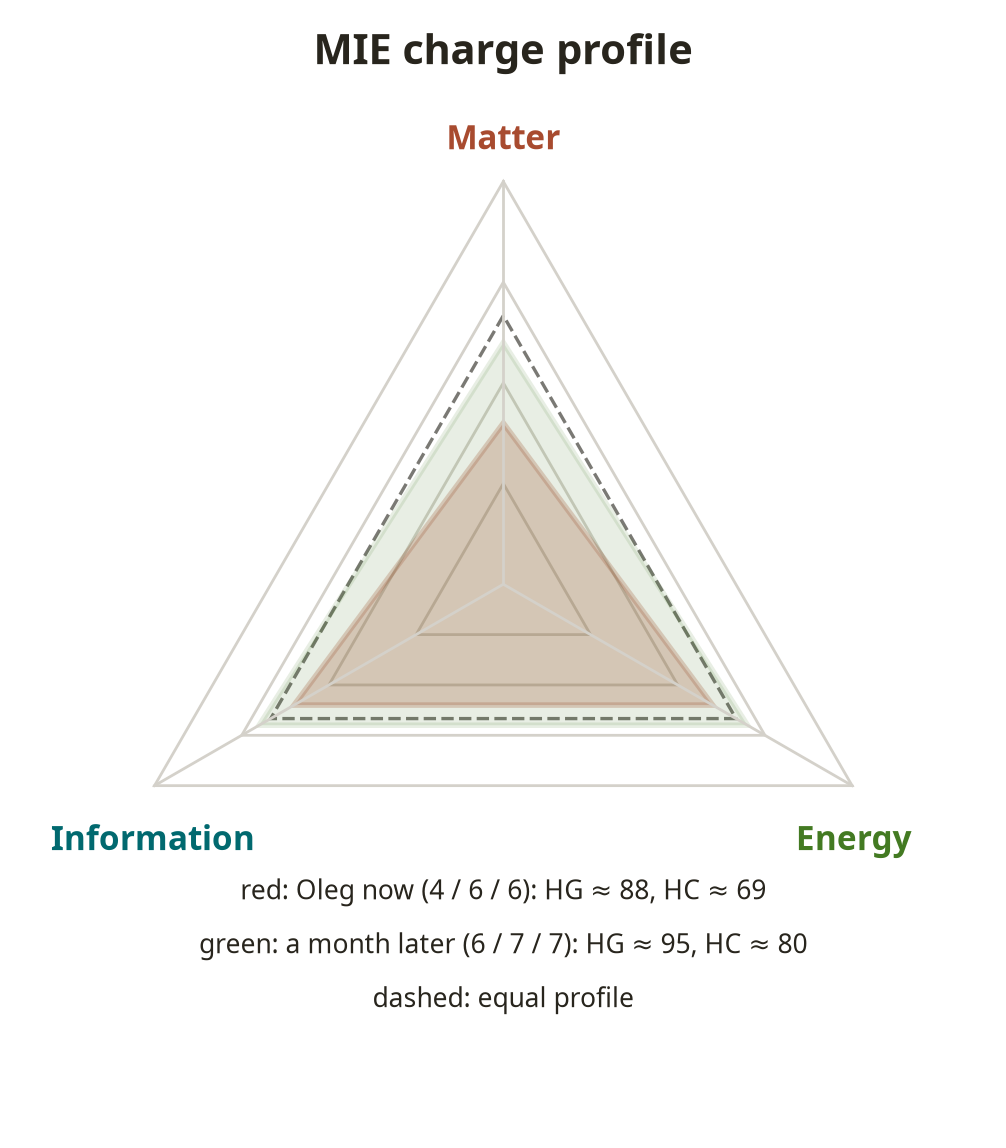
Fig. 8. Oleg's MIE charge profile: tilted toward Information and Energy, with a Matter deficit
|
STEP-BY-STEP CALCULATION: OLEG Step 1. Multiply: 87.5 × 55 = 4812.5. Step 2. Take the root: √4812.5 ≈ 69. One month later: profile 6 / 7 / 7, HG ≈ 95, L = 68. 95 × 68 = 6460; √6460 ≈ 80. |
|---|
|
WHAT THE RESULT MEANS Although Oleg's harmony is high (88), his harmonious charge is noticeably lower, 69: the modest level holds it back. The figure shows this clearly: the red triangle is even but small. A month later it has not only evened out but also grown: the green triangle is wider. |
|---|
Strategy harmony
The second kind of harmony concerns not the charge itself but how we work with it.
|
WHEN YOU NEED IT When you rest a lot, yet don't feel any better. This formula checks whether you are spending your effort on the wrong strategy: for example, only "replenishing" when the main problem is leaks. |
|---|
|
STRATEGY HARMONY (HGS) HGs = 100 × (1 − |effort − need| / 81.65) HGs is strategy harmony (the s stands for strategies), from 0 to 100. Effort is how you actually distribute your effort among the three strategies "replenish / retain / direct," as percentages (100% in total). Need is the distribution your system requires. The critical cells of the hologram point to it: if the main leaks are in information, you need more "retain." |effort − need| is the distance between what you do and what is needed. It is calculated the same way as |Δ| above: differences, squares, sum, root. 81.65 is the same maximum deviation as before. |
|---|
|
STEP-BY-STEP CALCULATION: OLEG Step 1. Need. Oleg's three critical cells: sleep (needs to be replenished), the work chat (needs to be retained), irritation in meetings (needs to be retained and then directed). Hence a sensible distribution: replenish 40%, retain 40%, direct 20%. Step 2. Actual effort. Oleg takes an honest look at what he does: coffee, weekends, vacation are all "replenish," about 70%. He hardly does any "retaining," 10%. "Direct" is 20%. Step 3. Differences. 70 − 40 = 30; 10 − 40 = −30; 20 − 20 = 0. Step 4. Squares, sum, root. 900 + 900 + 0 = 1800; √1800 ≈ 42.4. Step 5. Share of the maximum. 42.4 / 81.65 ≈ 0.52. Step 6. Strategy harmony. 100 × (1 − 0.52) ≈ 48. One month later Oleg distributes his effort as 40 / 35 / 25. Differences 0, −5, +5; the root of 50 ≈ 7.1; HGs ≈ 91. |
|---|
|
WHAT THE RESULT MEANS 48 is low harmony. Oleg spends a lot of effort, but on the wrong thing. He diligently "recharges" while the battery keeps leaking. This is exactly the strategy asymmetry we discussed above. A month later he isn't resting less; he has simply started closing the leaks. And the number nearly doubled. |
|---|
Charge dynamics
All the previous calculations are a "snapshot" of a state. But charge lives in time: today it is a little higher, tomorrow a little lower. The next formula turns the snapshot into a movie.
|
WHEN YOU NEED IT When you want to understand: where am I heading if I change nothing? Am I gradually getting better, worse, or holding at one level? This formula is especially useful if rest helps only for a short while. |
|---|
The idea is very simple; it is familiar to anyone who keeps an eye on a bank account. Charge today = charge yesterday + what came in − what went out. We add only two corrections: not everything that comes in is absorbed, and some energy "evaporates" on its own.
|
THE CHARGE DYNAMICS EQUATION Ψₜ = min(K, Ψₜ₋₁ + R × In − Out − λ × Ψₜ₋₁) Ψₜ is charge today (on day t). Ψₜ₋₁ is charge yesterday. In is how much energy came in during the day: sleep, movement, meaning, loved ones. It is measured in the same units as charge. R is resilience: how well the body absorbs incoming energy. Usually from 0 to 2, with about 1 as the norm. More on it just below. R × In is how much energy actually "got through." If R = 0.8, then 8 of every 10 incoming units are absorbed. Out is how much went out during the day: work, stress, leaks. λ × Ψₜ₋₁ is natural "evaporation." λ (lambda) is the share of charge that is lost on its own, even without any load. If λ = 0.1, 10% of yesterday's charge is lost every day. The larger the charge, the more evaporates, just as water evaporates faster from a full bucket than from a half-empty one. K is capacity, the "ceiling" of the battery (100). min(K, …) means charge cannot rise above the ceiling. |
|---|
|
STEP-BY-STEP CALCULATION: OLEG'S FIRST DAYS Oleg estimates his daily flows: inflow In = 22 (short sleep, almost no movement), outflow Out = 19.5 (overtime, chat, conflicts). Resilience R = 0.8, evaporation λ = 0.1. Yesterday's charge is 55. Day 1, step 1. What got through from the inflow. 0.8 × 22 = 17.6. Step 2. Evaporation. 0.1 × 55 = 5.5. Step 3. End of the day. 55 + 17.6 − 19.5 − 5.5 = 47.6. Day 2. 47.6 + 17.6 − 19.5 − 0.1 × 47.6 = 47.6 + 17.6 − 19.5 − 4.8 ≈ 40.9. Day 3. 40.9 + 17.6 − 19.5 − 4.1 ≈ 34.9. Each day the charge is a little lower than the day before. In about two weeks the model reaches zero. |
|---|
In real life, of course, this doesn't happen literally. A person "tops up" their charge with caffeine, weekends, tension. But the direction of movement is exactly this: downward.
Another very useful formula follows from this equation. It answers the question: does my charge have a balance point, a level at which it will settle on its own?
|
STEADY-STATE CHARGE LEVEL Ψ∗ = (R × In − Out) / λ Ψ∗ (read "psi-star") is the steady-state level: charge will drift toward it over time on its own if the daily balance doesn't change. R × In is how much energy is actually absorbed per day. Out is how much goes out. R × In − Out is the net daily balance: plus means profit, minus means loss. / λ means we divide by the evaporation rate. Where does this formula come from? At the balance point, charge stops changing: whatever came in equals what went out and evaporated. If you write down this condition and solve for charge, you get exactly Ψ∗. |
|---|
|
STEP-BY-STEP CALCULATION: OLEG BEFORE AND AFTER Now. R × In = 0.8 × 22 = 17.6. Balance: 17.6 − 19.5 = −1.9. Ψ∗ = −1.9 / 0.1 = −19. A negative steady-state level means there is no balance point above zero. Charge will drain away day after day. This is the "loss spiral" Hobfoll wrote about, only written as a formula. After the plan (we will see exactly what Oleg changed in the demo case): R = 0.85, inflow In = 30 (7 hours of sleep, morning light, a walk, an evening with family), outflow Out = 17.5 (notifications off, a boundary to the workday). R × In = 0.85 × 30 = 25.5. Balance: 25.5 − 17.5 = +8. Ψ∗ = 8 / 0.1 = 80. |
|---|
|
WHAT THE RESULT MEANS Look how small the changes are: inflow rose by 8 units, outflow fell by 2. This isn't "turning your life upside down"; it is a few new daily habits. But they change the sign of the balance from minus to plus. And instead of a slow fall toward zero, the system tends toward a level of 80. The main conclusion: Oleg doesn't need another vacation. He needs to change his daily balance by a few units. |
|---|
Now let's look at the same thing in a picture.
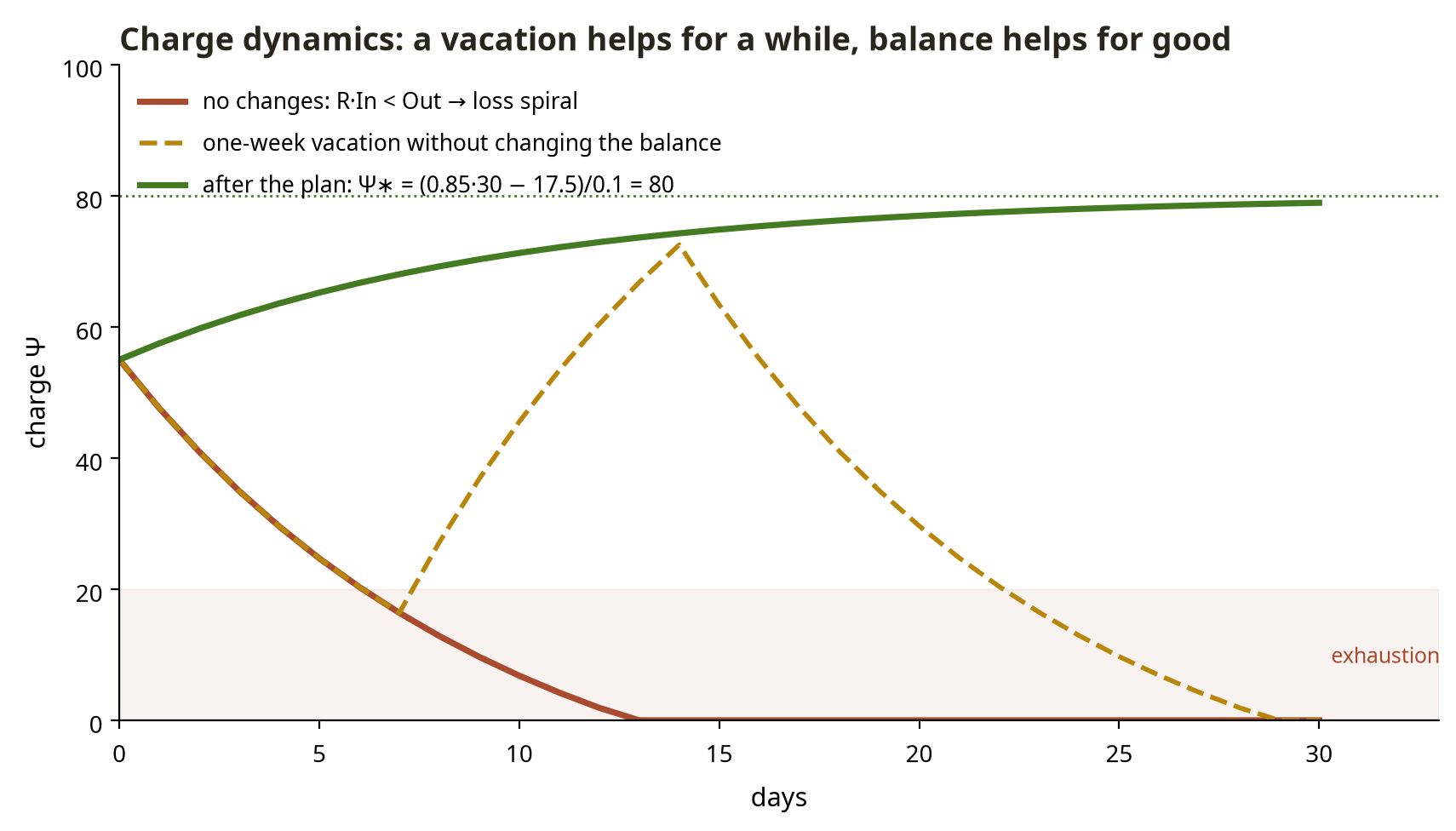
Fig. 9. Oleg's charge dynamics over 30 days: without changes, charge drains toward exhaustion; after the plan, it settles at a steady level
|
HOW TO READ THIS CHART What we see. Horizontally, the days, from the first to the thirtieth. Vertically, the level of charge, from 0 to 100. The pink band at the bottom is the exhaustion zone (below 20). All three lines start at the same point: Oleg's charge is currently 55. The red line: "change nothing." Each day a little more is lost than comes in. The line goes down smoothly but steadily and hits zero in about two weeks. No dramatic event, just a small daily minus. The yellow dashed line: "a vacation without changing habits." During the first week, charge falls just as in the red scenario. Then, on day seven, the vacation begins: inflow rises sharply, outflow drops, and the line climbs briskly, to over 70. But a week later Oleg returns to his old routine, and the line heads down again, ending up by day thirty almost where it would have been without the vacation. The green line: "change the daily balance." There is no sharp jump. Charge grows slowly, day by day, and gradually reaches a "plateau" of about 80, the same steady-state level Ψ∗. The dashed horizontal line marks this level. What conclusions can we draw. • A vacation is charging from the outlet: it raises the level but doesn't repair the battery. After you return, the old balance pulls the charge back down. • Lasting improvement comes from repairing the battery: changing your daily inflows and leaks. • The changes can be small: what matters is not their size but that the balance becomes positive. • Decline with a negative balance happens unnoticed. That's why it helps not to wait for "rock bottom" but to check your balance in advance. |
|---|
Resilience: how quickly you recover
There is one letter in the dynamics equation that deserves a separate conversation: R, resilience.
The word comes from the Latin resilire, "to spring back, to rebound." In psychology, resilience is a person's ability to recover after difficulties, to "bounce back into shape," the way a spring returns after being compressed. People differ in this quality: one recovers from a hard week over a weekend, another needs a week, and someone else needs a month.
In our formula, R shows how fully the body absorbs incoming energy. With R = 1, all incoming energy is put to use. With R = 0.5, only half: the person sleeps and rests but "doesn't fill up." With R above 1, the person recovers especially well: a little energy gives them a lot.
|
WHEN YOU NEED IT When you need to estimate R for your own dynamics calculation. You can't just plug in a random number: the result depends heavily on it. We suggest estimating resilience from something easy to recall from your own experience: your recovery speed. |
|---|
Ask yourself: "Think of your last truly hard week. How many days did it take afterward to get back to your usual state?" The answer is a number of days; let's call it d.
|
ESTIMATING RESILIENCE FROM RECOVERY SPEED R = 2 / (1 + d / 2) R is resilience, from 0 to 2. d is how many days you need to recover after a heavy load. d / 2 compares you with a "norm" of 2 days (what a healthy adult usually needs to recover over a weekend). This is our working convention, not a law of nature. The formula is chosen so that recovering in 2 days gives R = 1 (the norm), faster recovery gives more than 1, and slower recovery gives less than 1. |
|---|
|
WHAT THIS LOOKS LIKE IN DIFFERENT EXAMPLES • I recover in half a day: R = 2 / (1 + 0.25) = 1.6, very high resilience. • In 1 day: R = 2 / 1.5 ≈ 1.33. • In 2 days (a weekend): R = 2 / 2 = 1, the norm. • In 3 days: R = 2 / 2.5 = 0.8, slightly below the norm. This is Oleg. • In 6 days: R = 2 / 4 = 0.5, recovery twice as slow as the norm. • In 10 days: R = 2 / 6 ≈ 0.33, a serious signal; it is worth discussing your state with a professional. |
|---|
|
WHAT THE RESULT MEANS Oleg needs about three days after a hard week, so R ≈ 0.8. This means only 8 of every 10 units of rest are put to use. The good news: resilience can be trained. Regular sleep, movement, and the ability to "switch off" from work gradually raise it; a month later Oleg's R ≈ 0.85. |
|---|
The Integral Exhaustion Index
The last two formulas in this section answer the question of risk.
|
WHEN YOU NEED IT When it matters to understand how dangerous your state is for the future: is it ordinary tiredness that will pass on its own, or the road to burnout? The index combines two things: how large the deficit is now and how vulnerable the system is. |
|---|
By analogy with the Integral Sinfulness Index from our article on digital sins, we combine the depth of the deficit with vulnerability.
|
INTEGRAL EXHAUSTION INDEX (IEI) IEI = √(Def × Vul) IEI is the Integral Exhaustion Index, from 0 to 100. The higher it is, the higher the risk. Def is the deficit, from 0 to 100: how much calm energy is missing. It is calculated as follows: Def = 100 − L × Q Here L is the level of charge from the questionnaire (0–100), and Q is its quality (0–1). The product L × Q is the "calm part" of the charge. Subtracting it from 100 gives how much is missing to a full battery. Vul is vulnerability, from 0 to 100: the average of six ratings, each scored by the person from 0 to 100: • depth of deficit: how long and how far charge has been below normal; • leak speed: how quickly energy goes out; • contagion: how much the drained state spreads to family and team; • dependence on stimulants: caffeine, sugar, the "dopamine loops" of an endless feed; • difficulty of recovery: how hard it is to get back to normal; • loss of agency: how far the person has stopped managing their own time and attention. √(Def × Vul) is the root of a product, as in the harmonious charge formula: the result is high only if both the deficit and the vulnerability are high. |
|---|
Why not just add them? Picture a marathon runner right after a race: their deficit is huge, but their vulnerability is low; they know very well how to recover. Their index comes out moderate: √(80 × 10) ≈ 28. And that's correct: there is no danger. Danger arises when a large deficit meets high vulnerability.
|
STEP-BY-STEP CALCULATION: OLEG Step 1. The calm part of the charge. L × Q = 55 × 0.4 = 22. Step 2. Deficit. Def = 100 − 22 = 78. Oleg is missing 78 of 100 units of calm energy. Step 3. Vulnerability: six ratings with explanations. • Depth of deficit, 70: "it's been going on like this for half a year." • Leak speed, 75: "by lunchtime I'm already wrung out." • Contagion, 55: "I snap at my team, and at home I've become curt." • Stimulants, 65: "four coffees a day and the news feed before bed." • Difficulty of recovery, 60: "weekends aren't enough." • Loss of agency, 50: "the day runs itself, driven by the chat and other people's urgencies." Average: (70 + 75 + 55 + 65 + 60 + 50) / 6 = 375 / 6 = 62.5. Step 4. Product. 78 × 62.5 = 4875. Step 5. Root. √4875 ≈ 70. One month later: Def = 100 − 68 × 0.7 ≈ 52; vulnerability has dropped to 40; √(52 × 40) ≈ 46. |
|---|
|
WHAT THE RESULT MEANS IEI = 70 is high risk. Oleg hasn't burned out yet, but the system is moving in that direction: the deficit is large, and it meets noticeable vulnerability. Two ratings deserve special attention: leak speed and dependence on stimulants. A month later the index fell to 46, a moderate level: the state isn't ideal, but it is no longer dangerous. |
|---|
Relationship balance
We said that social energy is not a separate domain but an exchange. Some people charge us, others drain us. The last formula helps you see this exchange as a whole.
|
WHEN YOU NEED IT When you notice that after some encounters you feel a surge of energy and after others you feel empty, and you want to understand in which direction your relationships work overall. It is especially useful if there is a lot of communication around you but it doesn't make you feel any better. |
|---|
|
SOCIAL BALANCE INDEX (SB) SB = Σ (impact × frequency) SB is Social Balance. Impact is how this person or communication channel affects you: from −3 (drains you heavily) to +3 (charges you strongly). Frequency is how many times a week you are in contact with them. impact × frequency is one person's contribution for the week. Σ (sigma) means add up the contributions of all the people and channels on the list. A positive total means your relationships charge you overall; a negative total means they drain you. |
|---|
|
STEP-BY-STEP CALCULATION: OLEG'S RELATIONSHIP MAP Step 1. The list. Oleg writes down the people and channels he deals with every week, and for each one sets the impact and frequency. • Wife: +3 × 7 times a week = +21. "When I'm with her, I can breathe out." • Son: +2 × 3 = +6. "We don't see each other much, but every time it's a joy." • Project partner: +2 × 5 = +10. "Thinking is easy with him." • Manager: −2 × 5 = −10. "Every conversation is pressure." • Difficult client: −3 × 3 = −9. "After a call, it takes me an hour to recover." • The project's work chat: −1 × 20 = −20. "Each message is a small prick, but there are so many of them." Step 2. Total. 21 + 6 + 10 − 10 − 9 − 20 = −2. |
|---|
|
WHAT THE RESULT MEANS SB = −2: overall, Oleg's relationships drain him slightly. But the most interesting thing is where the minus comes from. Not from the manager or the difficult client, but from the work chat: each message is almost harmless, but twenty check-ins a week make the largest negative contribution. If Oleg checks the chat five times a day on a schedule and turns it into a single "batch" of communication, its contribution will be about −5 instead of −20. Then SB = +13: his relationships will start charging him. And he won't have to change either his manager or his client. |
|---|
All the indices together
We have met seven measures. To avoid getting confused, let's gather them into one cheat sheet. It is handy to keep in front of you during self-assessment: the left column has the name, next to it is the question the index answers, and on the right is how to read the number you get.
| Index | Question | Range | Zones (approximate) |
|---|---|---|---|
| Ψpheno | What is my charge by self-report? | 0–100 | below 40 low, 40–60 moderate, above 60 high |
| Ψeff | How much of my charge works for my values? | 0–100 | below 20 low, 20–40 moderate, above 40 high; as Charge % (Ψeff ÷ 85 × 100): 0–20 drained, 21–40 on the edge, 41–60 in the middle, 61–80 close to charged, 81–100 charged |
| HG / HC | Is my charge balanced and sufficient? | 0–100 | below 50 tilted, 50–75 strained, above 75 harmony |
| HGs | Am I recovering the right way? | 0–100 | same |
| Ψ∗ | Where is my charge heading? | below 0 to 100 | below 0 loss spiral, above 60 stability |
| IEI | How dangerous is my state? | 0–100 | below 30 low, 30–55 moderate, above 55 high |
| SB | Do my relationships charge me? | any | below 0 drain, above 0 charge |
|
THE LINK TO THE SUBJECTIVITY INDEX™ All these indices serve one outcome: a person's ability to remain the author of their own life. A drained person lives in reaction mode: to demands, notifications, other people's expectations. That is why a falling IEI is almost always accompanied by a rising Subjectivity Index™. |
|---|
The physiological basis of charge
Psychological charge is not only a metaphor. It has a bodily foundation: the brain makes up about 2% of body mass but uses about 20% of its energy. Sleep, movement, autonomic regulation, hormonal rhythms, and nutrition directly affect how a person experiences their energy.
Below are seven physiological domains linked to charge, along with the corresponding micro-interventions. We have assigned each intervention a level of evidence:
• A: supported by systematic reviews or randomized trials;
• B: there are good studies, but the data are fewer or mixed;
• C: preliminary data; the mechanism is plausible, but the evidence is thin.
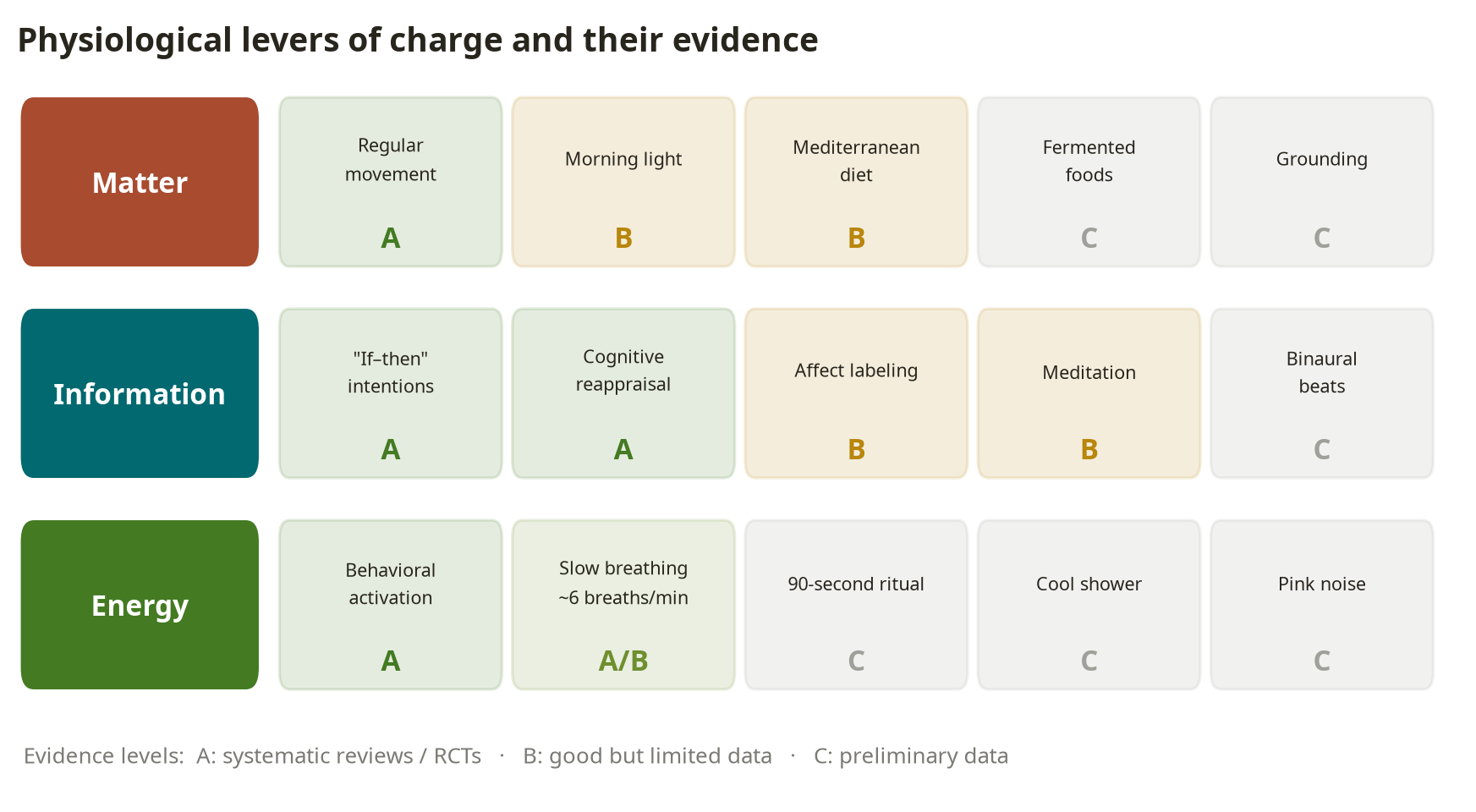
Fig. 10. Map of the physiological domains of charge across the MIE triad, with evidence levels for interventions
The figure gives a general overview: each row is one of the MIE domains, and each cell is one "lever" that helps charge, with a letter showing how reliably it has been studied. Green cells marked A are what you can rely on first. Grey cells marked C are things you can try if you like, but they should not form the basis of a program.
The table below expands this picture. For each physiological domain it shows: which marker (a sign in how you feel or in wearable-device data) indicates its state; which hologram cell it belongs to; which micro-intervention (a small daily action) helps it; and how well that action is supported by science.
| Domain | Marker | Cube cell | Micro-intervention | Evidence |
|---|---|---|---|---|
| Energy metabolism and movement | Subjective vitality, resting heart rate; in the lab, the mitochondrial health index | Matter – What – Structure | Regular walking and moderate exercise; 10 minutes of morning light | A (exercise), B (light) |
| Autonomic balance | Heart rate variability (rMSSD) | Energy – How – Structure | Slow breathing at about 6 breaths per minute, 5–10 minutes | A/B |
| Cognitive load | Sustained attention, daytime slumps | Information – How – Function | The "three-priorities card" and the "if–then" rule | A (implementation intentions) |
| Motivational activation | Time to start an action, persistence on a task | Energy – Whither – Development | The "90-second start": a first action in under 5 seconds | A (behavioral activation), C (ritual) |
| Stress axis | Perceived stress, cortisol rhythm | Information – How – Function | "Name the feeling" and cognitive reappraisal, 3 minutes | B (labeling), A (reappraisal) |
| Gut–brain axis | Digestive comfort, steadiness of mood | Matter – How – Function | Mediterranean-style diet, fiber, fermented foods | B (diet), C (fermented) |
| Brain rhythms and rest | Time to fall asleep, alpha activity (via a neuro-headband) | Information – How – Structure | Mindfulness meditation, an evening ritual; sound stimulation optional | B (meditation), C (binaural beats) |
Why do we insist so firmly on evidence levels? Because the topic of energy attracts many attractive but unverified claims. Some of them even appeared in early versions of our model. Below are the most important corrections.
|
SCIENTIFIC CORRECTIONS TO POPULAR CLAIMS • Gut serotonin. About 90% of serotonin is indeed produced in the gut, but this serotonin does not cross the blood–brain barrier and does not reach the brain directly (PMC). The gut–brain connection is real, but it works through the vagus nerve, the immune system, and metabolites, not by "pumping" serotonin. • Diet and mood. In the SMILES randomized trial, switching to a Mediterranean-style diet improved the condition of people with depression as an add-on to treatment (PubMed). • Breathing. 4–7–8 breathing is a breath-hold technique, not resonance breathing. Resonance breathing for heart rate variability biofeedback is about 6 breaths per minute (Frontiers in Psychology). • Movement. A meta-analysis showed that regular physical exercise increases feelings of energy and reduces fatigue (PubMed). • Naming feelings. Simply labeling an emotion reduces the amygdala's response to negative stimuli (Lieberman et al., 2007). • Implementation intentions. Plans in the form "if X, then I do Y" markedly increase goal attainment (Gollwitzer & Sheeran). • Behavioral activation is a method with proven effectiveness for depression (Cuijpers et al., 2023). • Grounding, pink noise, binaural beats. There are few data so far. They can be used as pleasant rituals, but not as the basis of a program. |
|---|
Micro-interventions: age ranges and limitations

We know which levers work. Now for how to use them safely. Even simple actions don't suit everyone: a cool shower is good for a healthy adult but not for a person with heart disease; a breath-hold technique may help one person and heighten anxiety in another.
So the next table shows, for each micro-intervention: how to do it, which sign to track to see the effect, from what age it is suitable, and in which cases it is better to refrain or to consult a doctor first. It is better to start with one or two interventions rather than all of them at once, and to check after a week whether your ratings have changed.
| Micro-intervention | How to do it | What to track | Age | Limitations |
|---|---|---|---|---|
| Morning light + movement | 10 minutes outdoors within the first half hour after waking, then 10–20 minutes of walking | Morning alertness (0–10), time to fall asleep | any | With eye conditions or light sensitivity, consult a doctor |
| Cool finish to a shower | 30 seconds of cool water at the end of a shower, gradually up to 1–2 minutes | Feeling of alertness | 18+ | Not recommended with stage II–III hypertension, coronary heart disease, arrhythmias, Raynaud's syndrome |
| Slow breathing | Inhale 4–5 seconds, exhale 5–6 seconds, about 6 cycles per minute, 5 minutes | Heart rate variability on a wearable, feeling of calm | 7+ | If dizzy, shorten the time; breath-hold techniques are not recommended during pregnancy or with panic attacks |
| Three-priorities card | In the morning, take 60 seconds to write down 3 main tasks and the first action for each | Number of priorities completed, daytime slumps | 12+ | None; with diabetes, combine with regular meals |
| 90-second start | Three breaths, shake out your hands, take the first physical action on the task in under 5 seconds | Time to start an action | 10+ | With clinical depression or bipolar disorder, only alongside treatment |
| Name the feeling | When anxiety spikes, write down: event → thought → feeling (in one word) → another view | Frequency and intensity of anxious episodes | 12+ | With severe trauma, together with a psychotherapist |
| Mediterranean plate | Vegetables, legumes, fish, olive oil, small amounts of fermented foods | Digestive comfort, steadiness of mood | any | With SIBO, histamine intolerance, or inflammatory bowel disease, together with a gastroenterologist |
| Evening switch-off ritual | An hour before bed: screens away, 10 minutes of meditation or journaling | Time to fall asleep, sleep quality | 10+ | Sound stimulation is contraindicated with epilepsy |
 |
SAFETY FIRST Micro-interventions are meant to maintain a healthy charge. They do not replace medical or psychotherapeutic care. If feeling drained is accompanied by persistently low mood for more than two weeks, sleep disturbances, loss of interest in everything, or thoughts of hopelessness or death, that is a reason to see a doctor or psychotherapist right away. |
|---|
Depletion profiles: every age and role has its own pattern
The same model looks different in different life situations.
 |
TEENAGER Typical profile: high L, low Q, low A. Plenty of energy, but it goes into the smartphone, anxiety about comparison with others, and late-night scrolling. Main leak: Information – How – Function. Key strategy: retain: screen boundaries, sleep, movement. For adults, the important thing is not to take the phone away but to help the teenager find a "Whither": something worthwhile in which their energy becomes promotion energy. |
|---|
 |
MANAGER Typical profile: overheating. A high L is held up by tension and caffeine; A is high but in "prevention" mode. Main leak: work communications and the absence of switching off. Key strategy: retain and replenish: workday boundaries, sleep, delegation. A special risk is contagion: a manager's drained state spreads to the team. |
|---|
 |
CAREGIVER FOR A LOVED ONE Typical profile: very high A (the meaning is enormous), low L, low Q. The person holds on through love and duty until the body gives way. Research shows that the chronic stress of caregiving is reflected even at the cellular level. Key strategy: replenish: regular help, "shifts," a minimal personal ritual, permission to rest without guilt. |
|---|
 |
OLDER ADULT Typical profile: recovery that turns into stagnation. Q is high, L is moderate, A falls after retirement or the loss of roles. Main deficit: Energy – Whither – Development. Key strategy: direct: new roles, participation, learning, social contact, movement. Energy returns along with an answer to the question "Why should I get up in the morning?" |
|---|
Demo case: Oleg, from overheating to flow
Now let's bring everything together and walk the whole path from beginning to end, the way any reader could.
Oleg's case is illustrative. It is built on typical patterns often seen in practice and serves as a demonstration of the method, not a description of a real client. All the numbers were chosen so that you can recalculate them yourself: every step relies on the formulas covered above.
The whole path has six steps: formulate the question, fill out the questionnaire, build the hologram, calculate the indices, draw up a plan, and check the result a month later.
Step 1. The focus question
All work begins with the right question. Oleg could ask: "Why do I have no energy?" But that question leads nowhere: you could go on answering it forever.
Together with a psychologist, he formulates a more specific question: "How can I get my energy back for the project and my family without leaving a job I like?"
|
COMMENT A good focus question immediately sets the "Whither": the project and the family. That is the source of alignment A. Oleg doesn't want to "run away from everything"; he wants to get his charge back for what he values. This wording already shifts him from "prevention" energy to "promotion" energy. The question also contains an important constraint: "without leaving my job." So the solution should be sought not in radical change but in balance. |
|---|
Step 2. Express assessment with the Ψpheno questionnaire
Oleg fills out the Ψpheno psychological charge questionnaire, the one described in the section "Charge as a vector." It takes about five minutes: twelve questions on a 0–10 scale and one question about tension.
Here are his answers; you can repeat them and recalculate.
| Block | Answers to the two questions | Block score | MIE domain |
|---|---|---|---|
| V: vitality | 4 and 4 | 4 | Matter |
| RS: recovery | 3 and 5 | 4 | Matter |
| AP: attention | 5 and 7 | 6 | Information |
| ES: emotional stability | 6 and 6 | 6 | Energy |
| SP: sense of purpose | 7 and 7 | 7 | WWH: "Whither" |
| SO: social exchange | 7 and 5 | 6 | Exchange |
Now, using the formulas from the section "Charge as a vector," we get the three components of charge.
|
CALCULATION: THE THREE COMPONENTS OF OLEG'S CHARGE Level L. Sum of the block scores: 4 + 4 + 6 + 6 + 7 + 6 = 33. Average score: 33 / 6 = 5.5. On a scale of 100: Ψpheno = L = 55. Quality Q. The answer to the question "how wound up am I?" is T = 6. Q = 1 − 6 / 10 = 0.4. Alignment A. The "sense of purpose" score is SP = 7. A = 7 / 10 = 0.7. Effective charge. Ψeff = L × Q × A = 55 × 0.4 × 0.7 ≈ 15, i.e. Charge % = 15.4 ÷ 85 × 100 ≈ 18%. MIE profile (needed for harmony). Matter = (V + RS) / 2 = (4 + 4) / 2 = 4; Information = AP = 6; Energy = ES = 6. |
|---|
|
WHAT WE LEARNED AT THIS STEP Oleg is in a state of overheating, on the border with exhaustion: a medium energy level (55) with high tension (quality only 0.4). Of 55 units of energy, only 15 work for the project and the family. The weak link is the body and recovery: blocks V and RS gave the lowest scores. And his strength is meaning: Oleg's sense of purpose is intact. |
|---|
Step 3. The charge hologram
The questionnaire gave the overall picture. Now we need to see the specific places where energy comes in and goes out. For this, Oleg fills out the hologram: for each of the 27 cells he gives a level L (from 0 to 10) and a flow F (from −5 to +5). To make it easier, he first "translates" each cell into the language of his own life: what exactly happens here for him.
Here is his full hologram. It is laid out on three "floors" (one figure for each), following the levels of the SFD lens: Structure (the base), Function (everyday life), and Development (how things change). Each floor is a 3 × 3 grid: the WWH lens runs horizontally, MIE vertically.
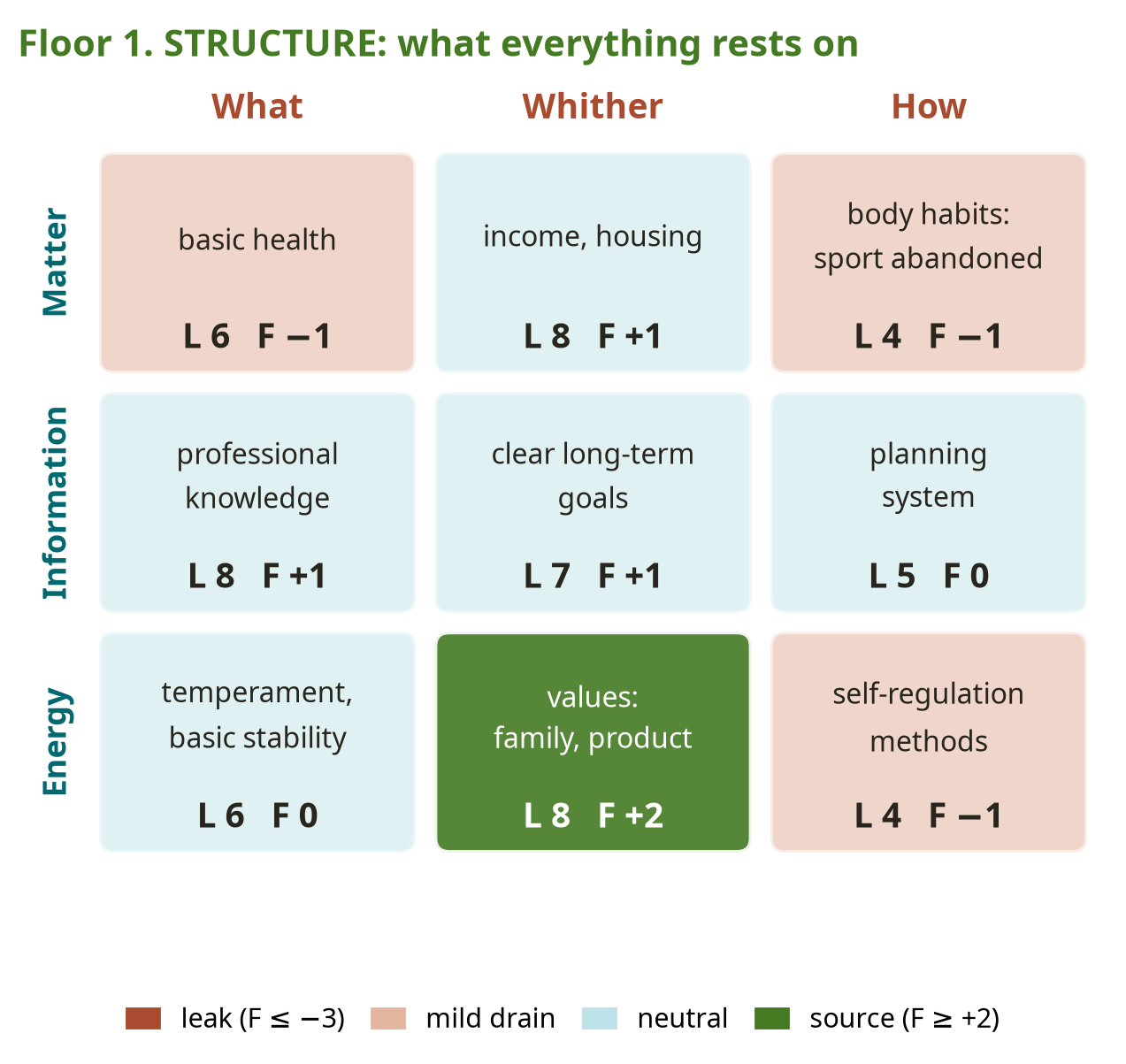
Fig. 11a. Oleg's hologram, the "Structure" floor: the base on which charge rests
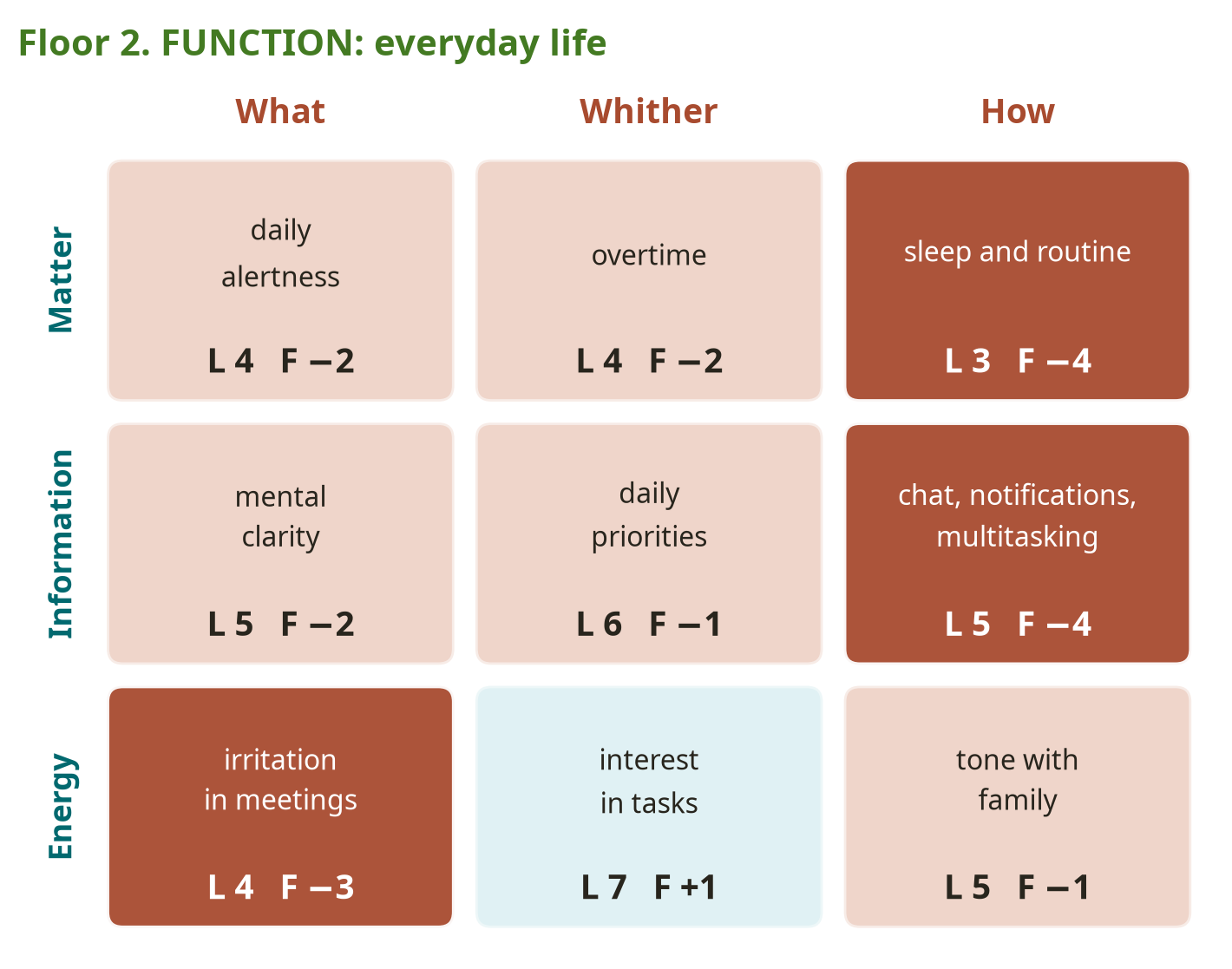
Fig. 11b. The "Function" floor: everyday life, which is exactly where the leaks are concentrated
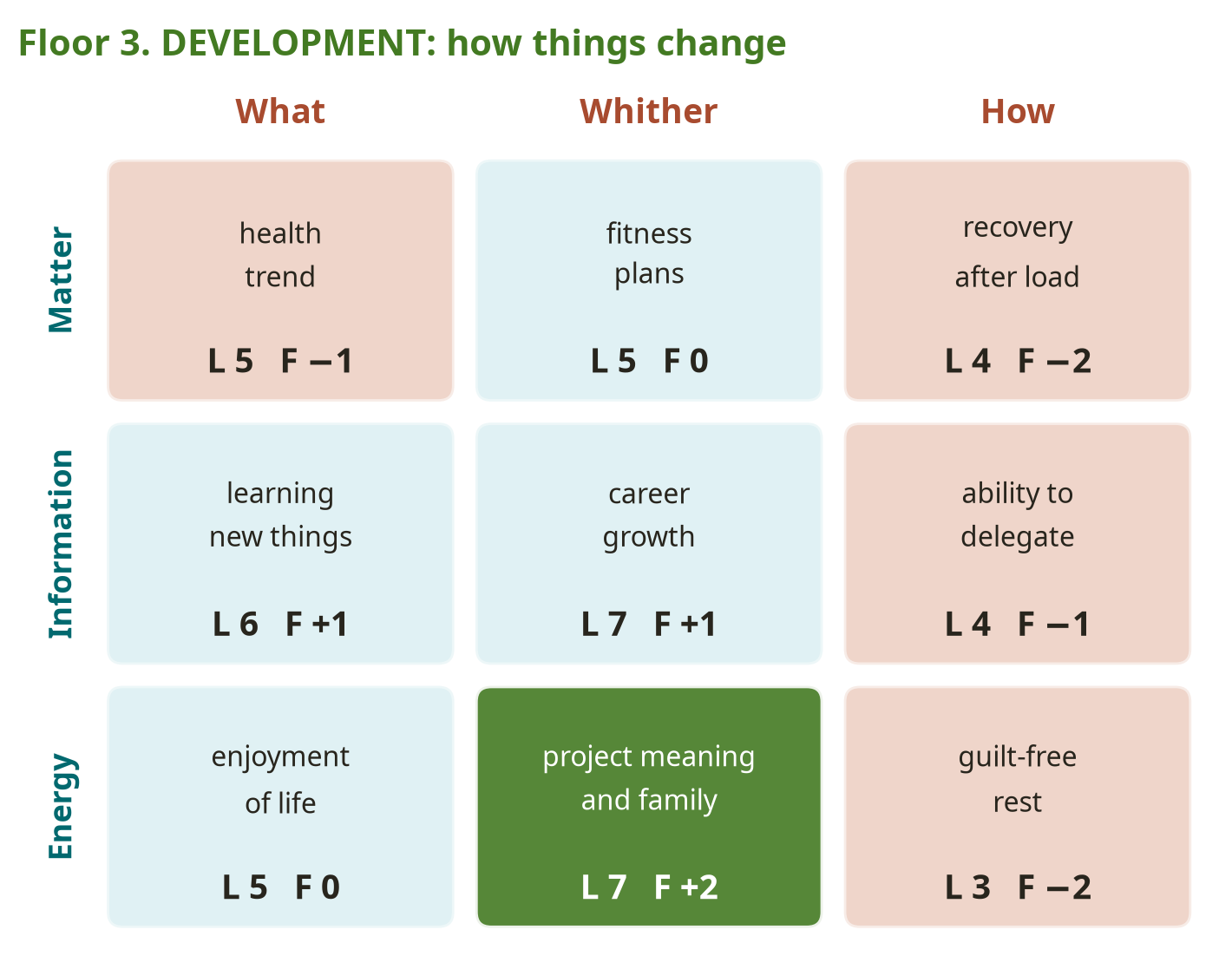
Fig. 11c. The "Development" floor: how charge changes and where it leads
How to read this picture. Each square is one cell of the hologram. It says what this cell means for Oleg and gives two ratings: L, how much energy is here, and F, whether this zone charges or drains him. Red means a leak (little energy, and it keeps going out), pink a mild drain, light blue neutral, green a source.
At first glance the main thing is clear: the middle floor, "Function," that is, everyday life, is almost entirely in red and pink. The top floor, "Development," and the bottom floor, "Structure," are noticeably calmer. This means Oleg's base is in order (knowledge, income, values) and he has prospects (growth, meaning), while energy is lost in his daily routine.
 |
BUILD YOUR OWN HOLOGRAM You can build the same kind of hologram for yourself with our web tool at alexz.us. The tool guides you through all 27 cells with prompts, calculates the priority indices for you, and shows the critical zones. |
|---|
Now let's choose where to start. For each cell with a negative flow, Oleg also rates the leverage potential PO: how much a change here will affect everything else. Then we calculate P using the priority index formula. Below are the five most telling cells: three critical ones, one strong source, and one "borderline" cell for comparison.
| Cell | L | F | P | Type | Strategy |
|---|---|---|---|---|---|
| Matter – How – Function: sleep and routine | 3 | −4 | 24 | Leak | Replenish |
| Information – How – Function: chat, notifications, multitasking | 5 | −4 | 21 | Melting reserve | Retain |
| Energy – What – Function: irritation in meetings | 4 | −3 | 20 | Leak | Retain, then direct |
| Energy – Whither – Development: the project's meaning, family | 7 | +2 | — | Source | Rely on it |
| Matter – How – Development: recovery after load | 4 | −2 | 17 | Leak (not critical) | Monitor |
|
HOW THE PRIORITIES WERE CALCULATED A reminder of the formula: P = (10 − L) + 2 × max(0, −F) + PO, where (10 − L) is the deficit, 2 × max(0, −F) is the drain strength, and PO is the leverage potential. • Sleep and routine: deficit 10 − 3 = 7; drain 2 × 4 = 8; PO = 9. P = 7 + 8 + 9 = 24. • Chat and notifications: deficit 10 − 5 = 5; drain 2 × 4 = 8; PO = 8. P = 5 + 8 + 8 = 21. • Irritation in meetings: deficit 10 − 4 = 6; drain 2 × 3 = 6; PO = 8. P = 6 + 6 + 8 = 20. • Recovery after load: deficit 10 − 4 = 6; drain 2 × 2 = 4; PO = 7. P = 6 + 4 + 7 = 17, below the threshold of 20, so not critical for now. • The project's meaning and family: the flow is positive (F = +2), so this is not a leak but a source. No priority is calculated. |
|---|
|
COMMENT Note the fourth row. Oleg has a strong source: meaning. It protects him from deep burnout: he has not lost his "Whither." His problem is not motivation but the body and the leaks. So interventions aimed at "finding meaning" would be a mistake here. He needs sleep and boundaries. The fifth row is interesting too. Oleg's recovery after load is also weak, but its priority index is 17, below the threshold. This doesn't mean the zone is unimportant. Most likely it will improve on its own once his sleep is sorted out. So it should be monitored rather than made a separate task. |
|---|
Step 4. The indices before the work begins
Now we have all the data we need to calculate the indices from the "Formulas" section. We won't repeat the calculations, since they were covered in detail above; instead, let's gather the results together and see what each one says about Oleg.
• HG ≈ 88, charge harmony. The profile is fairly even, but the weak link is Matter.
• HC ≈ 69, harmonious charge. The balance isn't bad, but the overall level is modest: Oleg is "evenly drained."
• HGs ≈ 48, strategy harmony. Oleg spends his effort mostly on "replenish" and hardly closes any leaks.
• Ψ∗ = −19, steady-state level. A negative number: there is no balance point, and charge is draining away. This is a loss spiral.
• IEI ≈ 70, exhaustion index. High risk: a large deficit meets noticeable vulnerability.
• SB = −2, social balance. Relationships drain him slightly; the main minus is the work chat.
|
WHAT THE INDICES SAY TOGETHER The most alarming measure is the negative steady-state level Ψ∗. It says that with the current balance, charge will fall no matter how many vacations he takes. The most revealing one is the low strategy harmony: Oleg is trying to recover, but in the wrong way. Together, the indices form a clear picture: motivation is fine, the body is shortchanged, and the leaks are open. Hence the plan. |
|---|
Step 5. A plan on three levels
For each critical cell, and for his main source, Oleg sketches changes on three levels. A micro-action is something he can do today, in a few minutes. A mindset shift is a new thought that will support that action. A long-term vision is what it should turn into over a few months.
This three-level scheme matters. An action alone, without a change in thinking, is quickly abandoned. A thought alone, without action, remains a good intention. And without a long-term vision, it is unclear where all this is going.
| Cell | Micro-action (today) | Mindset shift | Long-term vision |
|---|---|---|---|
| Sleep and routine | A "bedtime" alarm at 11:00 p.m., phone charges in the kitchen | "Sleep is not lost time; it is charging" | 7 hours of sleep as a non-negotiable norm |
| Chat and notifications | Turn off notifications, check the chat 5 times a day on a schedule | "Not everything urgent is important" | An agreement with the team on channels and response times |
| Irritation in meetings | Before a meeting, 2 minutes of slow breathing; during it, silently name the feeling | "Irritation is a signal of fatigue, not the truth about people" | Cut the number of meetings by a third |
| The project's meaning and family | Write down why he is doing this project | "My charge is for the product and my family, not for the chat" | A weekly screen-free evening with the family |
|
COMMENT Look at how the plan maps onto the triad of strategies. The first row is "replenish" (Matter). The second and third are "retain" (Information and Energy). The fourth is "direct." This is exactly the 40 / 40 / 20 distribution that strategy harmony suggested. Oleg did not add a single "vacation" or a single extra cup of coffee to the plan. |
|---|
Step 6. One month later
A month later, Oleg fills out the Ψpheno questionnaire and the hologram again. His new block scores: V = 6, RS = 6, AP = 7, ES = 7, SP = 8.5, SO = 6.5. The sum is 41, the average score is 6.83, so L ≈ 68. Tension has dropped to T = 3, so Q = 0.7. Sense of purpose is 8.5, so A = 0.85.
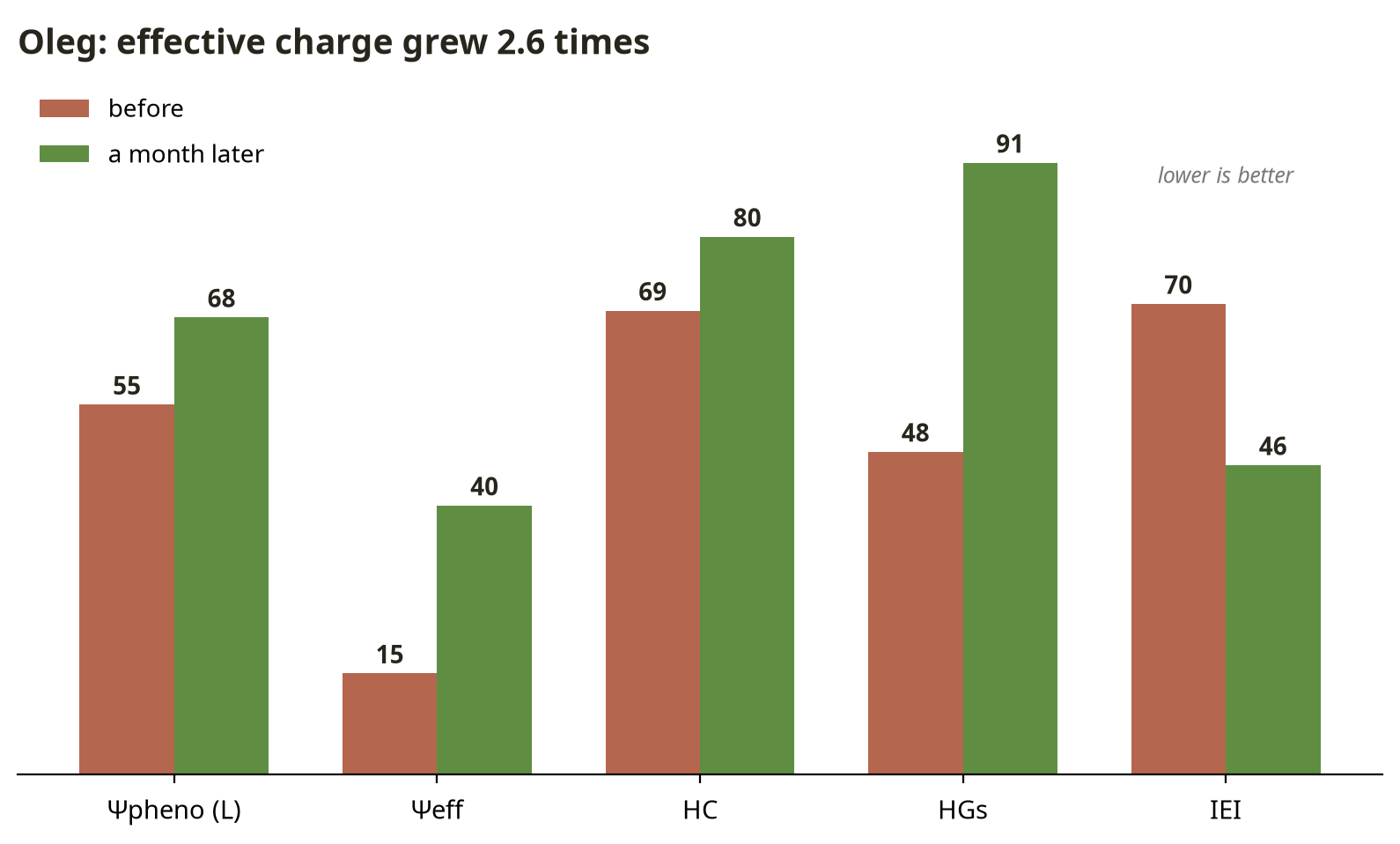
Fig. 12. Before → after: Oleg's indices over one month
The chart shows the five main indices before and after. Red bars are "before," green bars are "a month later." For the first four indices, the higher the bar, the better. For the exhaustion index IEI it is the opposite: the lower, the better.
The most noticeable changes are in strategy harmony (from 48 to 91) and effective charge (from 15 to 40, i.e. from 18% to 48% of a full charge). The level L, by contrast, rose more modestly, from 55 to 68. This confirms the main idea once again: the gain came not from "more energy" but from fewer losses and a more precise direction.
What changed in Oleg's life? He still runs the same project, with the same deadline and the same people. His objective workload has barely changed. What changed is the balance: inflow In rose from 22 to 30, and outflow Out fell from 19.5 to 17.5. The steady-state level of charge changed sign: from a loss spiral (Ψ∗ = −19), the system moved to Ψ∗ ≈ 80.
He no longer sits in his car outside the office. Sometimes he gets tired, but it is a calm tiredness, not a tense one. In the evenings he talks with his son more often. And in meetings he notices irritation before it has a chance to creep into his voice.
|
TRIADIC INSIGHT Charge doesn't come back from one big rest. It comes back from small daily changes in three directions at once: replenish the body, retain attention, and direct energy toward what you value. A vacation is charging from the outlet. Changing the balance is repairing the battery. |
|---|
Links to the other articles in the series
 |
ONE MODEL, THREE TOPICS • The metasin of the 21st century, the loss of sovereignty of consciousness, largely describes a system of charge leaks. Attention manipulation, the dopamine economy, information obesity: these are above all channels of depletion in the Information domain. • Uncertainty works as a constant background leak: an unclear "Whither" dampens Energy, and the attempt to "think everything through" overloads Information. • Psychological charge is what makes both previous works possible. You cannot preserve the sovereignty of your consciousness or withstand uncertainty with a drained battery. Together, the three articles describe one system: charge is the fuel, uncertainty is the environment, digital sins are the leaks. |
|---|
Limitations of the method
The ratings are subjective. L, Q, A, F, and PO are structured judgments, not measurements. Their value lies in making intuition visible and comparable over time.
The formulas are models, not laws. The dynamics equation simplifies reality: in life, inflow and outflow change every day. Its task is to show the direction of movement and the logic of the loss spiral, not to predict exact numbers.
The thresholds are provisional. Zone boundaries are guideposts for initial work. They still need to be refined with data.
Physiological markers require care. Wearable devices provide useful trends, not diagnoses. Laboratory values are interpreted by a doctor.
The method does not replace professional help. Pronounced exhaustion may be a sign of depression, an anxiety disorder, thyroid disorders, anemia, and other conditions. The hologram is a good reason to talk with a doctor or psychotherapist, not a substitute for one.
A minute's pause
Answer three questions for yourself.
1. Which of the four states are you in right now: flow, overheating, recovery, or exhaustion?
2. Which single leak takes the most energy from you every day, and can you close it at least halfway this week?
3. What do you need your charge for? If you had twice as much energy, where would you direct it?
Write down your answers. The repair of your battery may begin with them.
What you can do next
• The web tool at [alexz.us](https://alexz.us): an interactive version of the Ψpheno questionnaire, the hologram, the dynamics simulator, and the library of interventions. Developing it is the next step of this work.
• A pilot validation of the indices: comparing Ψpheno with the Subjective Vitality Scale and burnout questionnaires.
• Clinical cases: descriptions of real work with clients' charge and depletion.
• A team hologram: the average charge profile of a group and a map of shared leaks.
• Integration with wearable devices: sleep and heart rate variability as an objective layer alongside self-report.
Energy cannot be created out of nothing. But you can stop losing it, and learn to direct it to where it turns into life.
Further reading
1. Zolotov, A. Triadic Intelligence: Designing Reality With the Lens Triad. — Amazon
2. Ryan, R. M., & Frederick, C. (1997). On energy, personality, and health: Subjective vitality as a dynamic reflection of well-being. Journal of Personality. — M3EWB
3. Ryan, R. M., & Deci, E. L. (2008). From ego depletion to vitality: Theory and findings concerning the facilitation of energy available to the self. — SDT
4. Thayer, R. E. The Origin of Everyday Moods: Managing Energy, Tension, and Stress. Oxford University Press. — Oxford Academic
5. Russell, J. A. (1980). A circumplex model of affect. Journal of Personality and Social Psychology. — PDF
6. Hobfoll, S. E. Conservation of Resources theory; review: Sonnentag, S. (2024). Gain and loss cycles revisited. — SAGE
7. Demerouti, E., Bakker, A. B., et al. (2001). The job demands-resources model of burnout. Journal of Applied Psychology. — PubMed
8. Schaufeli, W. B., & Bakker, A. B. Defining and measuring work engagement. — PDF
9. Quinn, R. W., Spreitzer, G. M., & Lam, C. F. (2012). Building a sustainable model of human energy in organizations. Academy of Management Annals. — PDF
10. Schwartz, T., & McCarthy, C. (2007). Manage your energy, not your time. Harvard Business Review. — HBR
11. Collins, R. (2004). Interaction Ritual Chains. Princeton University Press. — Princeton
12. Fredrickson, B. L. The broaden-and-build theory of positive emotions. — PMC
13. Sonnentag, S., & Fritz, C. (2015). Recovery from job stress: The stressor-detachment model. Journal of Organizational Behavior. — Wiley
14. McEwen, B. S. (1998). Protective and damaging effects of stress mediators. New England Journal of Medicine. — PDF
15. Picard, M., et al. (2018). A mitochondrial health index sensitive to mood and caregiving stress. Biological Psychiatry. — PMC
16. Higgins, E. T. (1997). Beyond pleasure and pain: Regulatory focus. American Psychologist. — PDF
17. Csikszentmihalyi, M. Flow: The Psychology of Optimal Experience. — Amazon
18. Hagger, M. S., et al. (2016). A multilab preregistered replication of the ego-depletion effect. Perspectives on Psychological Science. — PubMed
19. Lehrer, P. M., & Gevirtz, R. (2014). Heart rate variability biofeedback: How and why does it work? Frontiers in Psychology. — Frontiers
20. Puetz, T. W., et al. (2006). Effects of chronic exercise on feelings of energy and fatigue. Psychological Bulletin. — PubMed
21. Lieberman, M. D., et al. (2007). Putting feelings into words: Affect labeling disrupts amygdala activity. Psychological Science. — PDF
22. Gollwitzer, P. M., & Sheeran, P. (2006). Implementation intentions and goal achievement: A meta-analysis. — Uni Konstanz
23. Cuijpers, P., et al. (2023). Individual behavioral activation in the treatment of depression: A meta-analysis. Psychotherapy Research. — Taylor & Francis
24. Jacka, F. N., et al. (2017). A randomised controlled trial of dietary improvement for adults with major depression (SMILES). BMC Medicine. — PubMed
25. World Health Organization (2019). Burn-out an "occupational phenomenon": International Classification of Diseases. — WHO
26. Gallup (2024). State of the Global Workplace. — Gallup
27. Mark, G. Attention Span: A Groundbreaking Way to Restore Balance, Happiness and Productivity. — Gloria Mark
Learn more about the approach in the book Dr. Alex Zolotov, Ph.D. «Triadic Intelligence: Designing Reality With the Lens Triad»