
Triadic Intelligence™ · Essay
Seeing the Invisible
From the Space of Feelings to the Soul Crystal: how an image can become a support for self-inquiry
By Dr. Alex Zolotov, Ph.D.
|
THIS ARTICLE IS BASED ON THE BOOK Dr. Alex Zolotov, Ph.D. Triadic Intelligence: Designing Reality With the Lens Triad A systems approach to thinking, transformation, and designing reality. Part of the Triadic Intelligence article series · ALEXZ.US. |

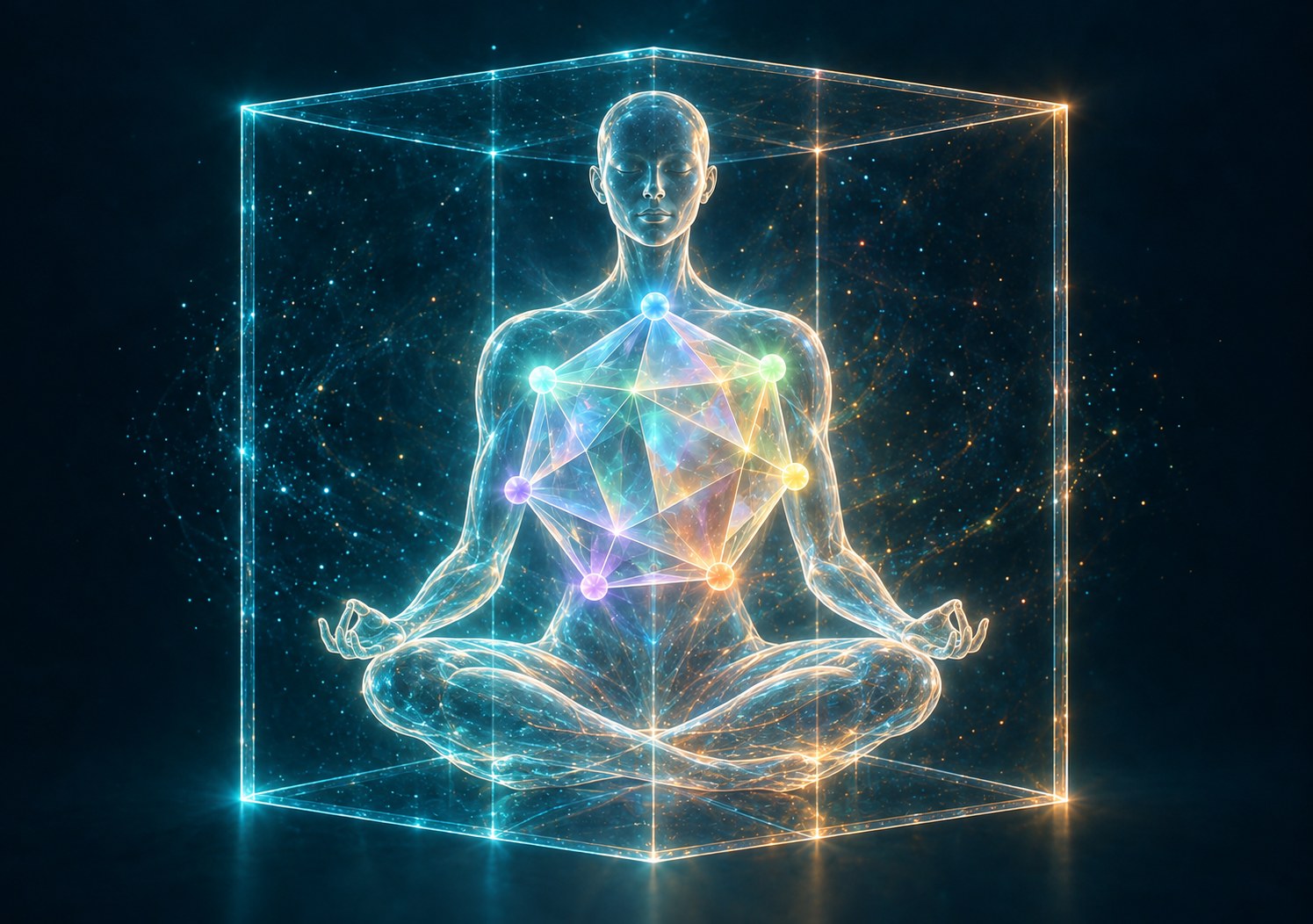
A person says, “I have lost myself.” But what exactly has become harder — getting through an ordinary day, feeling close to others, understanding what to act for? A single phrase can hold very different experiences. The Soul Crystal invites us to look at them within one shared spatial image and then return to the specific answers behind it. In this article we trace several paths of such imagery from the late nineteenth century to digital tools, and show how, within the Triadic Intelligence approach, an image can become a support for self-inquiry.
Behind the color and shape of the crystal stand a person’s own answers — and they can always be revisited.
|
HOW TO READ THIS ARTICLE The article moves from history to practice. You can read it straight through or go directly to the part you need. • History. How people tried to make the inner world visible — from Wundt and Leadbeater to digital art. • How the model works. Three lenses, nine components, and the rules for reading the crystal. • Practice. A hypothetical case, the “Before and Now” comparison, and the limits of interpretation. All profiles in this article are demonstration data. |

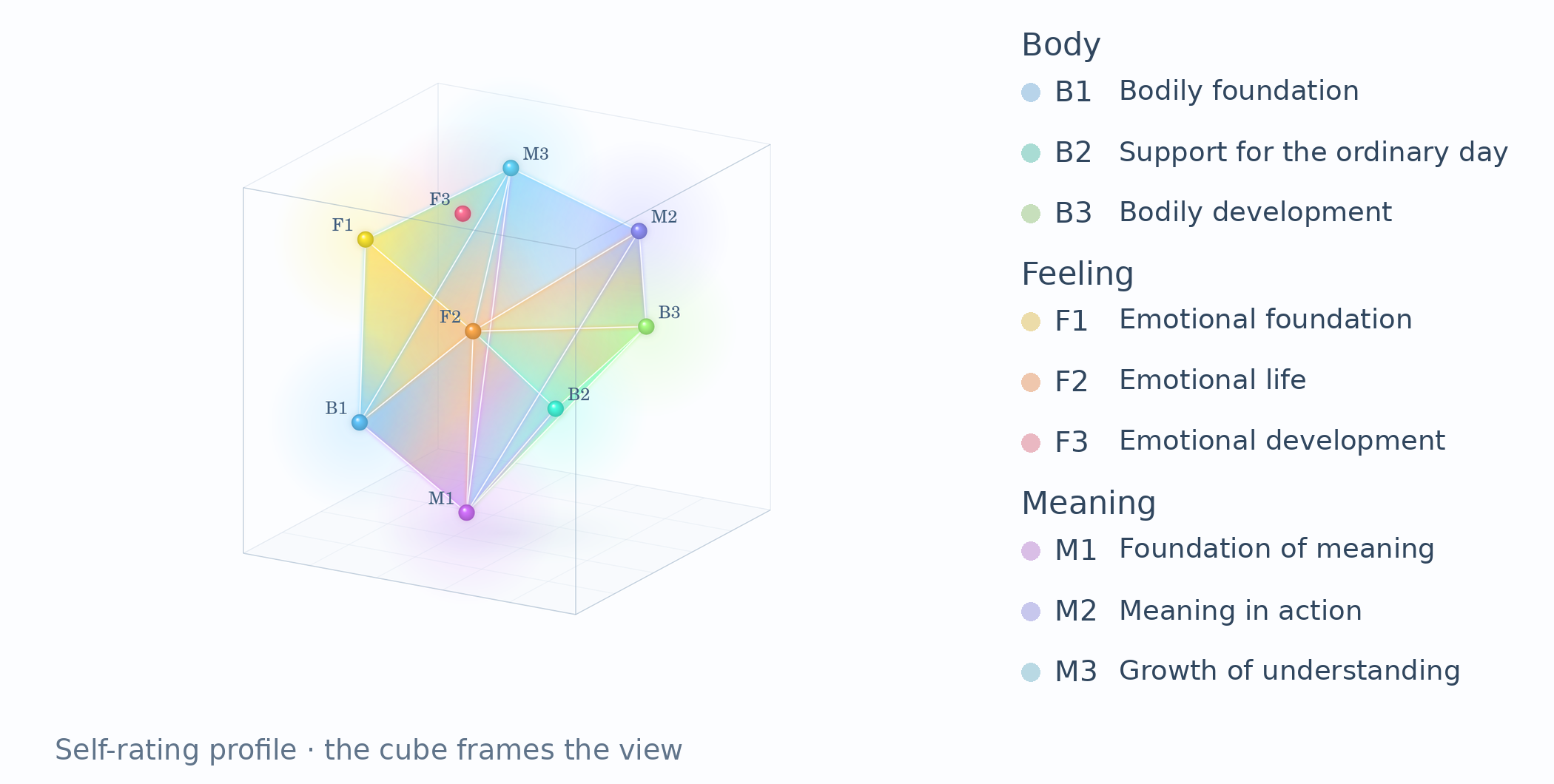
Fig. 1. Nine components of one demonstration profile. Each color is fixed to a component; the rating sets the position of the point along its constant direction. The cube serves as a viewing frame. Body, Feeling, and Meaning label groups in the legend, not coordinate axes.
Why Inner Life Needs an Image
We recognize ourselves through the stories we tell: “I’m coping,” “I don’t care about anything,” “I’ve finally found my calling.” Such stories preserve the meaning of experience, but sometimes they become too general. In them it is hard to tell apart fatigue and disappointment, loneliness and a need for quiet, a loss of values and a lack of strength to act in line with them.
An image offers a different point of entry. You can pause, look at the whole, choose one of its parts, and ask: what is happening here? The Soul Crystal is designed as an object of exactly this kind of attentive looking. Behind its color and shape stand the person’s own answers, which can always be revisited.
|
DEFINITION The Soul Crystal is an interactive spatial portrait of self-description. A person’s answers are combined into nine components; each component becomes a colored point of a three-dimensional figure, and any point can be opened to return to the original answers. |

|
WHY WE KEEP THE WORD “SOUL” It draws attention to the fact that experience belongs to a person: how I live through what happens, what moves me, what I stay faithful to, and what my response to life becomes. From this perspective, bodily state, feelings, and meaning meet in one lived whole. The name expresses the intent of the tool, while the nine components define the area of its use that is accessible to self-report. |

The body enters this area as the ground of experience. Fatigue and rest change how available our usual activities are; closeness and conflict color the day; the value of a chosen task affects how we perceive effort. Memory, character, faith, and moral choice are broader than this model. We offer a working perspective on inner life, leaving open the philosophical question of the nature of the soul.
Two Paths to a Visible Inner World
The wish to depict the inner person is older than psychological scales. In religious, philosophical, and artistic traditions it took many forms. For a contemporary tool it is especially useful to compare two lines from the late nineteenth and twentieth centuries: a space with defined dimensions and an image that expresses the character of an experience.
Wilhelm Wundt. The 1897 English edition of Wundt’s Outlines of Psychology distinguishes three directions of feeling: pleasure and displeasure, arousal and subduing, strain and relaxation. In the 1907 edition they are shown as a three-dimensional diagram [1]. Its strength lies in a clear question for each direction. This makes it possible to compare qualities of feeling, even though the whole inner life of a person does not fit into this space.
Charles Webster Leadbeater used a different language. In Man Visible and Invisible, first published in 1902, colored envelopes around the human figure express the supposed qualities of “subtle bodies” [2]. Color unites particular traits into a whole appearance. The author, however, attributes the source of these images to clairvoyance; the book offers no independent way to obtain or verify an individual form.
Thought-Forms. In the book by Annie Besant and Leadbeater, feelings and intentions acquire their own geometry: clouds, rays, directed formations. The first edition is dated 1905; John Crow examines the widespread date of 1901 as a bibliographic error [3, 4]. The artistic discovery here lies in the expressiveness of differences: experiences can be presented so that they have a visible character. The limitation is that the reader depends on the authors’ interpretation of these images.
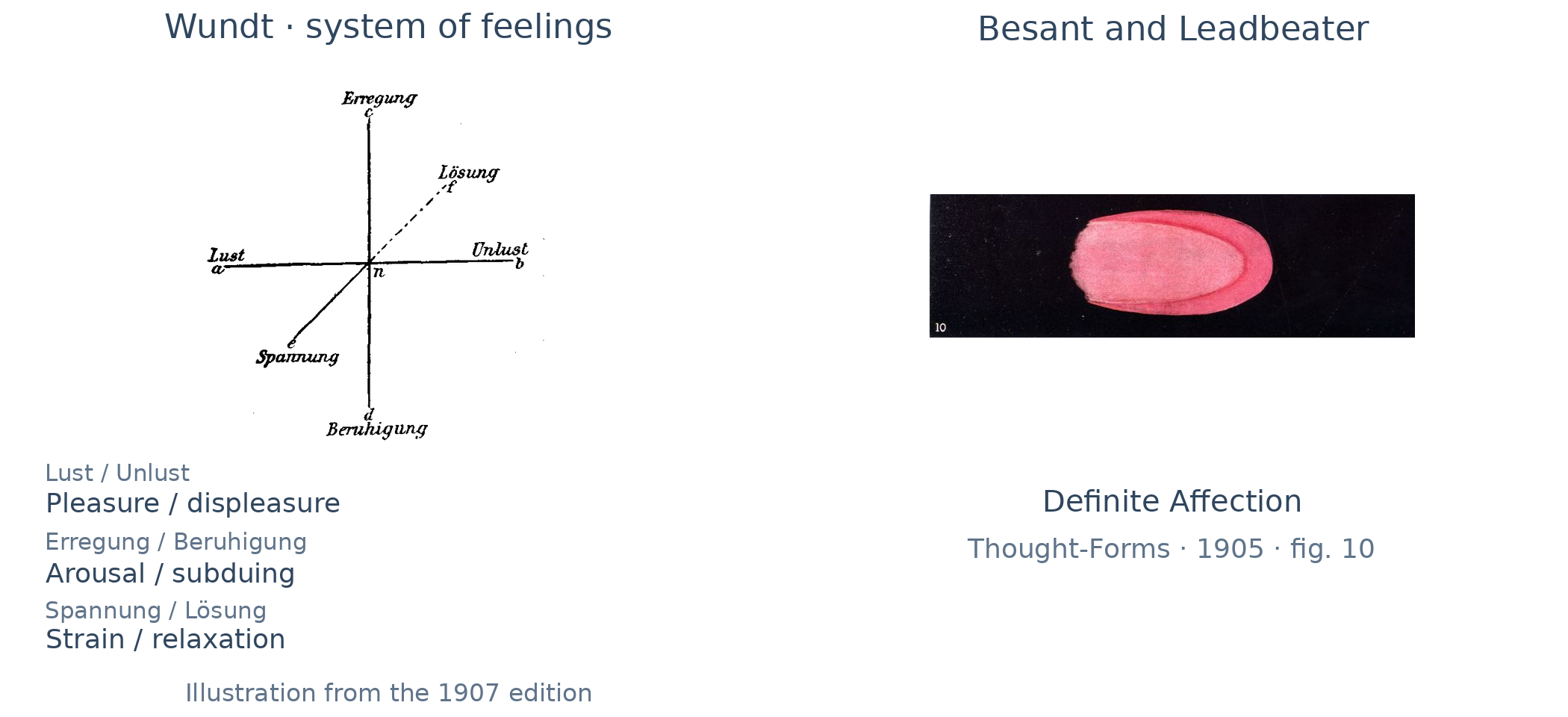
Fig. 2. Left — Wundt’s system of feelings from the 1907 edition, with the directions translated. Right — “Definite Affection,” fig. 10 from Thought-Forms, 1905. An analytical diagram and a symbolic image answer different questions. Sources [1, 3].
|
KEY IDEA OF THIS SECTION These lines developed in parallel. For us, their meeting sets a productive task: to preserve the expressiveness of the whole while keeping the path from the original data to the image open and traceable. |

What the Geometry of Experience Explains
Schlosberg and PAD. In 1954 Harold Schlosberg discussed three dimensions of emotion related to pleasantness, attention or rejection, and activation [5]. In 1974 Albert Mehrabian and James Russell developed the PAD approach: Pleasure, Arousal, Dominance — pleasantness, activation, and a sense of control [6, 7]. Its strength is a compact description of a state. But identical coordinates do not yet tell us what event a person is living through or why it matters to them.
Plutchik’s cone. Robert Plutchik’s three-dimensional model organizes the relationships between emotions. Directions distinguish families, the circular arrangement shows similarity and opposition, and the vertical dimension shows intensity. In a 2001 article the author presents the cone and its unfolded version [8]. For example, serenity, joy, and ecstasy convey the rising intensity of one family. The model makes such relationships easy to survey while remaining a general theoretical scheme.
Lövheim’s cube. In Hugo Lövheim’s 2012 model, the axes correspond to serotonin, dopamine, and noradrenaline, and the corners to eight basic emotions. This is a hypothesis about the link between emotions and neurotransmitters; the author notes the need for further empirical research [9]. It is vivid, but it cannot be read as a way of measuring neurotransmitter levels from a person’s answers.
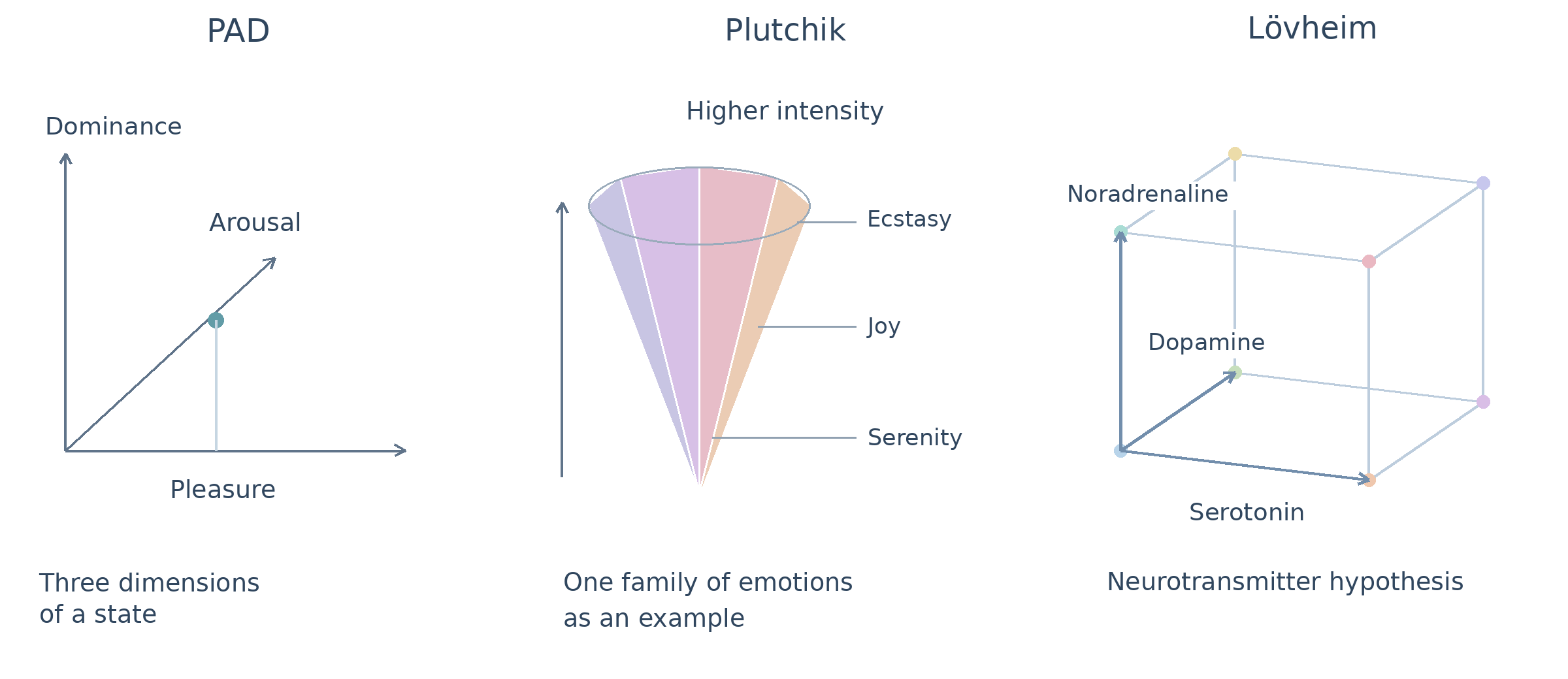
Fig. 3. Three tasks of spatial representation. The center shows Plutchik’s example of rising intensity; the more intense variants sit near the wide upper rim. The diagrams are explanatory and the colors are arbitrary. Sources [6–9].
|
KEY IDEA OF THIS SECTION Each geometry has its own task. In PAD we read the coordinates of a state; in Plutchik we look at relationships between families of emotions; in Lövheim we discuss a neurobiological hypothesis. Before creating a new three-dimensional image, it is worth deciding what meaning its points, directions, and surface will actually carry. |
From Image to Interaction
Eunoia II. Digital art added feedback. In Lisa Park’s 2014 work, signals from a commercial EEG headset are converted into sound that sets water in motion [10]. An inner state becomes the occasion for an observable response from the environment. Its expressiveness also depends on the conversion itself: the artist chooses how the signal will take visible form.
Bio-Well. The experience of this product is instructive as well. Its 2015 manual described a three-dimensional image of a supposed energy field. In a 2018 update notice, the developers announced the removal of the 3D view, stating that it had no informational purpose [11]. This episode is a reminder: volume is justified by the work it does for the viewer. Nothing about the reliability of the product’s other functions follows from this decision.
SoulToroid. According to its developer documentation, this contemporary project converts eight parameters of a natal profile into a personal torus-like form [12]. What is interesting here is the individualization of the image itself; its astrological basis differs from self-report, and the project description is not an independent test of its effectiveness.
Timeline: how the inner world became visible
Year |
Work |
Form of the image |
What the Soul Crystal takes from it |
1897 / 1907 |
Wundt, Outlines of Psychology [1] |
Three directions of feeling on a 3D diagram |
A clear question for each direction |
1902 |
Leadbeater, Man Visible and Invisible [2] |
Colored envelopes around the figure |
Color that unites traits into a whole |
1905 |
Besant and Leadbeater, Thought-Forms [3] |
A geometry of feelings and intentions |
Expressiveness of differences |
1954 / 1974 |
Schlosberg; Mehrabian and Russell, PAD [5–7] |
Three dimensions of emotion |
A compact description of a state |
2001 |
Plutchik [8] |
A cone and its unfolded version |
Relationships between parts made easy to survey |
2012 |
Lövheim [9] |
A neurotransmitter cube |
Vividness — with caution toward the hypothesis |
2014 |
Lisa Park, Eunoia II [10] |
EEG → sound → moving water |
Feedback and response |
2015 / 2018 |
Bio-Well [11] |
A 3D view, later removed |
Volume must do work for the viewer |
Today |
SoulToroid [12] |
A personal torus-like form |
Individualization of the image |
|
WHAT THIS GIVES THE MODEL Visualizing the inner world, then, has many predecessors. We see our contribution in combining a triadic organization of self-description with an explorable three-dimensional image: a selected point opens a component, the component opens the original answers, and a repeat observation shows the specific difference between dates. |

Three Lenses and Nine Components
Triadic Intelligence examines a complex phenomenon through complementary lenses [16, 17]. In the Soul Crystal, the first applied lens distinguishes Body, Feeling, and Meaning: bodily support, emotional life, and the experience of meaning. This is an adaptation of the approach to self-inquiry. The physical categories of matter, energy, and information are not transferred to the person as literal equivalences.
The second lens distinguishes structure, functioning, and development. Structure turns attention to foundations: what do I rely on? Functioning — to everyday life: how does this show up in my day? Development — to perceived change: what has begun to take shape differently? Nine components arise at their intersection.
Matrix of the nine components
Domain |
Structure |
Functioning |
Development |
Body |
B1 Bodily Foundation |
B2 Bodily Support for Everyday Life |
B3 Bodily Development |
Feeling |
F1 Emotional Foundation |
F2 Everyday Emotional Life |
F3 Emotional Development |
Meaning |
M1 Foundation of Meaning |
M2 Meaning in Action |
M3 Growth of Understanding |
Each name brings together several sides of experience. For example, everyday emotional life, F2, includes the liveliness of feelings, a caring orientation toward others, and the ability to notice an experience before acting on impulse. One person may rate these sides similarly, another very differently. That is why a component gives an overview, while the original answers preserve the differences within it.
The third lens — What, Where, How — poses clarifying questions to each component. In the tool it serves as a scheme for the content of questions: what resource or experience is present; where it is engaged in life; and how it is sustained and put into practice. This is an applied interpretation of the lens, and it should be judged by how well it fits the specific wording of the questions.
|
EXAMPLE: COMPONENT B2 — BODILY SUPPORT FOR EVERYDAY LIFE • What addresses available energy: do I have enough strength for the day? • Where addresses how the body is engaged in tasks and workloads: how do I use this resource — am I living in constant overstrain? • How addresses the way the resource is maintained: do my habits of sleep, eating, and rest help me recover? In this way the abstract names of the lens acquire understandable content. |

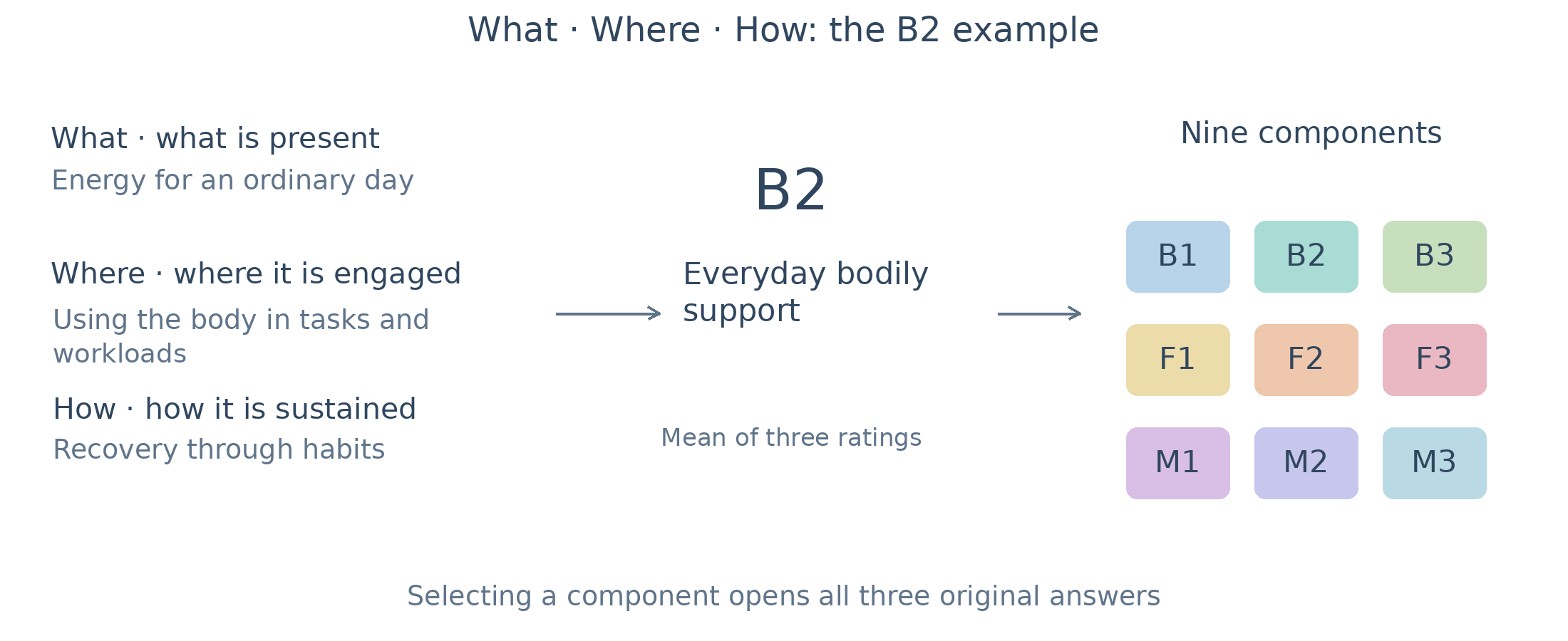
Fig. 4. An applied reading of the lens using B2. Left — the meaning of the three original questions; center — the component; right — its place in the matrix of nine components. The wording in the diagram is shortened for explanation.
|
THE MODEL IN NUMBERS • 27 original ratings — three for each of the nine components. • A 0–10 scale; the mean of three ratings is used for the overview, with equal weights. • Two observation periods: structure and functioning — the past two weeks; development — the past three months. |

In the current version there are 27 original ratings: three per component. Their mean on a scale from zero to ten is used for the overview. Equal weights are adopted as a simple rule; justifying the composition and homogeneity of the components remains a separate research task. If an answer is missing, the incompleteness must be shown explicitly. The nine points do not replace the original answers or the summary indexes provided by the method.
A person rates structure and functioning for the past two weeks and development for the past three months. These are different observation periods. A development component conveys perceived change over its own period, not an established rate of personal growth.
|
CONNECTION TO OTHER ARTICLES IN THE SERIES The nine components continue the author’s work “The Soul in Three Dimensions” [17], which describes the composition of the model. The stacking lens triad method on which the crystal is built is also used in other articles in the series — for example, in “The Quiet Center,” devoted to psychological neutrality. |

How the Spatial Portrait Works
Each point has a constant direction from the center of the cube. The rating changes its position along that direction; the color preserves its link to the component. A transparent convex hull is built over the nine points. The same data under the same template always produce the same shape.
We use spatial encoding of the profile. The directions of the soul-crystal-radial-v1 template were chosen for placing and recognizing points. They were not derived from established psychological relationships. Therefore the component ratings and their changes carry meaning, while the distances between different components remain a feature of the display.
The cube provides a frame for rotation and comparison. It has no quantitative Body, Feeling, and Meaning axes: these names are moved to the selector of the three groups. When Body is selected, B1, B2, and B3 light up together with the plane connecting them. Feeling and Meaning let you examine the emotional and meaning groups in the same way. The plane holds the selected components together, while the cards outside show their content and values.
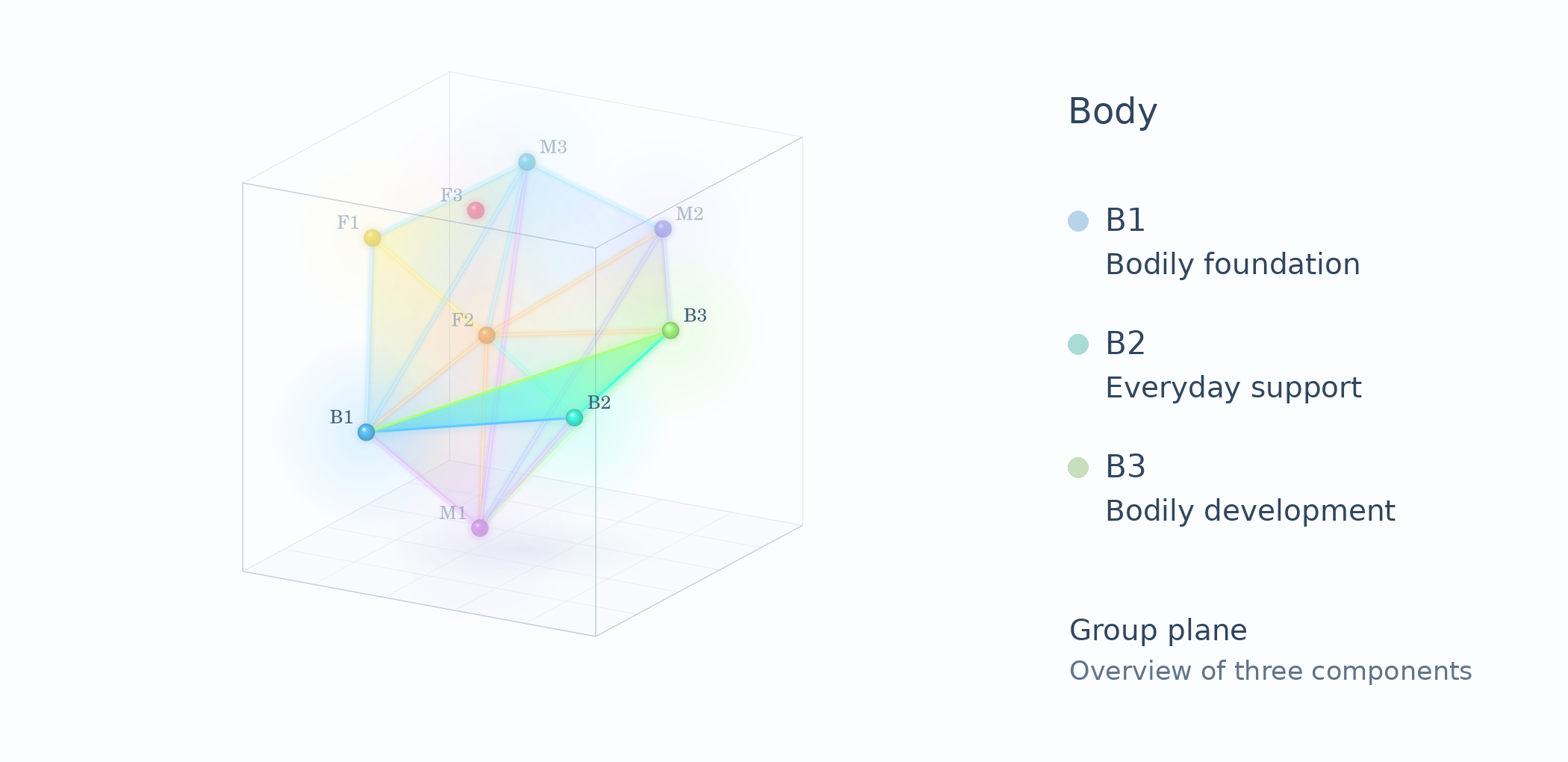
Fig. 5. The Body group. The plane connects bodily foundation, support for everyday life, and bodily development. Short codes link the points to the external legend; numerical ratings stay outside the crystal.
How to read the crystal
Element |
What we read |
Limit of interpretation |
Point and card |
Component rating and original answers |
Self-report for the stated period, with no judgment of a person’s worth |
Proximity and edges |
Placement in the adopted template |
Proximity does not establish a psychological link or causation |
Group plane |
Which three components are selected |
Area and tilt have no confirmed diagnostic meaning |
Hull and volume |
Overall appearance of the encoded profile |
Size and symmetry do not measure the health of the soul |
|
TECHNICAL NOTE A convex hull sometimes leaves a point inside the surface, so all nine components must remain accessible through a list and by selecting a point. Several faces may rearrange after a change in a single rating. When comparing profiles, we track the original points so as not to mistake this visual effect for several separate events. |

Why a Crystal
A table is convenient for precise reading. Nine bars make it easy to compare levels quickly. We add the crystal for a different way of engaging with the same data: the person receives a whole image that can be examined, rotated, and recognized on returning to the profile.
We assume that such an image can hold attention and support personal engagement in the inquiry. Rotation makes it possible to change the point of view; highlighting a group, to focus on one area; a saved profile, to return to an earlier self-description. These are hypotheses about the value of interaction that remain to be tested. They do not require attributing any additional diagnostic meaning to the surface.
The testable value of a profile begins with preserving differences. In one example all nine ratings equal six. In another they are 4, 3, 5; 6, 5, 7; 8, 7, 9. The mean is again six, although the bodily group averages four, the emotional group six, and the meaning group eight. The bars show the values precisely, while the crystal offers an overall picture of how they combine. The two representations complement each other.
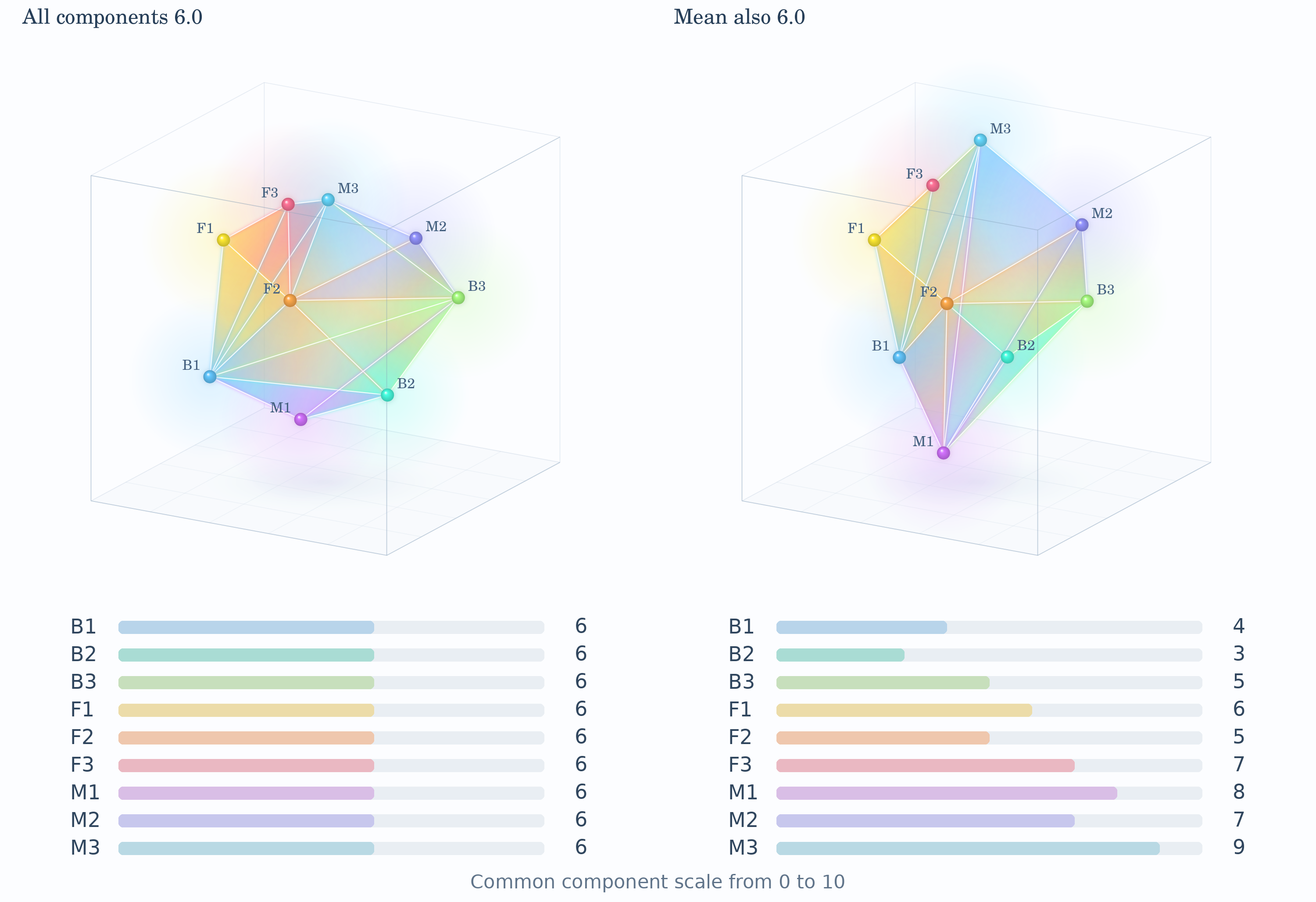
Fig. 6. The same mean of 6.0 with different profiles. A shared camera and scale keep the views comparable. The bars allow differences to be checked directly; the symmetry or asymmetry of the crystal is not in itself a measure of well-being.
The bars show the values precisely, while the crystal offers an overall picture of how they combine.
|
SCIENTIFIC NOTE Larkin and Simon’s work on diagrams shows how the placement of information can make search and inference easier. Kirsh and Maglio’s study reveals the role of actions on an external representation in a thinking task [13, 14]. These works give grounds for investigating our idea, but they do not confirm the advantage of a specific three-dimensional form. |

From a General Phrase to a Question of One’s Own
|
A HYPOTHETICAL CASE Let us take the second profile in the illustration as the basis for a hypothetical case. The person begins with the phrase “there is no meaning in my life anymore.” • Foundation of meaning M1 — 8 points • Meaning in action M2 — 7 points • Bodily support for everyday life B2 — 3 points |

Yet the foundation of meaning, M1, is rated eight, meaning in action, M2, seven, and bodily support for everyday life, B2, three. This difference invites a closer look: what in the experience is connected with values, what with putting them into practice, and what with the strength available?
The person opens the original B2 answers, notices low ratings for energy and recovery, and recalls weeks of finishing work late. Then they look at M2. Seven points seem fair to them overall, but one answer is a reminder that almost no time is left for important relationships. Behind the general rating, a specific situation emerged — one they wanted to give attention to.
“How can I keep, in an ordinary day, the strength and time for what I care about?”
This is how the question changes. A possible step is to choose one evening without late work and decide in advance what to devote it to. The person may accept this explanation, refine their answers, or choose a different step. This example shows a process of reflection, not a confirmed result of therapy.
|
KEY IDEA OF THIS SECTION The heuristic value of the model shows itself precisely in this transition. In the hypothetical case, the image became an occasion to take a closer look at oneself, and the original answers helped clarify the life situation. The decision remains with the person. |
What Shows Between Before and Now
A separate page is intended for repeat profiles. Both crystals sit at the same level and share a common scale and a synchronized viewing angle. Selecting a component highlights it in both images. An external card shows the previous rating, the new one, and the difference; the sign and label make it possible to read the direction of change independently of color.
In the demonstration exactly three components change: B2 from 4.2 to 7.0, F2 from 5.1 to 7.3, and M2 from 7.8 to 5.5. The other six ratings stay the same. The first two shifts point toward higher self-ratings, the third toward a lower one.
Three components that changed (demonstration data)
Component |
Before |
Now |
Difference |
B2 Bodily Support for Everyday Life |
4.2 |
7.0 |
+2.8 |
F2 Everyday Emotional Life |
5.1 |
7.3 |
+2.2 |
M2 Meaning in Action |
7.8 |
5.5 |
−2.3 |
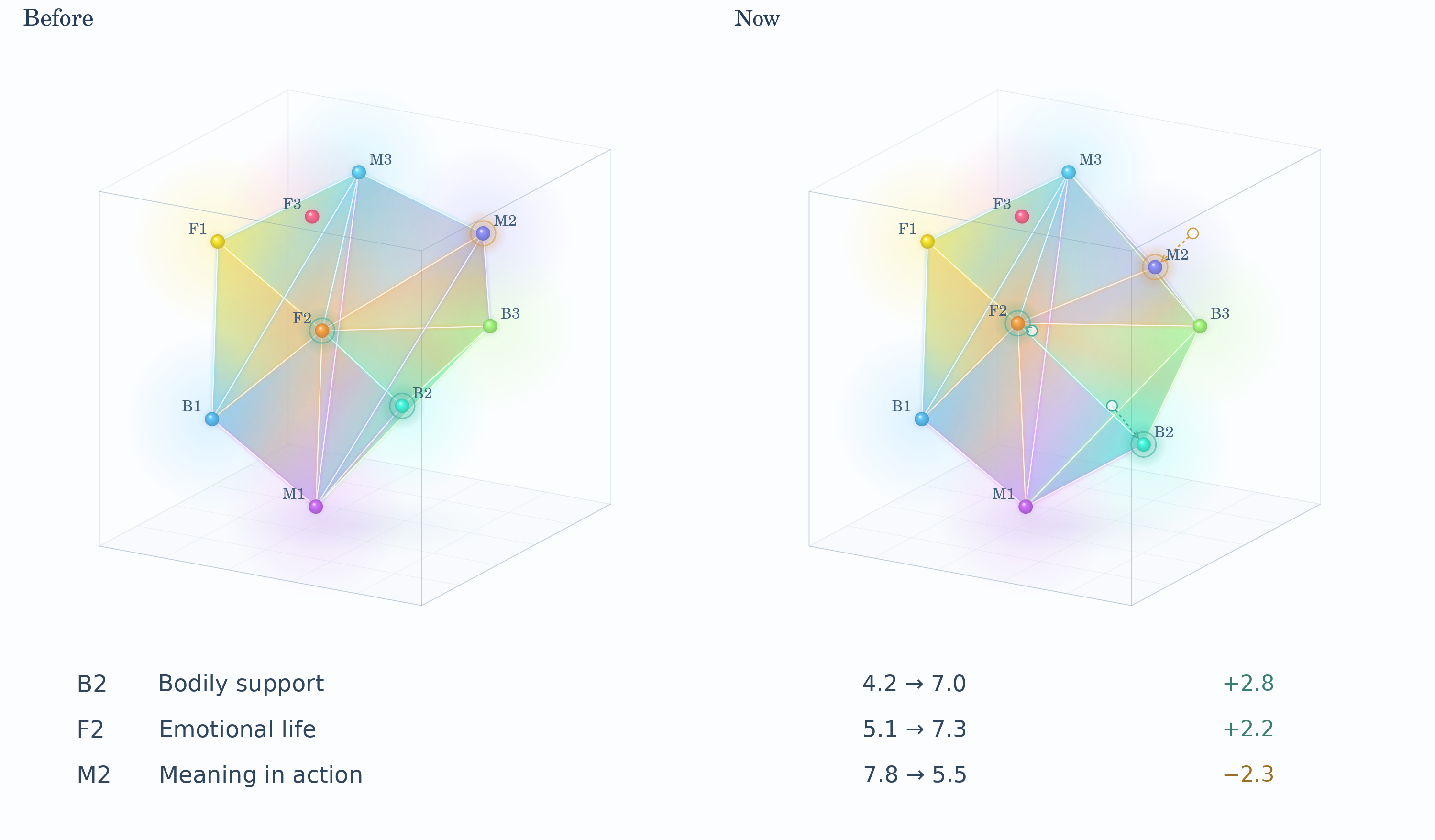
Fig. 7. Before and Now. B2, F2, and M2 are highlighted in both profiles. On the right crystal, dotted lines show the earlier positions of these points. Exact differences are shown below; all data are for demonstration.
|
HOW TO TALK ABOUT CHANGE: THREE STEPS • Fact. The explanation begins with what is actually known: “You rated bodily support for everyday life and emotional life higher, and meaning in action lower.” • Question. “What was happening with rest, relationships, and everyday decisions during these periods?” • A hypothesis for discussion. “Strength and emotional engagement may have increased, but actions may have matched your values less closely” — this is offered for discussion, not as an established cause. |
|
SCIENTIFIC NOTE: THE THRESHOLD OF CHANGE The demo highlights differences of at least two points. This is an interface rule that limits the number of highlights. The reliability of a change depends on measurement error, and its personal significance on the person’s experience; there is as yet no ready statistical or clinical threshold for this questionnaire. Jacobson and Truax discuss the distinction between reliable change and clinical significance [15]. |
Only compatible questions, scales, and calculation rules under the same display version can be compared. The dates and periods of the answers are kept alongside. Repeating the assessment after two weeks produces heavily overlapping three-month periods for development; such a difference does not prove growth within those particular two weeks. Two dates show a shift between self-descriptions. A stable trend requires a series of observations that accounts for context and measurement error.
How to Preserve Freedom of Self-Inquiry
A beautiful image has the power of invitation. We want a person to find it interesting to linger in front of their profile and examine it carefully. Light transparency, stable colors, and calm rotation were chosen for this purpose. Rotation can be stopped, all components are available through an ordinary list, and “Default view” resets the camera and clears selections, highlights, and helper arrows.
|
A LOW RATING IS NOT A VERDICT A low rating receives a neutral label as an area of attention, along with access to the original answers. Without normative studies it cannot be called “below normal.” It refers to a specific self-report for a specific period; human dignity is not measured on a scale. |

Nor should a large, even crystal become a mandatory ideal. Grief may be accompanied by a decline in positive feelings while the depth of relationships and meaning is preserved. A stricter rating sometimes arises together with a more attentive understanding of oneself. For us, the accuracy of the conversation matters more than movement toward an outwardly perfect figure.
|
PLAN FOR A FIRST TEST A first test of the tool can be carried out without making the model more complex. The same profiles are shown as a crystal, a table, and nine bars, varying the order of presentation. • Compared: reading accuracy, detection of differences, mistaken interpretations of geometry, and the ability to formulate a concrete question. • Assessed separately from understanding: interest, memorability, and the wish to return. • Requiring their own validation: the stability of repeated answers and the psychological basis of the components. |
|
TRY IT RIGHT NOW Choose one area of your day — for example, bodily support — and ask it the three questions of the lens: • What? Do I have enough strength for the day? • Where? How do I use this resource — am I living in constant overstrain? • How? Do my habits of sleep, eating, and rest help me recover? Then formulate one concrete question for yourself and one small step. The decision remains yours. |

The Soul Crystal offers a way to make self-inquiry visible and personal. Its wholeness invites a more attentive look at oneself; the ability to open every point preserves the connection with one’s own words. The value of this experience will be determined by whether it helps a person better understand what is happening and more freely choose their next step.

The value of the image lies in whether it helps a person understand what is happening — and choose their next step more freely.
|
LIMITATIONS • The crystal is a spatial encoding of self-report, not a diagnostic instrument. • The template directions were chosen for display; distances, area, volume, and symmetry have no confirmed psychological meaning. • The two-point threshold is an interface rule, not a statistical or clinical criterion. • The composition of the components, equal weights, and the stability of repeated answers require empirical testing. • All profiles and the hypothetical case in this article are demonstration data and do not refer to real participants. |
Sources
[1] Wundt, W. Outlines of Psychology. Translated by C. H. Judd. 1897, § 7. Primary source
Illustration: 1907 edition, Fig. 8, The Feelings represented by a Three-dimensional System. Open source
[2] Leadbeater, C. W. Man Visible and Invisible. 1902. Historical primary source; electronic reproduction. Open source
[3] Besant, A.; Leadbeater, C. W. Thought-Forms. 1905. Project Gutenberg; fig. 10, Definite Affection, reproduced. Primary source
[4] Crow, J. L. Thought Forms: A Bibliographic Error. Theosophical History. 2012. XVI, 3–4. A study of the dating of the first edition. Open source
[5] Schlosberg, H. Three Dimensions of Emotion. Psychological Review. 1954. 61(2): 81–88. DOI 10.1037/h0054570
[6] Mehrabian, A.; Russell, J. A. An Approach to Environmental Psychology. MIT Press, 1974. Open source
[7] Mehrabian, A. The PAD Comprehensive Emotion Tests. The author’s description of the scales. Open source
[8] Plutchik, R. The Nature of Emotions. American Scientist. 2001. 89(4): 344–350, Fig. 6. Open source
[9] Lövheim, H. A New Three-Dimensional Model for Emotions and Monoamine Neurotransmitters. Medical Hypotheses. 2012. 78(2): 341–348. DOI 10.1016/j.mehy.2011.11.016
[10] Park, L. Eunoia II. 2014. Description of the artwork on the artist’s website. Open source
[11] Bio-Well. Operational Manual. March 2015. Open source
Bio-Well Software Updates, version 5.8.0, 2018. Open source
[12] The Realm of Patterns. SoulToroid project documentation. Developer’s description, not an independent evaluation of effectiveness. Accessed October 15, 2026. Open source
[13] Larkin, J. H.; Simon, H. A. Why a Diagram Is (Sometimes) Worth Ten Thousand Words. Cognitive Science. 1987. 11(1): 65–100. DOI 10.1111/j.1551-6708.1987.tb00863.x
[14] Kirsh, D.; Maglio, P. On Distinguishing Epistemic from Pragmatic Action. Cognitive Science. 1994. 18(4): 513–549. DOI 10.1207/s15516709cog1804_1
[15] Jacobson, N. S.; Truax, P. Clinical Significance: A Statistical Approach to Defining Meaningful Change in Psychotherapy Research. Journal of Consulting and Clinical Psychology. 1991. 59(1): 12–19. DOI 10.1037/0022-006X.59.1.12
[16] Zolotov, A. Triadic Intelligence: Designing Reality with the Lens Triad. The author’s book; the methodological basis of the approach. Open source
[17] Zolotov, A. The Soul in Three Dimensions (Душа в трёх измерениях). Author’s manuscript, 2026; Soul Crystal, spatial encoding specification soul-crystal-radial-v1. Internal development materials: composition of components and the display rule. These materials do not present empirical validation.
Historical illustrations are reproduced from the primary sources listed. The other diagrams were prepared to explain the model. The cover and closing illustrations were created for this article with AI and are artistic in nature. Demonstration profiles do not refer to real participants.