
Triadic Intelligence™ · Essay
A Map for the Fog
Mastering life uncertainty through the Stacking Lens Triad Method: how to turn an anxious background hum into a space of choice
By Dr. Alex Zolotov, Ph.D.
Fog Map — try this essay as a tool5-minute Express check, or the full 27-cell map with your 14-day plan.Map the fog
 |
THIS ARTICLE IS BASED ON THE BOOK Dr. Alex Zolotov, Ph.D. Triadic Intelligence: Designing Reality With the Lens Triad A systems-based approach to thinking, transformation, and reality design. Available on Amazon. |
|---|
Marina woke up at 4:12 a.m.
No alarm. No reason.
She just opened her eyes and immediately remembered yesterday's email from HR: "Next quarter the company is moving to a new AI-based operating model. Details to follow."
Details to follow.
Three words. No one said she would be let go. No one said she wouldn't. And that was exactly what made it unbearable.
Before morning she had rewritten her résumé three times in her head, held an imaginary conversation with her boss, calculated how many months her savings would last, and read twelve articles about which professions will disappear first.
When the alarm finally rang, she felt as if she had already lived through that entire hard quarter.
Although in reality nothing had happened yet.
We do not fear the unknown. We fear the unmapped.
This article is about how to build that map. Not in order to eliminate uncertainty completely (that is impossible and, as we will see, not even necessary), but in order to stop mistaking fog for an abyss.
What uncertainty is
In everyday speech we call "uncertainty" anything that gives us the feeling of "who knows what will happen." But behind that word there are at least four different states. And confusing them means treating the wrong illness.
The four faces of uncertainty
Risk. We do not know the outcome, but we know the probabilities. A roll of the dice, an insured event, surgical success rates. As early as 1921, the economist Frank Knight distinguished "measurable risk" from "true uncertainty," which cannot be expressed as a percentage (MIT News).
Uncertainty in the narrow sense. We know neither the outcome nor the probabilities. How will my profession change in five years? What will happen to the relationship after the move?
Ambiguity. There is enough information, but it can be read in different ways. The boss says, "We need to talk." Is it about a promotion, or about a layoff? In 1961 Daniel Ellsberg showed that people systematically avoid situations with unknown probabilities, even when it costs them; this became known as ambiguity aversion (Ellsberg paradox).
Unknown unknowns. We do not even suspect that we don't know something. This is where "black swans" come from: rare, unpredictable events with enormous consequences, as described by Nassim Taleb (Investopedia).
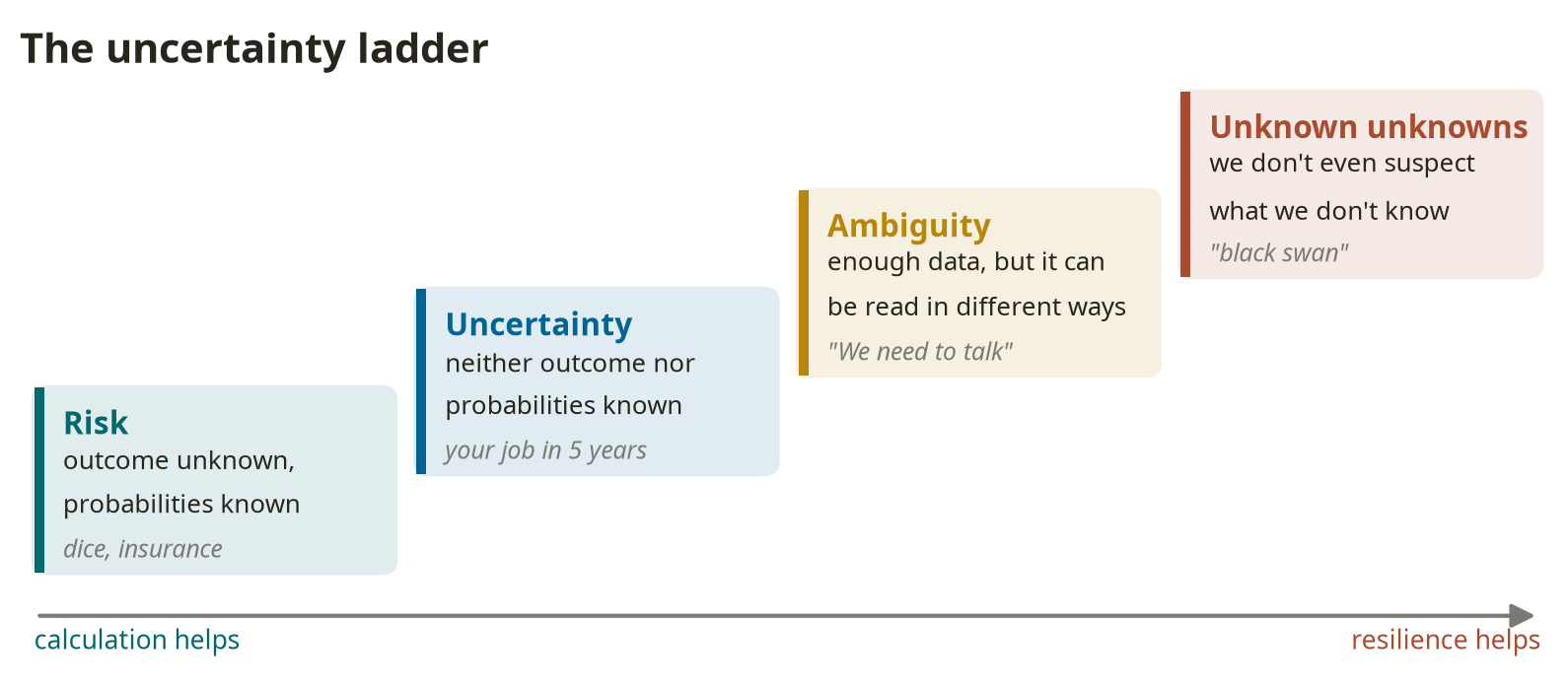
Fig. 1. The uncertainty ladder: the higher the step, the less calculation helps and the more resilience matters
There is one more distinction that will become central for us. Uncertainty can be reducible: it shrinks when we gather information, ask, or test. And it can be irreducible: no amount of reading will tell you what the weather will be like in a month or how the market will behave.
Most of the human suffering connected with uncertainty grows out of a single mistake: we try to think through what can only be insured against or endured.
Uncertainty in psychology: why "not knowing" hurts more than "knowing the worst"
In 2016, researchers at University College London ran an experiment in which participants played a computer game where snakes hid under some rocks, and a "bite" came with a mild electric shock. The greatest stress, measured by self-report, sweating, and pupil dilation, was felt not by those who knew for sure they would be shocked, but by those whose chance was about 50% (UCL; Nature Communications).
Put simply: uncertainty turned out to be harder to bear than inevitable pain.
Every psychotherapist has seen this in the consulting room dozens of times.
 |
EXAMPLES FROM PRACTICE • A woman waits nine days for biopsy results. When the diagnosis turns out to be serious, she says: "Strangely enough, I feel relieved. At least now I know what I'm fighting." • A man cannot "let go" for years after a divorce, not because he still loves her, but because he never understood why it ended. The unanswered question hurts more than the loss. • A teenager never sends a message to the girl he likes. He puts the chance of rejection at 50%. But what frightens him far more than rejection is waiting for the reply. • The parents of an adult son who has stopped staying in touch describe their nights as "worse than any bad news." |
|---|
Psychology has long described several mechanisms behind these stories.
Intolerance of uncertainty. This is a stable trait: a tendency to react negatively to unclear situations, to regard uncertainty as "bad," and to try to avoid it. Michel Dugas and colleagues showed that it lies at the heart of chronic worry and generalized anxiety disorder (The Cognitive Behaviour Therapist). Nicholas Carleton went further and proposed that fear of the unknown may be one of our fundamental fears, "one fear to rule them all" (PubMed).
Need for cognitive closure. Arie Kruglanski described it as the desire for a firm answer to a question, any firm answer, rather than remaining in ambiguity (Springer). Hence hasty decisions, conspiratorial explanations, and a readiness to believe the worst just to avoid living in "maybe."
Psychological entropy. Jacob Hirsh and colleagues proposed a model in which anxiety is the subjective experience of entropy, that is, of disorder in the perception–action system: the more equally likely options there are, the higher the tension (Psychological Review, ERIC).
Anticipatory anxiety. Daniel Grupe and Jack Nitschke described how uncertainty about a future threat deprives us of the ability to avoid it or soften its impact, and it is precisely this that produces anxiety (PubMed).
 |
A PSYCHOTHERAPIST'S COMMENT Notice that none of these mechanisms says uncertainty is "bad." They say it becomes hard when uncertainty meets low tolerance and a lack of resources. Those are three different levers. And that is the first hint toward the triadic approach. |
|---|
Why now
Humanity has always lived with uncertainty. Harvests, wars, epidemics. But three circumstances make the 21st century special.
Uncertainty has become an environment rather than an event. In 1986, right after Chernobyl, the sociologist Ulrich Beck described the "risk society," in which the main threats are produced by civilization itself (Risk society). Zygmunt Bauman called our era "liquid modernity," where the only certainty is change and anxiety and insecurity become a background condition (British Journal of Social Work).
The language of management has made it official. The acronym VUCA (volatility, uncertainty, complexity, ambiguity) was introduced by the U.S. Army War College in 1987 (VUCA). The futurist Jamais Cascio proposed a harsher frame, BANI: the world is brittle, anxious, nonlinear, and incomprehensible (Medium, Jamais Cascio).
Information has stopped reassuring us. Uncertainty used to be treated with knowledge: find out, calm down. Today there is so much information that it becomes a source of fog in itself. The twelve articles Marina read that night did not reduce her uncertainty. They multiplied it.
Add one more effect. Eldar Shafir and Sendhil Mullainathan showed that scarcity (of money, time, or connections) eats up "mental bandwidth," leaving fewer resources for planning and decisions (APA Monitor). Uncertainty works the same way: it takes up space in the mind before anything has happened.
Uncertainty in sociology, management, and family life
 |
UNCERTAINTY BEYOND THE THERAPIST'S OFFICE • Sociology. A young generation postpones marriage, children, and buying a home, not because they don't want them, but because "who knows what will happen." Uncertainty becomes a demographic factor. • Management. A company announces a "reorganization" with no details. Within two months the best employees leave, the ones with the most options. Those who remain are frozen in waiting. The lack of clarity turns out to be more costly than any tough decision. • Education. A graduate chooses a profession without knowing whether it will still exist in ten years. Parents advise something "safe," but nothing is safe anymore. • Family. A couple lives for years in "maybe we'll move" mode. Nothing gets planned: not a renovation, not a child, not a new job. Life is put on pause for a decision that never gets made. • Public health. During the pandemic people were worn down not only by the illness but by constantly changing rules: allowed today, forbidden tomorrow, "await further instructions" the day after. |
|---|
The same thing repeats in all of these examples: uncertainty paralyzes us not when there is a lot of it, but when we have nothing to hold it with.
The Triadic Intelligence approach
Triadic Intelligence starts from a simple idea: any complex phenomenon becomes understandable when it is viewed from several sides at once. Not from one "correct" side, but from three interconnected ones.
We use three lenses.
MIE: Matter, Information, Energy. What is the situation made of? Where does it live: in resources and the body, in knowledge and meaning, or in emotions and motivation?
WWH: What, Whither, How. What is happening now? Where am I heading? By what means am I getting there?
SFD: Structure, Function, Development. What holds everything up? How does it work right now? How is it changing and growing?
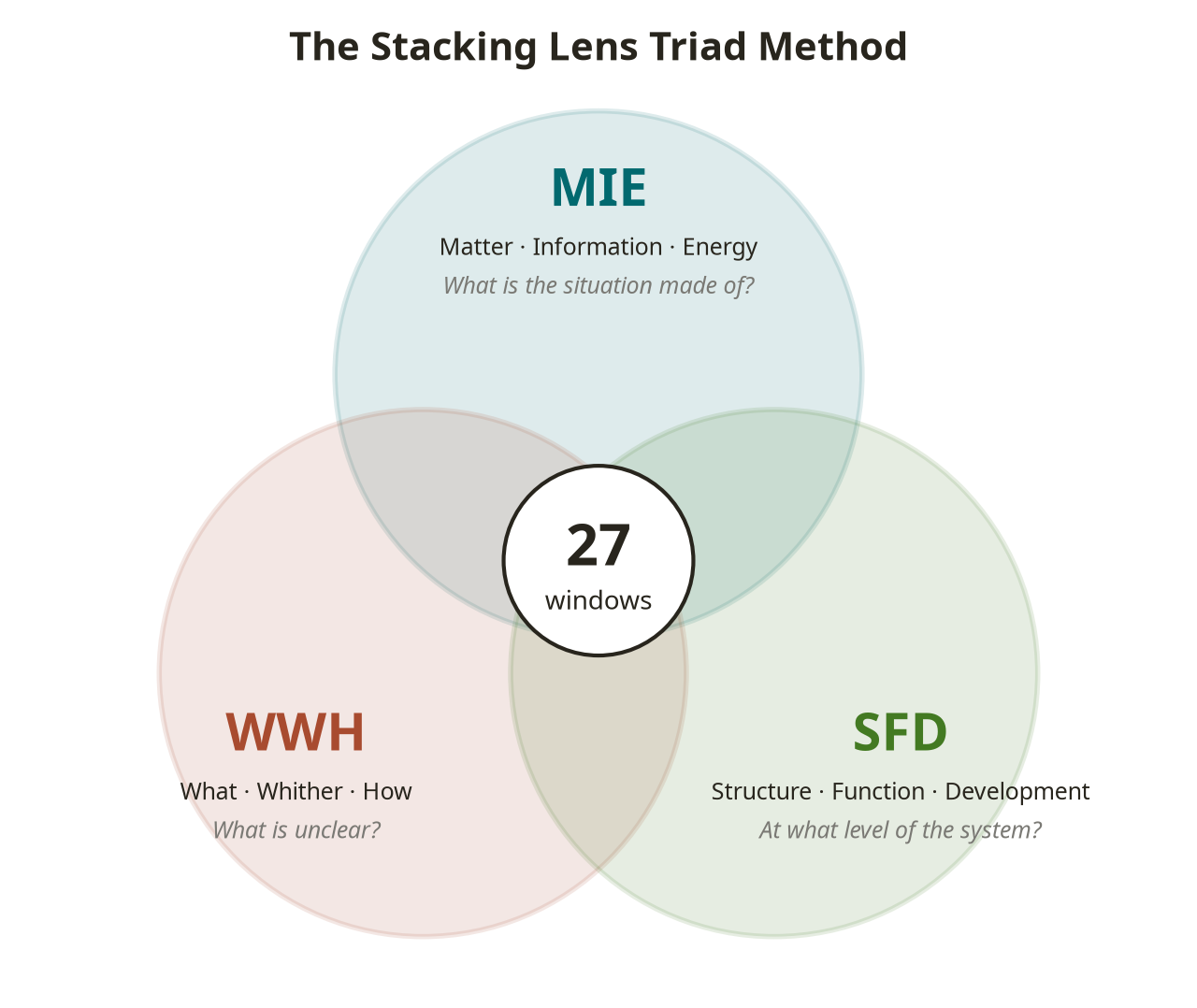
Fig. 2. The three lenses of Triadic Intelligence form a nine-dimensional cognitive space
Each lens on its own gives a useful but incomplete view. When the lenses are stacked on top of one another (hence the name of the method, the Stacking Lens Triad Method), we get a cube of 3 × 3 × 3 = 27 cells. Twenty-seven "windows" through which any life situation can be viewed.
For example:
• Matter – What – Structure: how stable is my basic financial and physical foundation?
• Information – How – Function: can I apply the knowledge and skills I need right now?
• Energy – Whither – Development: does my motivation keep its direction when circumstances change?
The key concept of the method is harmony. A system is stable when its components are in balance and none of them suppresses the others. When Information grows at the expense of Energy and Matter, a person "thinks instead of living." When Energy swallows everything, a person acts impulsively. When Matter becomes the only support, life turns into accumulation without meaning.
 |
TRIADIC INSIGHT Classical psychology asks: "Why are you anxious?" Classical management asks: "What is the probability of the risk?" Triadic Intelligence asks differently: "What is your uncertainty made of, where is it leading you, and how is it built?" As long as uncertainty is "fog," nothing can be done with it. Once it has coordinates, it can be worked with. |
|---|
Three lenses turned on uncertainty itself
The Stacking Lens method is usually applied to a situation. Here we take the next step: we look through the three lenses at uncertainty itself. And we discover that it, too, has a triadic anatomy.
MIE: three strategies (reduce, insure, endure)
This is the central idea of the article.
Each element of the MIE triad corresponds to its own way of dealing with uncertainty.
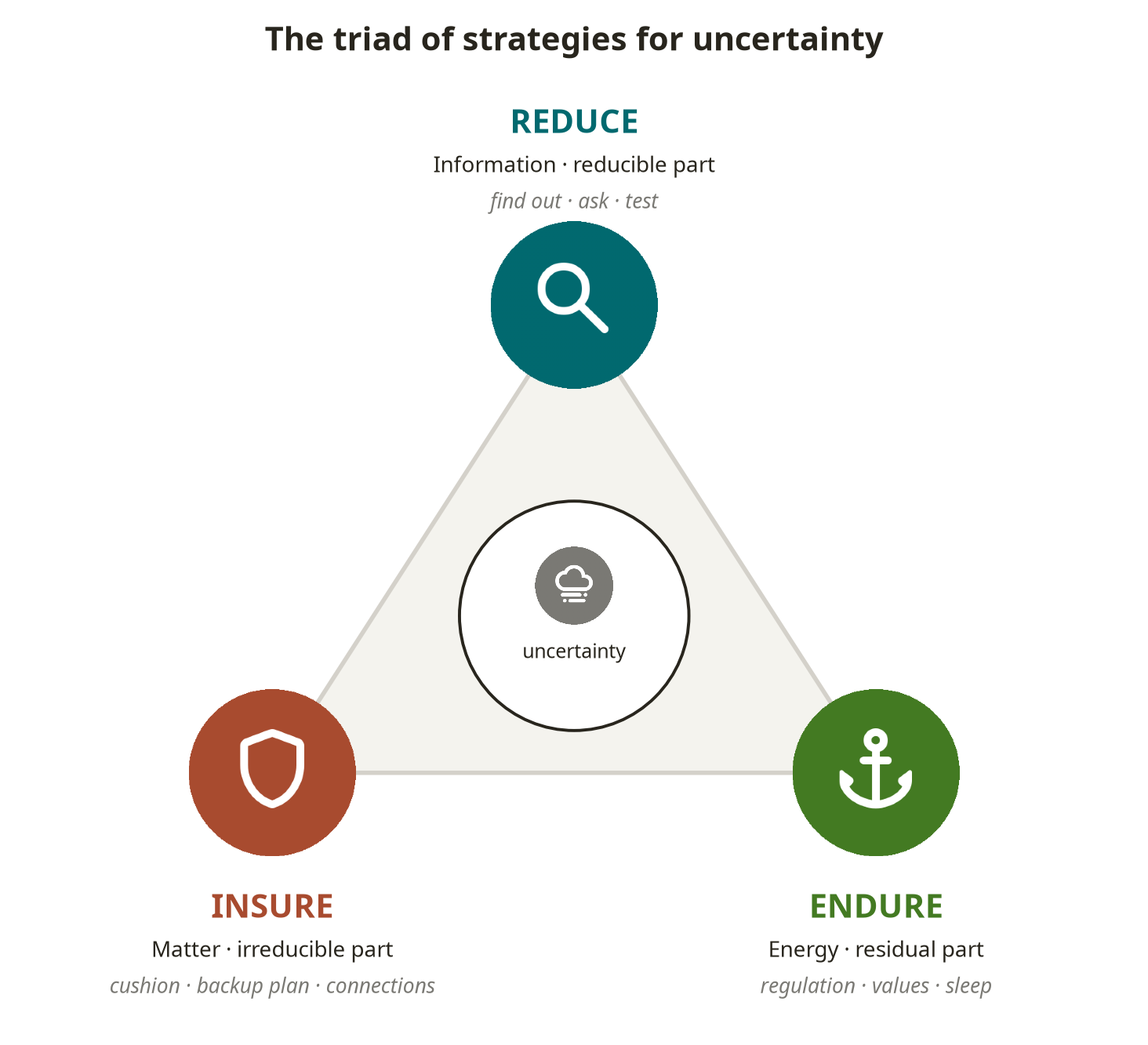
Fig. 3. The strategy triad: each element of MIE is responsible for its own way of working with uncertainty
 |
INFORMATION: REDUCE For reducible uncertainty. Find out, ask, check, try it on a small scale. Marina can talk to her manager, find three colleagues who went through a similar reorganization, take a short course on working with AI. Each of these actions literally shrinks the unknown. |
|---|
 |
MATTER: INSURE For irreducible uncertainty. If you cannot know the future, you can prepare for its different versions: a financial cushion, a backup plan, a second skill, supportive relationships. A sailor does not know whether there will be a storm. But he takes an anchor and a supply of water on board. |
|---|
 |
ENERGY: ENDURE For the residual uncertainty that always remains. This is the ability to stay in "I don't know" without panic: regulating anxiety, leaning on values, bodily steadiness, sleep, face-to-face contact. Not dispelling the fog, but learning to walk through it calmly. |
|---|
Most people's main mistake is an asymmetry of strategies. We invest almost all our energy in "reduce": we read, google, ruminate, replay scenarios. And almost nothing in "insure" and "endure."
That night Marina spent four hours on "reduce." But none of the articles she read could tell her what her company would decide. That uncertainty was irreducible, at least until the next quarter. What she needed was not more information, but a safety cushion and the ability to fall asleep.
You cannot think your way through what can only be insured against. You cannot insure yourself against what can only be endured.
WWH: unclear "What," "Whither," and "How"
The second lens shows what our uncertainty is actually about.
• Unclear "What": I don't understand where I am. What is happening to me? Is this burnout or depression? A relationship crisis or temporary fatigue?
• Unclear "Whither": I don't understand where I'm going. What do I want? Which goal is worth the effort?
• Unclear "How": I know where I want to go, but I don't know how to get there.
|
COMMENT When forecasting is impossible, our compass is not plans but values. If "Whither" is defined by values ("I want to do work where I'm useful to people"), then an unclear "How" becomes a solvable task rather than an existential threat. Plans break in the fog. Values do not. |
|---|
SFD: unclear foundations, processes, and trajectory
The third lens shows at what level of the system the uncertainty lives.
• Structural: the foundations themselves are shaky (housing, health, relationships, income).
• Functional: it is unclear how current processes are working. Am I coping with my job? Is the treatment working?
• Developmental: the trajectory is unclear. Where is all this heading? What am I turning into?
The hardest uncertainty is structural: when the foundation shakes, it is hard to think about development. The most common one in our time is developmental: "Who will I be in five years if the world changes faster than I can learn?"
How to read the formulas in this article
Before we go further, let us pause for a minute.
Formulas appear in the next sections. For many people this is the moment they want to turn the page: letters, symbols, roots, percentages. It all looks like a school test, not a conversation about one's own life.
We want it to be different. The formulas here are not mathematics for its own sake. They are simply a short way of writing down what we already understand intuitively. The sentence "the less I understand, the harder it is, especially if I have nothing to lean on" is already a formula, only written in words.
So we will take every formula apart the same way, in four steps:
1. When you need it: the life situation in which this calculation helps.
2. The formula itself, decoded: what every letter and every symbol means, in plain words.
3. Step-by-step calculation: using Marina's example, with a comment on every step.
4. What the result means: how to read the number you get and what to do with it.
If a symbol appears again, we will remind you what it means. You will not have to flip back.
 |
A SMALL GLOSSARY OF THE SYMBOLS USED IN THIS ARTICLE • × means "multiply". 5 × 2 = 10. • / means "divide". 10 / 2 = 5. The same thing is sometimes written as a fraction. • − means "minus", subtraction. 10 − 3 = 7. • √ means "square root": the number that, multiplied by itself, gives the original number. √25 = 5, because 5 × 5 = 25. • ² means "squared", that is, a number multiplied by itself. 3² = 3 × 3 = 9. • |…| here means "size of the deviation", regardless of direction: how far we have moved from the point we need, no matter which way. • ≈ means "approximately equal" (after rounding). • ≥ means "greater than or equal to". P ≥ 20 means "P is 20 or more". • Δ (the Greek letter "delta") means "difference, deviation". • Small letters and numbers at the bottom, as in Uᵣ or x₁, are just "tags". Uᵣ is "the part of U that can be reduced" (r for "reducible"); x₁ is "the first item on a list". • Abbreviations (S, C, U, r and others) are decoded every time, right next to the formula. Most of them are the first letters of English words, which makes them easy to match with the international literature. |
|---|
A formula is neither a verdict nor a diagnosis. It is a way to ask yourself a precise question and see the answer in numbers.
The uncertainty hologram: strength and clarity
Now let us put everything together. If we lay the three lenses on top of one another (the three MIE domains, the three WWH questions and the three SFD levels), we get a cube of 3 × 3 × 3 = 27 cells. We call it the uncertainty hologram. Just as a hologram shows an object from every side, this model shows a life situation from every side at once: where a person has support and where there is fog.
Each cell is one concrete question about life. For example, the cell "Matter — How — Structure" asks: what material reserves can I lean on? For Marina, this is her financial cushion. The cell "Information — Whither — Development" asks: do I understand where my field is heading? For Marina, this is the question about the future of her profession.

The key idea: rate two things, not one
Here lies the central methodological refinement of our approach.
In early versions of the method, each cell was rated on a single scale, "strength" from 0 to 10, and uncertainty was calculated as "10 minus strength". But this mixes up two very different states.
"I don't have much money" is a weakness.
"I don't know whether my money will last" is
uncertainty.
The first can be perfectly clear: a person knows exactly how much is in the account and understands that it is not enough. The second can concern even a strength: the money may well be there, but it is unclear how long it will last.
 |
WHEN YOU NEED IT Every time you fill in the hologram or simply think about a difficult situation. Two scales help you avoid confusing "things are bad" with "things are unclear". What to do next depends on this distinction: act, or first clarify. |
|---|
 |
TWO SCALES FOR EACH CELL S — strength, from 0 to 10. The question: how well are things going in this area? 0 means very badly, 10 means excellently. C — clarity, from 0 to 10. The question: how sure am I of my rating, and do I understand what is going on here? 0 means complete unknown, 10 means everything is clear. U = 10 − C U — uncertainty of the cell, from 0 to 10. 10 − C is how much clarity is missing to reach full clarity. If clarity is 3 out of 10, then 7 is missing, and that is the uncertainty. The main point: uncertainty is a lack of clarity, not a lack of strength. Strength S does not enter this formula. |
|---|
 |
STEP-BY-STEP CALCULATION: TWO OF MARINA'S CELLS The "financial cushion" cell (Matter — How — Structure). Step 1. Strength. Her savings will last about three months. For someone whose job is in question, that is not much: Marina gives S = 3. Step 2. Clarity. But here everything is clear: she knows exactly how much she has and what she spends. C = 8. Step 3. Uncertainty. U = 10 − 8 = 2. There is almost no fog. The "AI work skills" cell (Information — How — Function). Step 1. Strength. Marina is fairly good at learning new software, so she will most likely cope: S = 6. Step 2. Clarity. But she has never tried doing a real work task with AI and does not know how hard it is. C = 3. Step 3. Uncertainty. U = 10 − 3 = 7. The fog here is thick. |
|---|
 |
WHAT THE RESULT MEANS Look how differently the two cells appear. The first is weakness without fog: Marina does not need to find anything out; she needs to act (top up the cushion). The second is strength in the fog: things are probably not that bad, but she does not know it. She does not need to worry; she needs to check. With the old single-score rating, both cells would have looked almost equally "average". Two scales show that they need completely different kinds of help. |
|---|
Four states of a cell
Combining the two scales gives a simple map of four states. To use it, we need to agree on what counts as "high" and "low". We suggest this guideline: 6 and above is high, 5 and below is low.
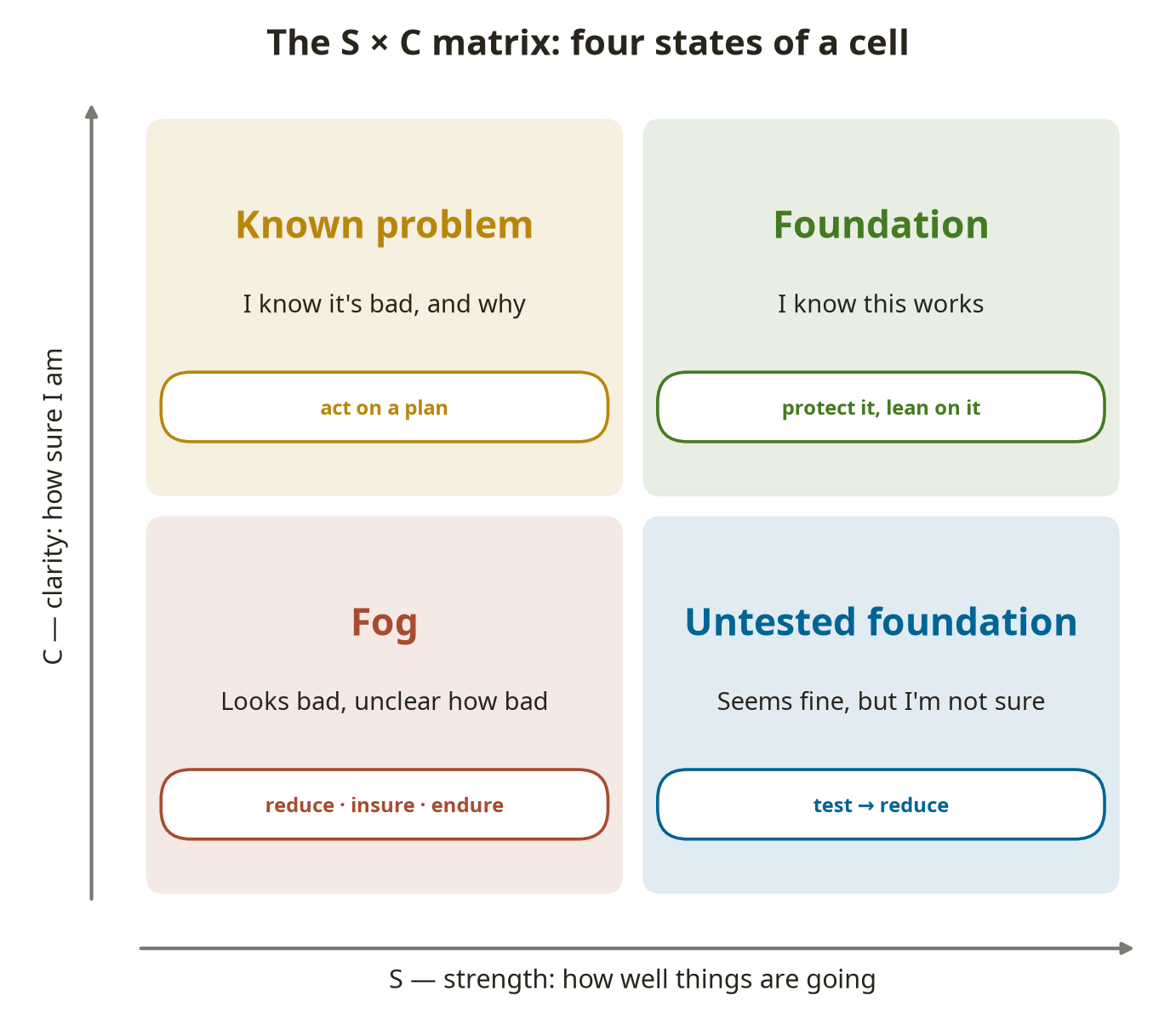
Fig. 4. The S × C matrix: four states of a cell and the strategy that suits each
How to read this figure. The horizontal axis is strength S: the further right, the better things are. The vertical axis is clarity C: the higher, the better a person understands what is going on. The upper right corner is support: everything is fine, and that is known. The upper left is a known problem: bad, but clear. The lower right is untested support: probably fine, but there is no certainty. The lower left is fog: it looks bad, and it is unclear how bad. The main strategy is shown at the bottom of each square.
The table below spells out the same picture in words. Find the row that resembles your cell and look at the right column: it suggests where to start.
| State | Strength S | Clarity C | What it means | Main strategy |
|---|---|---|---|---|
| Support | high | high | I know this works | Protect it, lean on it |
| Known problem | low | high | I know it is bad, and I understand why | Act according to a plan |
| Untested support | high | low | Everything seems fine, but I am not sure | Check: reduce |
| Fog | low | low | It looks bad, and it is unclear how bad | Reduce, insure, endure |
|
A PSYCHOTHERAPIST'S COMMENT With a single-score rating, a known problem and fog look equally "bad". But they are handled differently. A known problem needs a plan. Fog first needs clarity. A person who builds a plan in the fog builds it on sand. And a person who keeps endlessly gathering information about a known problem is simply postponing action under the guise of analysis. In practice this is very common: "I need to think about it a little more" often means "I am afraid to start". |
|---|
Reducibility: how much of the fog can be cleared
Not all fog is the same. One kind of unclarity can be cleared in an evening: make a call, ask, try. Another will not be cleared by any amount of reading: for example, nobody knows exactly what the job market will look like in two years. To tell these cases apart, we introduce one more rating.
|
WHEN YOU NEED IT When you notice that you think a lot about some unclarity, but it does not get easier. Reducibility helps you see whether it is worth continuing to look for information, or whether it is time to prepare and learn to endure. |
|---|
To rate reducibility, ask yourself: "What share of this unclarity can I clear up myself, through my own actions, in the next one to three months?" Guidelines for the answer:
• 0: nothing depends on me; it is impossible to know in advance;
• 0.2: almost nothing, apart from general trends;
• 0.5: about half can be found out; half will remain unknown;
• 0.8: most of it can be checked with some effort;
• 1: everything can be found out; it is enough to ask or try.
|
SPLITTING UNCERTAINTY INTO TWO PARTS Uᵣ = U × r Uₙ = U × (1 − r) U is the uncertainty of the cell, from 0 to 10 (we have already calculated it: U = 10 − C). r is the reducibility coefficient, from 0 to 1: what share of the fog can be cleared by your own efforts. Uᵣ is the reducible part of uncertainty. It is the job of the "reduce" strategy: find out, ask, check. 1 − r is the remaining share. If r = 0.9, then 1 − 0.9 = 0.1. Uₙ is the non-reducible part (the small n stands for "non-reducible"). The "insure" and "endure" strategies work with it. The two parts always add up to the whole uncertainty: Uᵣ + Uₙ = U. |
|---|
|
STEP-BY-STEP CALCULATION: TWO OF MARINA'S CELLS The "AI work skills" cell (Information — How — Function). We have already calculated the uncertainty: U = 7. Step 1. Reducibility. Marina asks herself: can I find this out myself? Yes, almost completely: it is enough to do one real work project with AI. r = 0.9. Step 2. Reducible part. Uᵣ = 7 × 0.9 = 6.3. Step 3. Non-reducible part. Uₙ = 7 × (1 − 0.9) = 7 × 0.1 = 0.7. The "job market in her field" cell (Matter — Whither — Development). Clarity C = 2, so U = 10 − 2 = 8. Step 1. Reducibility. What happens to the market in two years hardly depends on Marina; she can only learn general trends. r = 0.2. Step 2. Reducible part. Uᵣ = 8 × 0.2 = 1.6. Step 3. Non-reducible part. Uₙ = 8 × 0.8 = 6.4. |
|---|
|
WHAT THE RESULT MEANS In the first cell, almost all the fog (6.3 out of 7) is cleared by action. Worrying here is pointless; she needs to check: do a trial project, and the unclarity will go away. In the second cell, almost all the fog (6.4 out of 8) will not clear, no matter how many articles Marina reads. Reading even more about the market is useless. She needs to prepare: a cushion, a backup plan, a second skill. This is exactly where Marina spent most of her energy that night, and exactly where reading helped least. |
|---|
Priority: which cells matter most
Twenty-seven cells is a lot. Working on all of them at once is impossible, and not necessary. In complex systems, the behavior of the whole is usually determined by a few key points. We call this the rule of the vital few: out of 27 cells, choose the 3–5 most important ones.
|
WHEN YOU NEED IT When the hologram is filled in and you see many yellow and red zones but do not know where to start. The priority index helps you choose the few cells where work will have the greatest effect. |
|---|
|
CELL PRIORITY INDEX P = U + IM + PO P is priority. The larger the number, the more important it is to work on the cell. The range is from 2 to 30. U is the uncertainty of the cell, from 0 to 10: how much fog there is here. IM is the impact on the problem, from 1 to 10. The question: how important is this cell for my main question? PO is the breakthrough potential, from 1 to 10. The question: how much will a change here move everything else? For example, clarity about one's main goal changes almost everything, so its potential is usually high. + means we simply add up three ratings: fog, importance and leverage. |
|---|
A cell is considered critical if two conditions are met at once: P ≥ 20 and U ≥ 5.
The second condition is our refinement, and it matters. Without it, a cell with almost no fog could become critical: for example, U = 1, IM = 10, PO = 10 gives P = 21. Such a cell is important, but it is not a zone of uncertainty; it is a known problem. It needs a plan, not an investigation.
There is also a practical consequence. If U is less than 5, the cell cannot become critical, however high the other ratings are. So IM and PO only need to be rated in cells with U ≥ 5, which saves time.
|
STEP-BY-STEP CALCULATION: THE "WHERE THE PROFESSION IS HEADING" CELL The cell "Information — Whither — Development". Marina's rating: clarity C = 2, so U = 8. Impact on the main question: IM = 9 (almost her whole future depends on it). Breakthrough potential: PO = 8 (if she understands where the profession is heading, it will become clear what to learn and what to propose to her manager). Step 1. Add up. 8 + 9 + 8 = 25. Step 2. Check the first condition. 25 ≥ 20: yes. Step 3. Check the second condition. U = 8, which is not less than 5: yes. Result: the cell is critical, and it has Marina's highest priority. |
|---|
|
WHAT THE RESULT MEANS P = 25 out of 30 is a very high priority. There is a lot of fog here, the main question depends on this zone, and clarification will produce a strong shift. So this is the place to start. Marina's full hologram and all her critical cells are analyzed below, in the end-to-end case. |
|---|
How to read the hologram
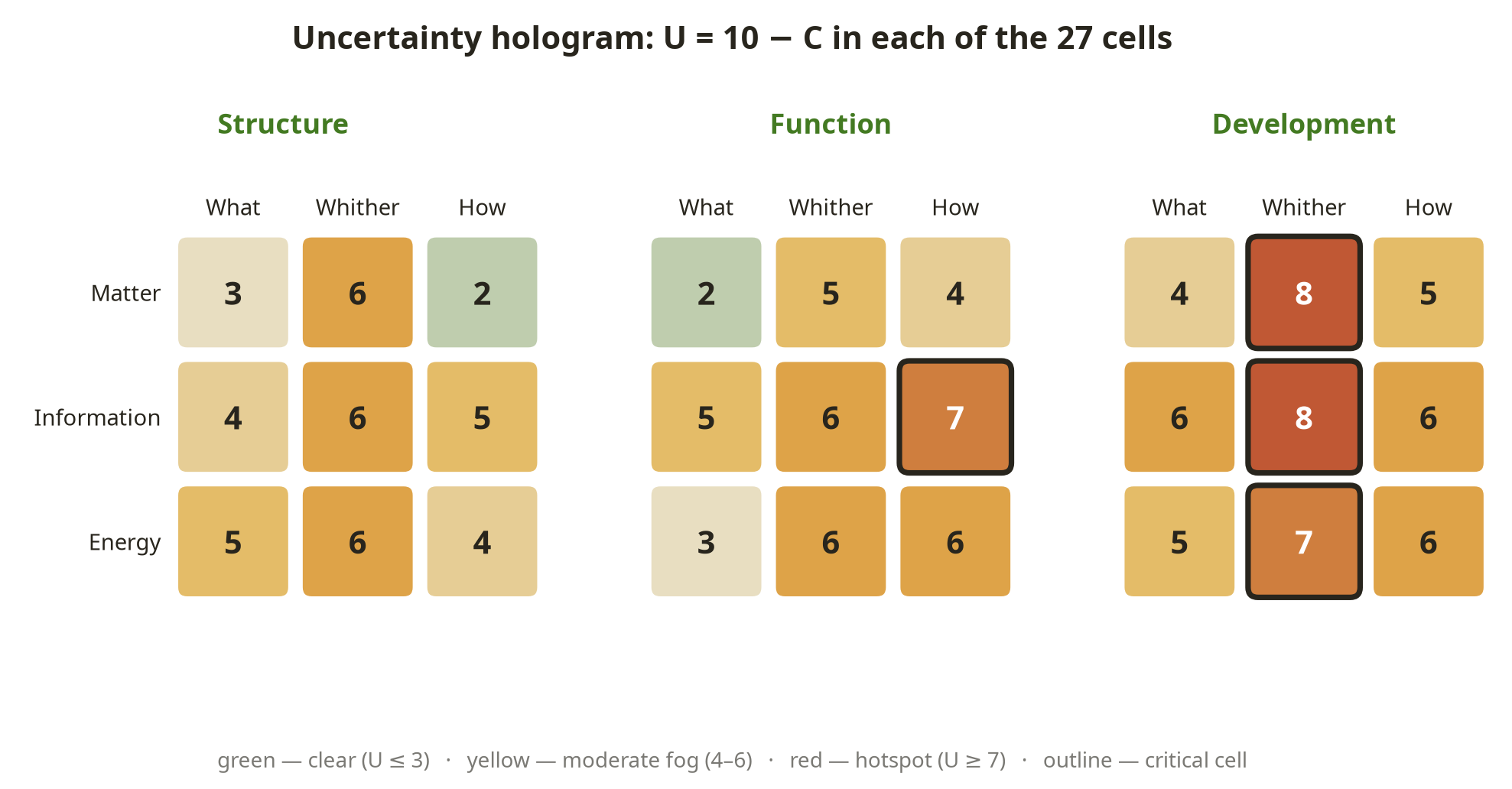
Fig. 5. Marina's uncertainty hologram: 27 cells in three SFD layers; color shows the level of fog; critical cells are outlined
How to read this figure. We see three squares, the three layers of the SFD lens: "Structure" (what everything rests on), "Function" (how things work now) and "Development" (where things are heading). Each square has nine cells: horizontally, the WWH questions ("What", "Whither", "How"); vertically, the MIE domains (Matter, Information, Energy). The number in a cell is uncertainty U. Green means clarity, yellow means moderate fog, red means a hot zone. Critical cells are outlined in black.
Even at first glance the main thing is visible: Marina's fog thickens on the right, in the "Development" layer, and especially in the "Whither" column. Her present is fairly clear; her future is not.
The hologram shows three things:
1. Hot spots: the critical cells with the highest priority.
2. Contradictions: zones pulling in different directions. For example, solid Matter alongside completely "foggy" Energy: the money is there, but it is unclear what to keep living for.
3. Links: how fog in one cell spreads to its neighbors. Unclarity about "Whither" in Information almost always dampens Energy: it is hard to want something you cannot name.
Links have their own simple formula.
|
LINK STRENGTH INDEX BETWEEN TWO CELLS L = SC + SU + OP L is link strength, from 3 to 30. SC is the strength of connection, from 1 to 10: how much does fog in one cell increase fog in the other? SU is surprise, from 1 to 10: how non-obvious is this link? Unexpected links often turn out to be hidden levers. OP is the opportunity for improvement, from 1 to 10: how much will working on this link improve both cells? A link is considered key if L ≥ 20. |
|---|
|
EXAMPLE: THE "PROFESSION — MEANING" LINK Marina notices: when she thinks that her profession may disappear, she loses the desire to work at all. This is a link between the cells "Information — Whither — Development" (where the profession is heading) and "Energy — Whither — Development" (what to keep working for). Step 1. Strength of connection. Very noticeable: SC = 8. Step 2. Surprise. Fairly unexpected for Marina herself; she thought she had lost interest in work because of fatigue: SU = 6. Step 3. Opportunity. If she clarifies where the profession is heading, her motivation will return too: OP = 8. Result: L = 8 + 6 + 8 = 22, a key link. |
|---|
The conclusion for Marina: it is better to start working on motivation not with "finding meaning" but with clarifying the future of her profession. Then the second cell will begin to clear up by itself.
Harmony and uncertainty indices
The hologram shows where the fog is. The next four formulas answer four other questions: are my forces balanced?, am I coping the right way?, how heavy does this feel to me? and how dangerous is my fog for the future? Each can be read separately: choose the one that answers your question.
The Triad Harmony Coefficient
|
WHEN YOU NEED IT When you feel "stuck in your head": you think, read and analyze a lot, while your energy and actions keep shrinking. Or the opposite: you are very busy, but you do not understand why. Harmony shows how balanced your attention is between body and resources, thoughts, and emotions. |
|---|
First you need your MIE profile: how your attention and energy are distributed across the three domains. A simple exercise makes this easy. Take 20 tokens (coins, matches, or just numbers on paper) and divide them into three piles, according to how much attention and energy has gone in recent weeks:
• to Matter: money, body, sleep, household, concrete practical tasks;
• to Information: thoughts, reading, analysis, mulling things over, plans;
• to Energy: feelings, rest, socializing, whatever gives you strength.
The number of tokens in each pile multiplied by 5 gives the share in percent.
Marina divides them like this: Matter, 3 tokens; Information, 12; Energy, 5. That makes 15% / 60% / 25%.
Next you need a target profile: the distribution that suits this particular situation. It does not have to be an equal 33 / 33 / 33. During an illness a person needs "heavy" Matter; during studies, Information. Marina and her psychologist decide that what she needs now is 35 / 30 / 35: more grounding and strength, less mental replaying. After all, she sleeps badly and her cushion is thin.
|
HARMONY COEFFICIENT (HG) |Δ| = √[(x₁ − t₁)² + (x₂ − t₂)² + (x₃ − t₃)²] HG = 100 × (1 − |Δ| / 81.65) HG is the harmony coefficient (Harmony Grade), from 0 to 100. 100 means a perfect match with the target. x₁, x₂, x₃ are the current shares of Matter, Information and Energy, in percent (for Marina, 15, 60 and 25). t₁, t₂, t₃ are the target shares (t for "target"). For Marina, 35, 30 and 35. x₁ − t₁ shows how much the current share differs from the needed one. A minus means "too little", a plus means "too much". ²: we square each difference so that the minuses do not cancel out the pluses. √[…]: we add up the squares and take the square root. The result is |Δ|, the overall deviation from the target: how "lopsided" the profile is. 81.65 is the largest possible deviation from the equal profile: when all attention goes into one domain (100 / 0 / 0). Dividing by it turns the deviation into a share of the maximum. 1 − … flips the scale: the smaller the deviation, the higher the harmony. × 100 turns the result into familiar points. |
|---|
Do not be put off by the root and the squares: this is simply the "distance" between how things are and how they should be. As if you were measuring how far you have walked from the center of a room.
|
STEP-BY-STEP CALCULATION: MARINA'S PROFILE Step 1. Differences from the target. Matter: 15 − 35 = −20 (a big shortfall). Information: 60 − 30 = +30 (a big excess). Energy: 25 − 35 = −10 (a shortfall). Step 2. Squares. 20² = 400; 30² = 900; 10² = 100. Step 3. Sum and root. 400 + 900 + 100 = 1400; √1400 ≈ 37.4. This is |Δ|. Step 4. Share of the maximum. 37.4 / 81.65 ≈ 0.46, almost half of the strongest possible imbalance. Step 5. Harmony. 100 × (1 − 0.46) ≈ 54. For comparison. If we compare not with the target but with the equal profile 33.3 / 33.3 / 33.3, the differences are −18.3, +26.7 and −8.3, and HG ≈ 59. The result is almost the same. |
|---|
|
WHAT THE RESULT MEANS 54 out of 100 is the zone of tension, close to imbalance. The number confirms what Marina's night already showed: she is trying to think her way through what needs to be solved with material steps and recovery. Her attention has been pulled into Information. A month later, Marina divides the tokens again: 6 / 7 / 7, that is, 30 / 35 / 35. Differences from the target: −5, +5, 0. The root of 50 ≈ 7.1, and HG ≈ 91: harmony. |
|---|
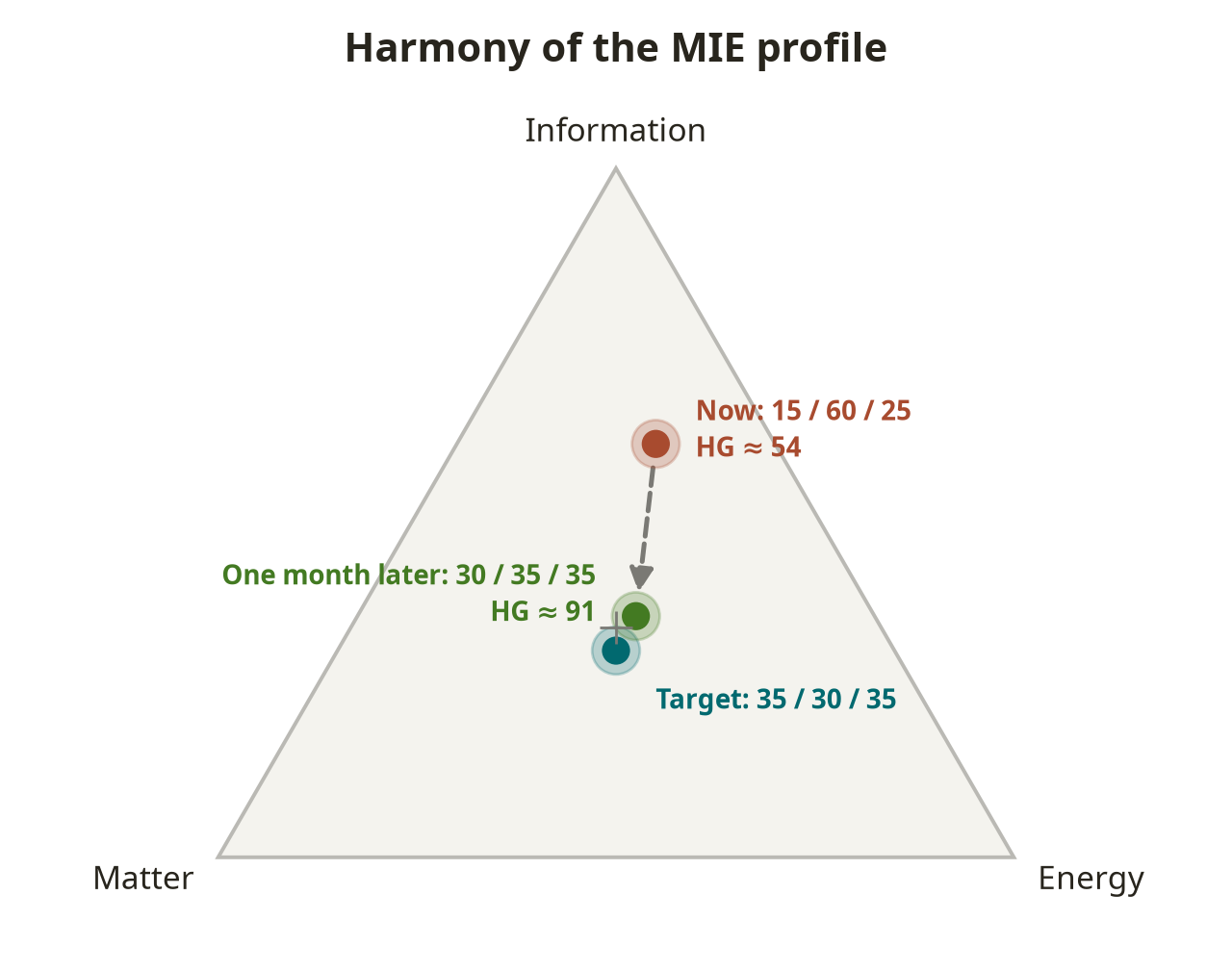
Fig. 6. Marina's MIE profile: a skew toward Information and the movement toward the target profile a month later
How to read this figure. The triangle is a "map" of all possible profiles. Each corner is an MIE domain: the closer a point is to a corner, the more attention goes into that domain. The cross in the center is the equal profile. The red dot is Marina now: it is clearly shifted upward, toward Information. The teal dot is the target. The green dot is Marina a month later, almost next to the target. The dashed arrow shows the path she has traveled.
A note for the attentive reader: 81.65 is the maximum deviation specifically from the equal profile. For a different target the maximum is slightly different, but we keep one number as a common scale. That way, results from different people and different months can be compared with one another.
Coping harmony: the balance of three strategies
Now let us apply the same formula to the strategies "reduce, insure, endure". In our view, this is one of the most useful applications of the method.
|
WHEN YOU NEED IT When you are doing a lot to cope with uncertainty, but it does not get easier. This formula checks whether the way you cope matches what your situation actually needs. |
|---|
The calculation needs two profiles. The first is the need profile: what share of your uncertainty is reducible and what share is not. The hologram suggests it. The second is the effort profile: how you actually distribute your energy.
How to get the need profile. Take the critical cells. For each one, the reducible part Uᵣ goes to "reduce". For the non-reducible part Uₙ, ask yourself: "Can I prepare for this?" If yes, it goes to "insure". If not, and what remains is simply an unknown that has to be lived through, it goes to "endure". Marina has four critical cells. Their full analysis is in the end-to-end case below; here we show only the outcome of the calculation.
| Critical cell | U | r | Uᵣ | Uₙ | Where Uₙ goes |
|---|---|---|---|---|---|
| Where the profession is heading | 8 | 0.5 | 4.0 | 4.0 | insure: several role scenarios |
| What to keep working for | 7 | 0.4 | 2.8 | 4.2 | endure: meaning cannot be known in advance |
| AI work skills | 7 | 0.9 | 6.3 | 0.7 | endure: the residual "what if I can't cope" |
| Job market in her field | 8 | 0.2 | 1.6 | 6.4 | insure: cushion, backup plan |
| Total | 30 | — | 14.7 | 15.3 | insure 10.4 · endure 4.9 |
Now let us turn the totals into shares of the total uncertainty (30): reduce, 14.7 / 30 ≈ 49%; insure, 10.4 / 30 ≈ 35%; endure, 4.9 / 30 ≈ 16%. This is what Marina's situation needs.
How to get the effort profile. Recall the last three days and estimate how much time went into dealing with uncertainty, and on what exactly. Marina counts about 10 hours: reading, thinking and replaying scenarios, 8 hours ("reduce"); going over the budget, half an hour ("insure"); a walk and a talk with a friend, an hour and a half ("endure"). That makes 80% / 5% / 15%.
|
COPING HARMONY COEFFICIENT (HGC) HGc = 100 × (1 − |effort − need| / 81.65) HGc is coping harmony (c for "coping"), from 0 to 100. Effort is how you actually distribute your energy between "reduce / insure / endure", in percent (100% in total). Need is the distribution your situation requires (from the table of critical cells). |effort − need| is the distance between what you do and what is needed. It is calculated the same way as |Δ| above: differences, squares, sum, root. 81.65 is the same maximum deviation as in the harmony formula. |
|---|
|
STEP-BY-STEP CALCULATION: MARINA Step 1. Differences. Reduce: 80 − 49 = +31 (a large excess). Insure: 5 − 35 = −30 (almost nothing is being done). Endure: 15 − 16 = −1 (almost normal). Step 2. Squares. 31² = 961; 30² = 900; 1² = 1. Step 3. Sum and root. 961 + 900 + 1 = 1862; √1862 ≈ 43.2. Step 4. Share of the maximum. 43.2 / 81.65 ≈ 0.53. Step 5. Coping harmony. 100 × (1 − 0.53) ≈ 47. A month later Marina distributes her effort as 45 / 38 / 17. Differences: −4, +3, +1. Sum of squares: 16 + 9 + 1 = 26; √26 ≈ 5.1; 5.1 / 81.65 ≈ 0.06; HGc ≈ 94. |
|---|
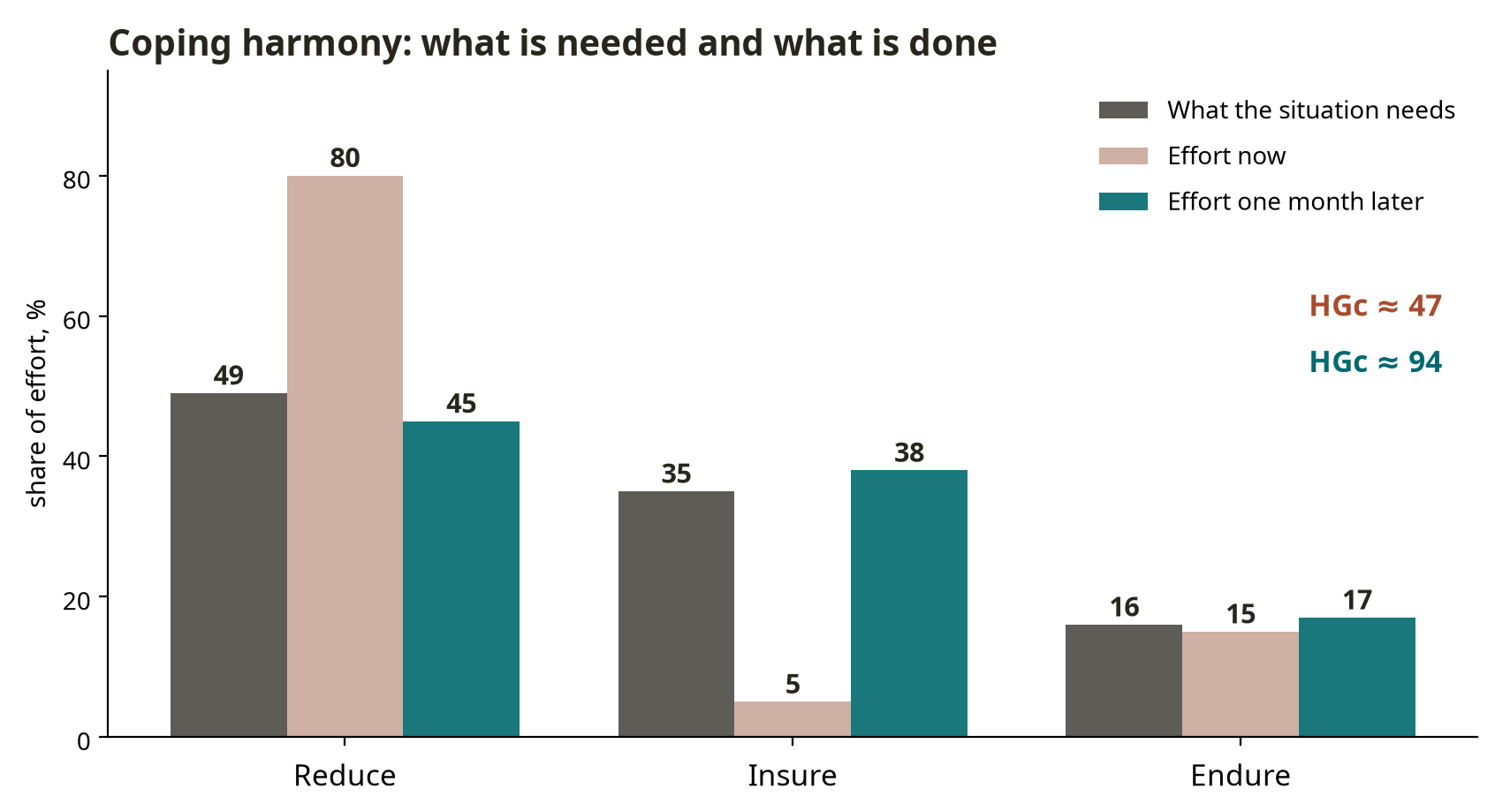
Fig. 7. What the situation needs and what Marina does: the need profile, effort now, and effort a month later
How to read this figure. Each of the three strategies has three bars. The dark one shows how much of this strategy the situation needs. The pinkish one shows how much Marina does now. The teal one shows how much she does a month later. Two imbalances stand out at once: the pink "reduce" bar is much higher than needed, while the pink "insure" bar has almost vanished. A month later, the teal bars have almost caught up with the dark ones.
|
WHAT THE RESULT MEANS 47 is an imbalance. Marina spends a lot of energy, but disproportionately: almost twice as much as needed goes into "reduce", while "insure" is almost abandoned. This is exactly the asymmetry of strategies we discussed above. Interestingly, her "endure" is almost normal: the walks and her friend are working. The main problem is not that she cannot calm down, but that she prepares for the future by reading instead of by preparing. A month later, she did not think about her situation any less. She simply started saving money and updated her résumé. And the number doubled. |
|---|
Uncertainty Load Index
|
WHEN YOU NEED IT When it matters to understand how heavily your uncertainty weighs on you, and what would ease that state most. Two people in the same situation experience it completely differently. So we separate the objective uncertainty of the situation from its subjective weight. |
|---|
The formula consists of three ratings. Here is where each one comes from.
U, the uncertainty of the situation. This is the average U across the critical cells of the hologram: they are the ones that "hurt" most. For Marina: (8 + 7 + 7 + 8) / 4 = 30 / 4 = 7.5.
IU, intolerance of uncertainty. This is a personal trait: how hard it is for a person to bear "I don't know" in general. It is convenient to measure with the widely used IUS-12 questionnaire (Carleton et al., 2007). It has 12 statements, for example: "Unforeseen events upset me greatly" or "I can't stand being taken by surprise". Each is rated from 1 ("not at all characteristic of me") to 5 ("entirely characteristic of me"). The total score ranges from 12 to 60. To convert it to our scale, simply divide the total by 6: you get a number from 2 to 10. Marina's total is 48, so IU = 48 / 6 = 8.
R, coping resources. This is what a person can lean on while there is no answer. We suggest rating three things, each from 1 to 10, and taking the average:
• support: are there people nearby to talk to and rely on;
• reserves: money, time, a fallback option;
• regulation skills: the ability to calm down, get enough sleep, switch off.
Marina: support, 4 ("I have a friend, but it feels awkward to discuss work with her"); reserves, 3 ("a cushion for three months"); regulation skills, 2 ("I don't sleep, I can't stop my thoughts"). Average: (4 + 3 + 2) / 3 = 3.
|
UNCERTAINTY LOAD INDEX (ULI) ULI = U × IU / R ULI shows how heavily the uncertainty weighs. The higher, the heavier. U is the objective uncertainty of the situation, from 1 to 10 (the average U of the critical cells). IU is intolerance of uncertainty, from 2 to 10 (the IUS-12 total divided by 6). R is coping resources, from 1 to 10 (the average of three ratings). U × IU is uncertainty "amplified" by personal sensitivity to it: the same unclarity is heavier for someone who tolerates it poorly. / R: resources "divide" this weight; the more support, the easier it is to carry the same load. Guidelines (tentative): up to 5, a working level; 5–15, tension; above 15, overload. |
|---|
The formula reveals the main point: anxiety has three levers, not one. You can reduce the uncertainty (Information), increase tolerance (Energy) or increase resources (Matter). And because this is a product, a small improvement in each lever gives more than a big effort on just one.
|
STEP-BY-STEP CALCULATION: MARINA Step 1. Uncertainty amplified by sensitivity. 7.5 × 8 = 60. Step 2. Divide by resources. 60 / 3 = 20. This is overload. Step 3. What each lever gives on its own (a month later Marina will repeat the assessment, and these values will become real): • Only reducing uncertainty to 5: 5 × 8 / 3 ≈ 13.3, still tension. • Only lowering intolerance to 5 (IUS-12 total = 30): 7.5 × 5 / 3 = 12.5. • Only doubling resources to 6: 7.5 × 8 / 6 = 10. Step 4. All three levers together. 5 × 5 / 6 ≈ 4.2, a working level. |
|---|
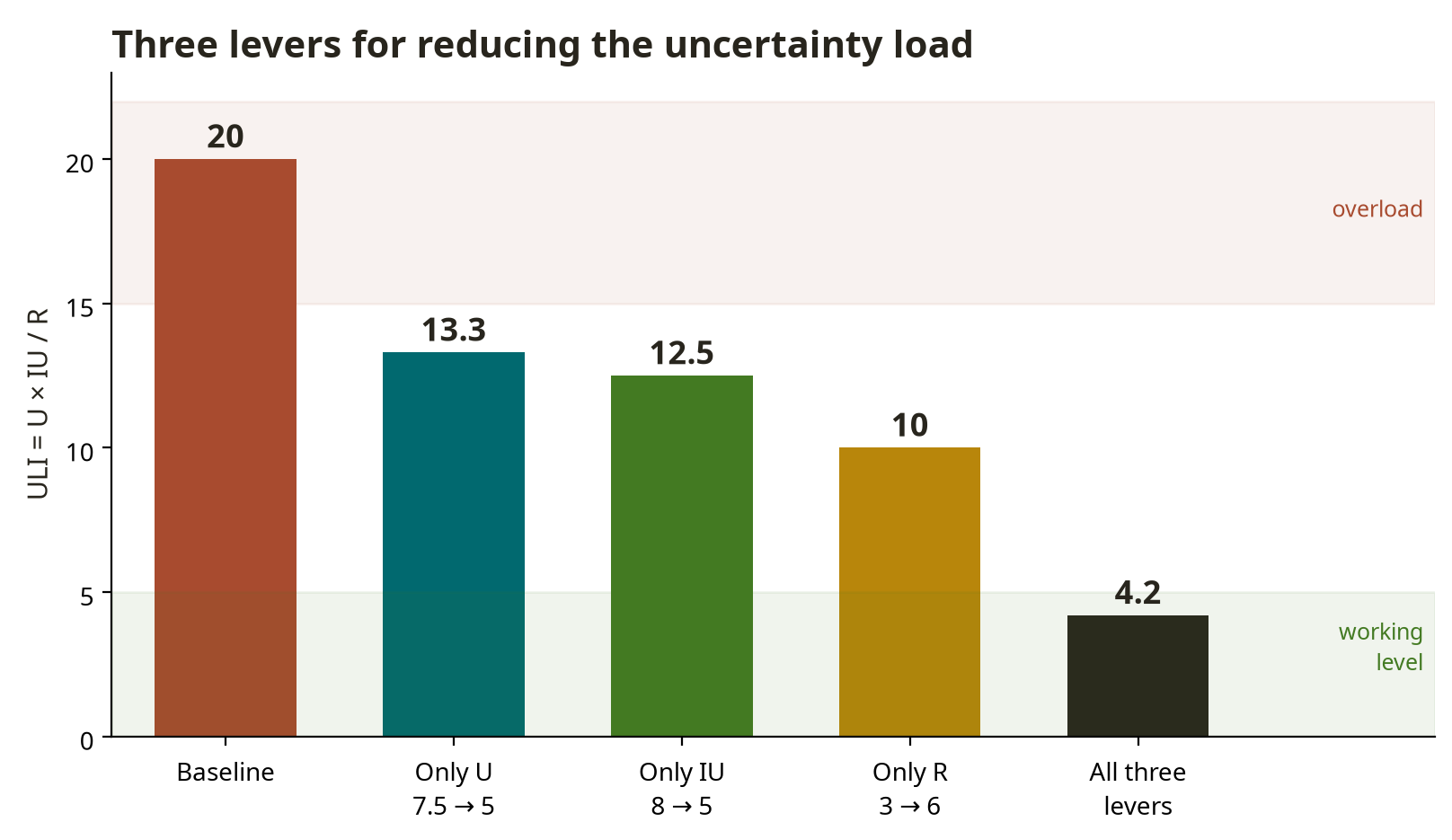
Fig. 8. Three levers for reducing the load: each one works, but together they give a multiplied effect
How to read this figure. The first bar is Marina's load now: 20, in the red overload zone. The next three show what happens if you pull only one lever: each lowers the load, but none brings it out of the tension zone. The last, dark bar is all three levers together: 4.2, in the green zone of the working level.
|
WHAT THE RESULT MEANS ULI = 20 is overload. Marina feels so bad not only because the situation is unclear, but also because she tolerates unclarity poorly and has almost no support. No single effort (reading, meditation, or money) will solve the problem completely. But small steps in all three directions cut the load almost fivefold. An honest caveat: intolerance of uncertainty is a trait, and it usually changes more slowly than within a month. But it can be trained: even brief programs reduce it noticeably (Psychological Medicine). |
|---|
Integral Uncertainty Index
|
WHEN YOU NEED IT When it matters to understand how dangerous your fog is for the future: is it ordinary unclarity that will clear up by itself, or a situation that could do serious harm? The index connects two things: how much fog there is, and how vulnerable you are to it. |
|---|
|
INTEGRAL UNCERTAINTY INDEX (IUI) IUI = √(UL × VL) IUI is the Integral Uncertainty Index, from 0 to 100. The higher, the more dangerous. UL is the Uncertainty Level, from 0 to 100: the average U across all 27 cells of the hologram, multiplied by 10. VL is the Vulnerability Level, from 0 to 100: the average of five ratings of consequences, each scored by the person from 0 to 100: • destructiveness: how much damage if the fog persists; • spread: how much it "infects" other areas of life and loved ones; • stagnation: a tendency toward analysis paralysis and procrastination; • difficulty of recovery: how hard it is to regain clarity on your own; • loss of agency: how much the person has lost control over their time, attention and choices. √(UL × VL) is the root of the product. This is a special kind of "average": it is high only if both numbers are high. |
|---|
Why not simply add them? Imagine a person moving to a new city for an interesting job. There is a lot of fog, UL = 80: new people, new streets, new rules. But vulnerability is low, VL = 10: the job is secure, housing is found, loved ones are supportive. The index turns out moderate: √(80 × 10) ≈ 28. And that is right: this is curiosity, not a threat. Danger arises when a lot of fog meets high vulnerability.
|
STEP-BY-STEP CALCULATION: MARINA Step 1. Uncertainty level. The sum of U across all 27 cells of Marina's hologram is 140 (the full hologram is shown in the end-to-end case). Average: 140 / 27 ≈ 5.2. Multiply by 10: UL = 52. Step 2. Vulnerability: five ratings with explanations. • Destructiveness, 70: "if I lose my job, the money will run out in three months". • Spread, 65: "I've started snapping at my husband; the kids ask what's wrong". • Stagnation, 80: "for two weeks I've been meaning to talk to my boss and I can't". • Difficulty of recovery, 75: "I can't get out of this loop of thoughts by myself". • Loss of agency, 85: "the day goes by in news and articles, not in my own work". Average: (70 + 65 + 80 + 75 + 85) / 5 = 375 / 5 = VL = 75. Step 3. Product. 52 × 75 = 3900. Step 4. Root. √3900 ≈ 62. A month later: the average U across the hologram fell to 3.4 (UL = 34), vulnerability to 48. √(34 × 48) = √1632 ≈ 40. |
|---|
|
WHAT THE RESULT MEANS IUI = 62 is a high level. Marina has a moderately large amount of fog, but it meets very high vulnerability: stagnation (80) and loss of agency (85) deserve special attention. This means the main risk is not the reorganization itself, but the fact that anxiety has already begun to run her time and decisions. A month later the index fell to 40, a moderate level. The fog has not disappeared, but it is no longer dangerous. |
|---|
All the indices together
We have met four indicators. To keep them straight, let us gather them into one reminder. It is handy to keep in front of you during self-assessment: the left column has the name, next to it the question the index answers, and on the right how to read the number you get.
| Index | Question | Range | Zones (tentative) |
|---|---|---|---|
| HG | Are my attention and energy balanced? | 0–100 | below 50, imbalance; 50–75, tension; above 75, harmony |
| HGc | Am I coping the right way? | 0–100 | the same |
| ULI | How heavily does the uncertainty weigh? | 0.2–100 | up to 5, working; 5–15, tension; above 15, overload |
| IUI | How dangerous is the fog? | 0–100 | up to 30, low; 30–55, moderate; above 55, high |
|
LINK WITH THE AGENCY INDEX™ In the end, all these indices serve one outcome: preserving agency, a person's ability to remain the author of their own life. A high IUI is almost always accompanied by a drop in the Agency Index™: decisions start being made not by the person but by their anxiety. |
|---|
An end-to-end case: Marina, from fog to map
Now let us put everything together and walk the whole path from start to finish, the way any reader could walk it.
Marina's case is illustrative. It is built on typical patterns that often come up in practice and serves as a demonstration of the method, not a description of a real client. All the numbers are chosen so that you can recalculate them yourself: every step relies on the formulas explained above.
The whole path has six steps: formulate the question, fill in the hologram, find the critical cells, calculate the indices, make a plan, and check the result a month later.
Step 1. The focal question
All work begins with the right question. Marina could have asked: "What will happen to me?" But such a question leads nowhere: it can be answered endlessly, and every answer will breed new anxiety.
Together with her psychologist she formulates a more concrete question: "How do I get through the next quarter of the reorganization while keeping my income, my health and my self-respect?"
|
COMMENT A good focal question already reduces uncertainty: it turns "everything" into "this". It has a time frame (a quarter), a goal (to get through, not to "guess the future") and three supports worth keeping: income is Matter, health is body and strength, self-respect is Energy and values. Marina is no longer asking what the company will decide. She is asking what she herself can do. |
|---|
Step 2. A hologram of 27 cells
Marina fills in the hologram. For each of the 27 cells she sets strength S and clarity C, from 0 to 10, and the uncertainty follows automatically: U = 10 − C. To make it easier, she first "translates" each cell into the language of her own life: what exactly is going on for her here. The whole thing takes about forty minutes.
Here is her complete hologram. It is laid out in three "layers" (one figure for each), following the levels of the SFD lens. Each layer is a 3 × 3 grid: the WWH lens runs horizontally, MIE vertically.
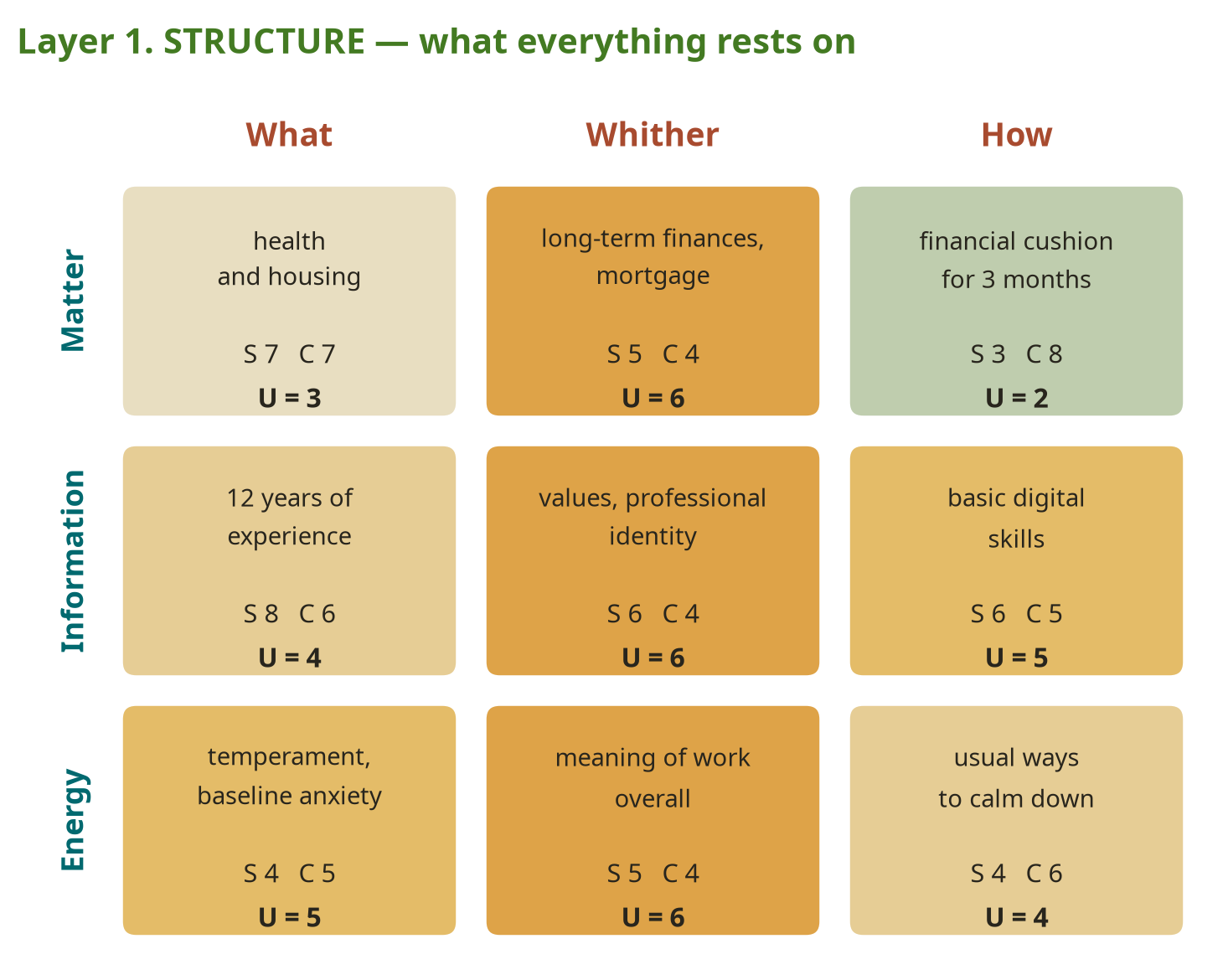
Fig. 9a. Marina's hologram, the "Structure" layer: what her life rests on
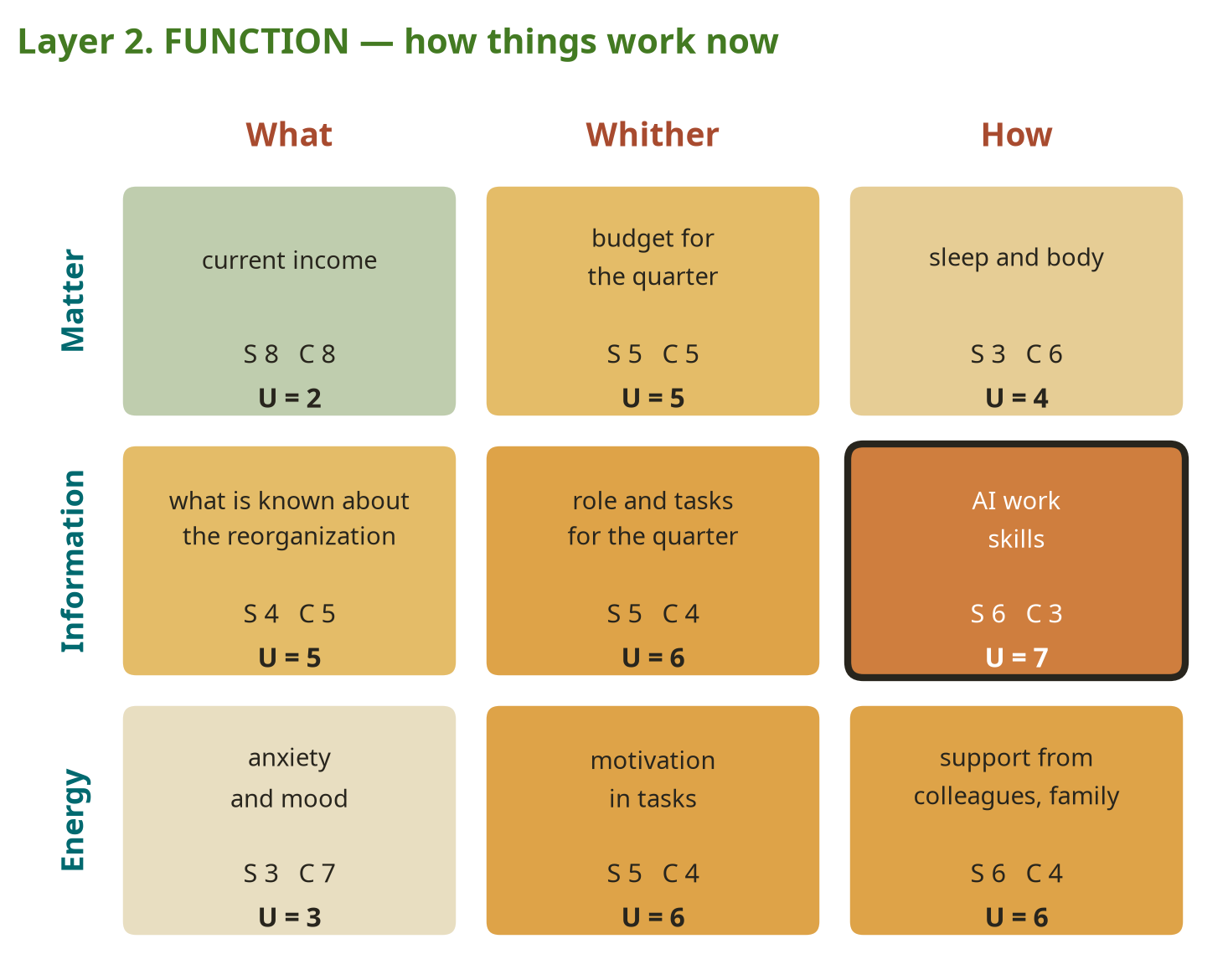
Fig. 9b. The "Function" layer: how things work now
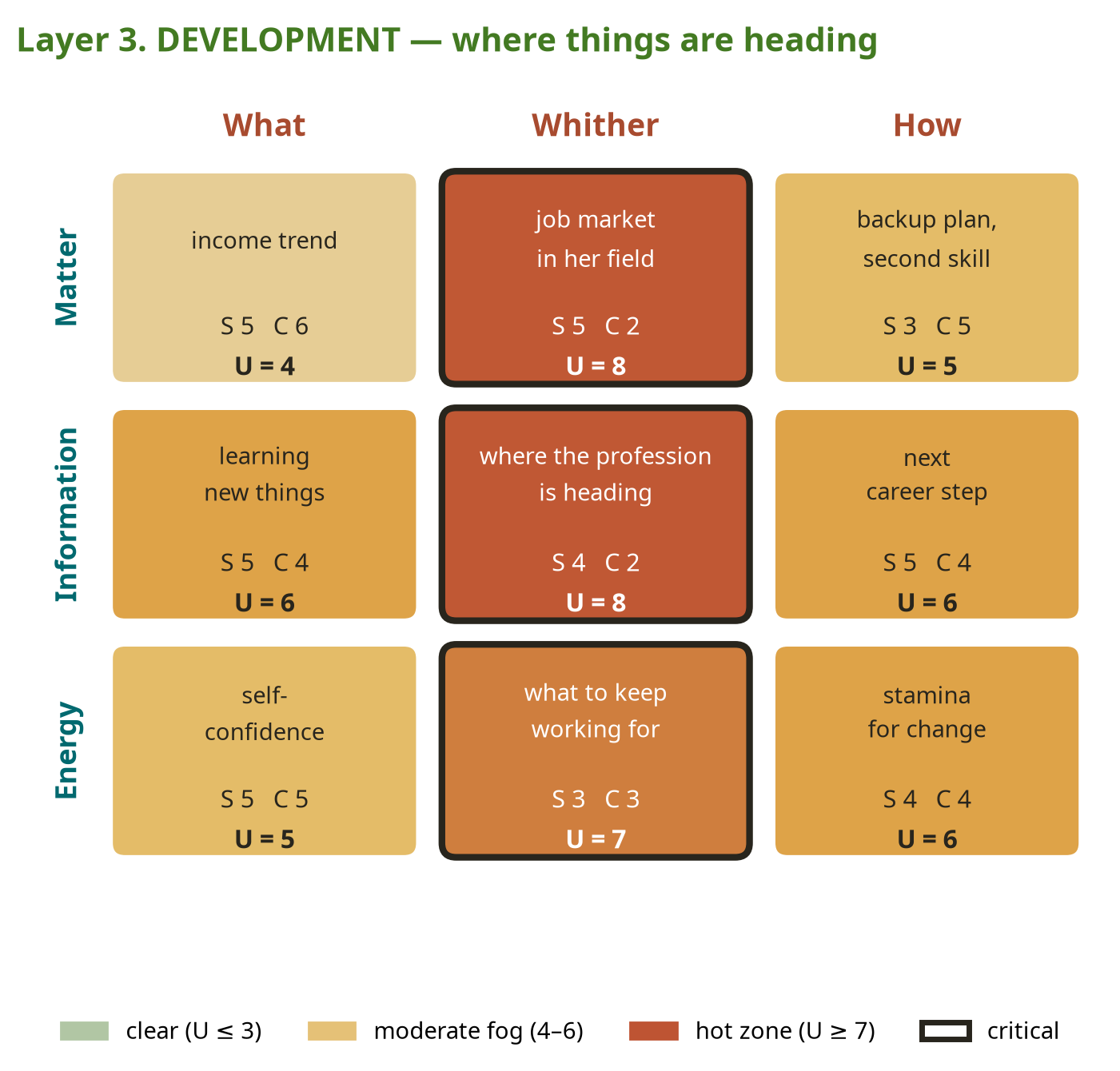
Fig. 9c. The "Development" layer: where things are heading, and this is where the fog thickens
How to read these figures. Each rectangle is one cell of the hologram. It says what this cell means for Marina, and gives three numbers: S, how well things are going here; C, how clear it is; U, how much fog there is. Color shows only the fog: green means clear, yellow means moderate fog, red means a hot zone. Critical cells are outlined in black (how they were found is explained in the next step).
The main point is visible at first glance: the lower layers, "Structure" and "Function", are mostly yellow and calm, while the upper layer, "Development", is almost entirely in fog. Especially the "Whither" column. This means that Marina's foundation is in order (experience, health, current income), and the unclarity lives in the future: where the profession, the market and her own motivation are heading.
One more important detail. Note the "financial cushion" cell in the "Structure" layer: it is green (U = 2), even though the cushion is small (S = 3). This is not fog but a known problem. Marina knows exactly that the money will last three months, and it is precisely this clarity that makes the problem solvable.
 |
BUILD YOUR OWN HOLOGRAM You can build the same kind of hologram for yourself with our web tool at alexz.us. The tool walks you through all 27 cells with prompts, calculates the uncertainty and priority indices for you, and shows the critical zones. |
|---|
To calculate the average level of uncertainty, add up U across all 27 cells. The "Structure" layer: 3 + 6 + 2 + 4 + 6 + 5 + 5 + 6 + 4 = 41. The "Function" layer: 2 + 5 + 4 + 5 + 6 + 7 + 3 + 6 + 6 = 44. The "Development" layer: 4 + 8 + 5 + 6 + 8 + 6 + 5 + 7 + 6 = 55. In total, 140; the average is 140 / 27 ≈ 5.2. We will need this number for the Integral Uncertainty Index.
Notice how the totals grow from layer to layer: 41, 44, 55. The fog thickens as we move from the present to the future.
Step 3. Critical cells
Now let us choose where to begin. As we remember, only a cell with U ≥ 5 can become critical. Marina has 19 such cells, and for each one she also rates impact on the problem IM and breakthrough potential PO. Then we calculate P with the priority formula.
Below are the six most telling cells: four critical ones, one "borderline" cell for comparison, and one known problem that Marina rated separately because it worries her.
| Cell | S | C | U | r | IM | PO | P | State | Strategy |
|---|---|---|---|---|---|---|---|---|---|
| Information — Whither — Development: where the profession is heading | 4 | 2 | 8 | 0.5 | 9 | 8 | 25 | Fog | Reduce + insure |
| Energy — Whither — Development: what to keep working for | 3 | 3 | 7 | 0.4 | 9 | 8 | 24 | Fog | Endure + reduce |
| Information — How — Function: AI work skills | 6 | 3 | 7 | 0.9 | 8 | 9 | 24 | Untested support | Check |
| Matter — Whither — Development: job market in her field | 5 | 2 | 8 | 0.2 | 8 | 5 | 21 | Fog | Insure |
| Information — Whither — Function: role and tasks for the quarter | 5 | 4 | 6 | 0.8 | 8 | 5 | 19 | Fog (not critical) | Watch |
| Matter — How — Structure: financial cushion | 3 | 8 | 2 | — | 10 | 9 | 21 | Known problem | Plan, not analysis |
|
HOW THE PRIORITIES WERE CALCULATED A reminder of the formula: P = U + IM + PO, where U is uncertainty (10 − C), IM is the impact on the main question, PO is the breakthrough potential. A critical cell has P ≥ 20 and U ≥ 5. • Where the profession is heading: U = 10 − 2 = 8; P = 8 + 9 + 8 = 25. Both conditions are met: critical. • What to keep working for: U = 10 − 3 = 7; P = 7 + 9 + 8 = 24: critical. • AI work skills: U = 10 − 3 = 7; P = 7 + 8 + 9 = 24: critical. • Job market: U = 10 − 2 = 8; P = 8 + 8 + 5 = 21: critical. The breakthrough potential is low: the market does not depend on Marina. • Role and tasks for the quarter: U = 10 − 4 = 6; P = 6 + 8 + 5 = 19: below the threshold of 20, not critical for now. • Financial cushion: U = 10 − 8 = 2; P = 2 + 10 + 9 = 21. The first condition is met, but the second is not: U = 2 is less than 5. This is not fog but a known problem. |
|---|
|
COMMENT Look at the last two rows. "Role and tasks for the quarter" is also fog, but with high reducibility (r = 0.8): it will most likely clear up by itself after one conversation with her manager. So it is worth watching rather than turning into a separate task. And the "financial cushion" is a good illustration of the second condition. P = 21, but U = 2. Marina knows perfectly well that the cushion will last three months. There is nothing to find out here. What is needed is action. One more observation. Three of the four critical cells lie in the "Development" layer and in the "Whither" column. Marina's fog is the fog of the future and of direction. Her present is holding. |
|---|
Step 4. The indices before the work begins
We now have all the data to calculate the indices from the section "Harmony and uncertainty indices". We will not repeat the calculations (they are explained in detail above); instead, we will gather the results together and see what each says about Marina.
• HG ≈ 54, MIE harmony. Attention has been pulled into Information (60%), with a shortfall in Matter and Energy.
• HGc ≈ 47, coping harmony. 80% of her energy goes into "reduce", although the situation needs about half that. "Insure" is almost abandoned.
• ULI = 20, uncertainty load. Overload: fog of 7.5 meets high intolerance (8) and low resources (3).
• IUI ≈ 62, the integral index. A high level: moderate fog meets very high vulnerability, especially stagnation and loss of agency.
|
WHAT THE INDICES SAY TOGETHER The most alarming indicator is the ULI overload: things are so hard for Marina that anxiety already stops her from acting. The most revealing one is the low coping harmony: she is trying as hard as she can, but mostly by reading and thinking. Together the indices form a clear picture: the foundation is fine, the future is in fog, and energy is going to the wrong place. She needs to think about the future less and prepare for it more. Hence the plan. |
|---|
Step 5. A plan on three levels
For each critical cell, and for the known problem of the cushion, Marina sketches changes on three levels. A micro-action is something that can be done today, in a few minutes or an hour. A mindset shift is a new thought that supports this action. A long-term vision is what it should turn into over the next few months.
This three-level scheme matters. Action alone, without a change in thinking, is quickly abandoned. A thought alone, without action, remains a good intention. And without a long-term vision, it is unclear where all of this leads.
| Cell | Micro-action (today) | Mindset shift | Long-term vision |
|---|---|---|---|
| Where the profession is heading | Write to three colleagues who went through a similar reorganization; ask her manager for 15 minutes | "I don't need to know everything; I need to know the next step" | A map of two or three scenarios for how her role might develop |
| What to keep working for | Spend 10 minutes writing down the moments at work when she was happy | "Values are a compass when there is no map" | Define her "Whither" through values, not a job title |
| AI work skills | Do one real work project with AI within a week | "Checking instead of worrying" | A personal six-month learning plan |
| Job market | Update her profile and résumé: one hour | "I am preparing for several versions of the future" | A second source of income or an adjacent skill |
| Financial cushion | Set up an automatic transfer of 10% of income from the next paycheck | "A cushion is not pessimism; it is freedom" | A six-month reserve |
|
COMMENT Look at how the plan maps onto the triad of strategies. The conversations with colleagues and the manager, and the trial project, are "reduce". The résumé, the automatic savings and the second skill are "insure". Writing down the happy moments at work is "endure": it gives her grounding in her values while there is no answer. Add to this an evening walk without her phone, which helps Marina sleep. This very distribution (about half on "reduce", a third on "insure" and the rest on "endure") is what the coping harmony calculation suggested. And one more thing: there is not a single "read some more" item in the plan. |
|---|
Step 6. One month later
A month later, the reorganization has still not been completed. Objectively, the situation at the company has barely changed. But Marina fills in the hologram and the questionnaires again. Here is what changed.
• Critical cells. "Where the profession is heading": U fell from 8 to 5, after three conversations with colleagues and a meeting with her manager. "What to keep working for": from 7 to 5. "AI work skills": from 7 to 3, after two projects. "Job market": from 8 to 7, almost unchanged, and that is normal: this uncertainty is non-reducible, but it is now insured. The average U of the critical cells: (5 + 5 + 3 + 7) / 4 = 5.
• The whole hologram. The average U fell from 5.2 to 3.4.
• Intolerance of uncertainty. The IUS-12 total is 30 instead of 48, so IU = 5.
• Resources. Support, 7 (she talked to her husband and colleagues); reserves, 5 (first money saved, an updated résumé); regulation skills, 6 (she sleeps seven hours). Average: R = 6.
• The MIE profile. The tokens fell like this: 6 / 7 / 7, that is, 30 / 35 / 35.
• Effort. 45 / 38 / 17 between "reduce", "insure" and "endure".
• Vulnerability. Destructiveness, 50; spread, 40; stagnation, 45; difficulty of recovery, 50; loss of agency, 55. Average: VL = 48.
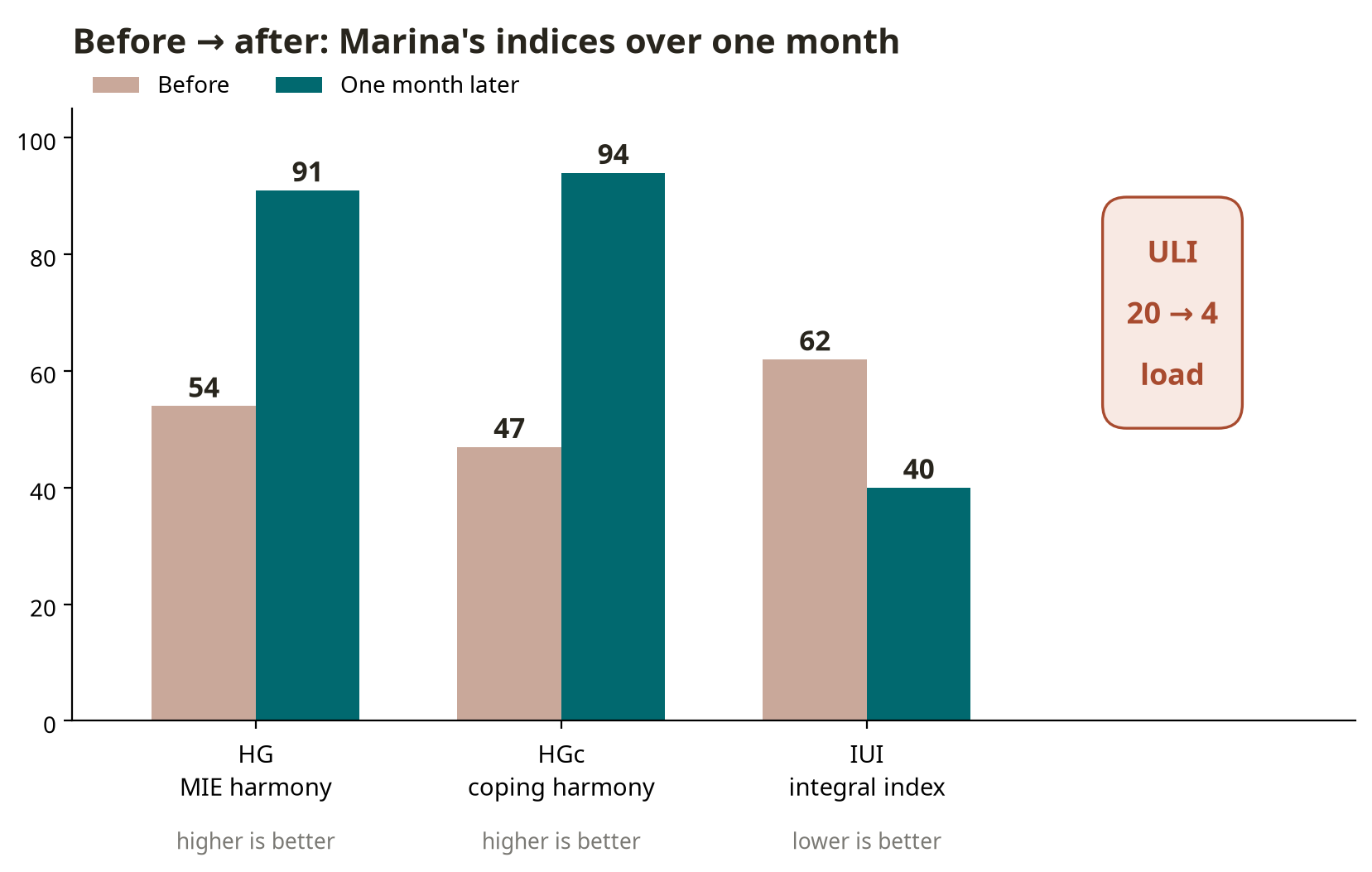
Fig. 10. Before → after: how Marina's key indices changed over one month
The chart shows the main indices before and after. The pinkish bars are "before", the teal ones "one month later". For the first two indices, MIE harmony and coping harmony, the higher the bar, the better. For the integral index IUI, it is the opposite: the lower, the better. The Load Index is shown separately on the right: it fell from 20 to 4.
The most striking changes are in coping harmony (from 47 to 94) and uncertainty load (from 20 to 4, that is, fivefold). The average level of fog fell more modestly, from 5.2 to 3.4. This confirms the main idea: the gain came not so much from "more clarity" as from a different relationship with the unclarity that remains.
What changed in Marina's life? She still works at the same company, and the decision about the reorganization has still not been made. But she sleeps. She talked to her manager, did two projects with AI and set aside her first 10% of income. In the mornings she no longer opens articles about the professions that will disappear first. Instead: five minutes of the Express Hologram (more on it in the next section) and one action for the day.
The fog has not gone anywhere. But she now has a map.
|
TRIADIC INSIGHT Uncertainty cannot be defeated; it can only be broken down. Once the fog is split into the reducible, the non-reducible and the residual, each part gets its own tool: knowledge, reserves, resilience. And then a person stops spending their whole life trying to guess the future and starts preparing for it. |
|---|
The Express Hologram: five minutes a day
The full 27-cell hologram is an in-depth diagnosis. It makes sense to do it once a month or at a moment of serious crisis. But uncertainty does not live once a month. It wakes up with us every morning.
For daily work we offer a short version, the Express Hologram. It drops the third lens (SFD) and keeps only the intersection MIE × WWH: nine cells instead of twenty-seven. That is enough to see in five minutes where the fog is today and to choose one action.
|
WHEN YOU NEED IT Every morning, especially during periods when uncertainty "hangs in the background" and makes it hard to concentrate. The Express Hologram does not replace the full one. It helps turn a vague worry into one concrete step, every day. |
|---|
Nine questions
Each of the nine cells has one simple question. The table below gathers them together: the rows are the MIE domains, the columns are the WWH questions. You can print it and keep it by your bed or on your desk.
| What: where am I now | Whither: where am I going | How: by what means | |
|---|---|---|---|
| Matter | What resources do I have right now: money, time, body? | What resources will my destination require? | What physical step can I take today? |
| Information | Do I understand what is really going on: where are the facts and where are the assumptions? | Am I clear about what I want and what matters to me? | Do I know how to act: is there a plan and the knowledge I need? |
| Energy | How do I feel: how much strength and how much anxiety? | Do I want to go there: is my motivation alive? | Will I have the strength to endure the process, and where do I get it? |
In the express version, each cell is rated only for clarity C, from 0 to 10: "how clear is this to me today?" The uncertainty of the cell, as before, is U = 10 − C. Strength S can be marked simply with a plus or a minus, if you want to tell fog apart from a known problem.
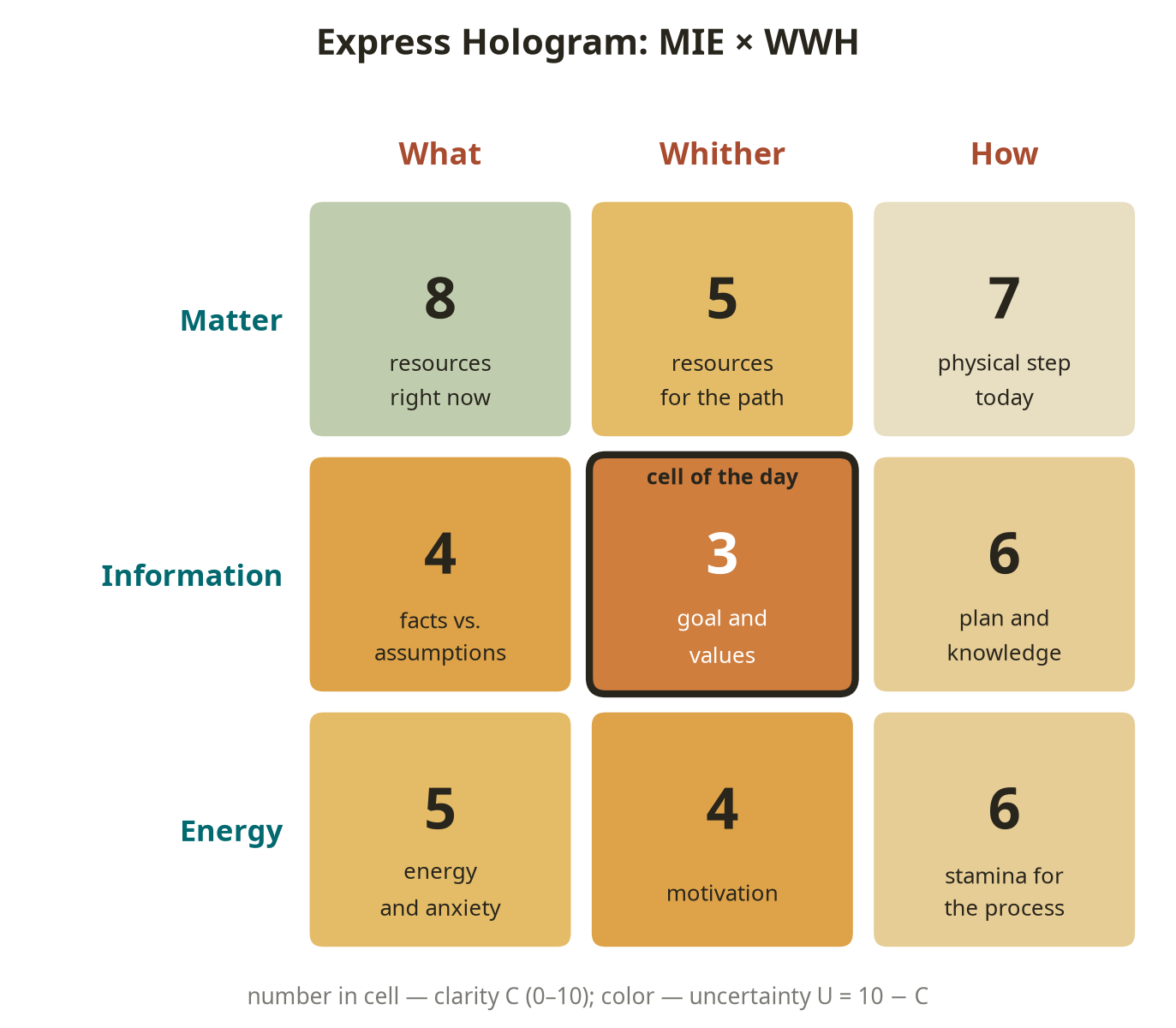
Fig. 11. The Express Hologram: nine MIE × WWH cells, one question in each. The numbers are an example of Marina's clarity ratings C in her second week
How to read this figure. This is the same grid as in the table, but with Marina's answers. The large number in a cell is her clarity C that morning. Color shows the fog: the lower the clarity, the "hotter" the color. The outlined cell is the "cell of the day", the one Marina chose to work on today.
Five steps in five minutes
|
THE EXPRESS HOLOGRAM PROTOCOL • Step 1. Focus (30 seconds). In one sentence: what is causing the most unclarity today? • Step 2. Nine ratings (2 minutes). Quickly, without deliberating, rate C from 0 to 10 in each cell. The first number that comes to mind is usually the most honest. • Step 3. Cell of the day (30 seconds). Find the cell with the highest U, that is, the lowest clarity. If there are several, choose the one that most affects your focus. • Step 4. Strategy (1 minute). Ask yourself: can this be found out? → reduce. It cannot be found out, but can I prepare for it? → insure. Does it simply remain unknown? → endure. • Step 5. One action (1 minute). Write down one concrete step for today, no longer than ten to fifteen minutes. |
|---|
Two indicators
If you want to see the dynamics, two numbers are easy to derive from the nine ratings.
|
DAILY FOG INDEX (DFI) DFI = (U₁ + U₂ + … + U₉) / 9 × 10 DFI shows how "foggy" today is, from 0 to 100. U₁, U₂, … U₉ are the uncertainties of each of the nine cells (10 minus clarity). The small numbers at the bottom are just cell numbers. + … + means we add up all nine numbers. / 9 means we divide by nine to get the average. × 10 converts the 0-to-10 scale into the familiar 0-to-100. Guidelines (tentative): below 30, a clear day; 30–60, moderate fog; above 60, thick fog. |
|---|
|
MIE CLARITY PROFILE Add up clarity C for each row: separately for Matter, Information and Energy. Then convert the three totals into percentages of the grand total. The same harmony formula HG as above is applied to this profile, with the equal profile 33.3 / 33.3 / 33.3 as the target. It shows in which area clarity is "overweighted" and where it has collapsed. |
|---|
|
STEP-BY-STEP CALCULATION: MARINA'S MORNING IN HER SECOND WEEK Step 1. Focus. "What will happen to my role after the reorganization?" Step 2. Nine clarity ratings C. Matter: 8, 5, 7. Information: 4, 3, 6. Energy: 5, 4, 6. Step 3. Convert to uncertainty U = 10 − C. Matter: 2, 5, 3. Information: 6, 7, 4. Energy: 5, 6, 4. Step 4. Daily Fog Index. Sum of U: 2 + 5 + 3 + 6 + 7 + 4 + 5 + 6 + 4 = 42. Average: 42 / 9 ≈ 4.7. Multiply by 10: DFI ≈ 47, moderate fog. Step 5. Cell of the day. The highest U = 7 is in the cell "Information — Whither": "What will my role be?" This can be found out → strategy reduce. Step 6. Action. Write to her manager and ask for 15 minutes to talk before Friday. Step 7. Clarity profile. Row totals of C: Matter 8 + 5 + 7 = 20; Information 4 + 3 + 6 = 13; Energy 5 + 4 + 6 = 15. Total 48. Shares: 20 / 48 ≈ 42%, 13 / 48 ≈ 27%, 15 / 48 ≈ 31%. Differences from the equal profile: +8.4, −6.2, −2.0. Sum of squares ≈ 113, root ≈ 10.6; 10.6 / 81.65 ≈ 0.13; HG ≈ 87. |
|---|
|
WHAT THE RESULT MEANS DFI ≈ 47 is an ordinary working day with moderate fog. Clarity is distributed fairly evenly (HG ≈ 87), and there is a single gap: in Information, in the "Whither" question. That is why today's action is so simple: not to read another article, but to ask the person who knows the answer. Five minutes in the morning gave her not anxiety, but a plan for the day. |
|---|
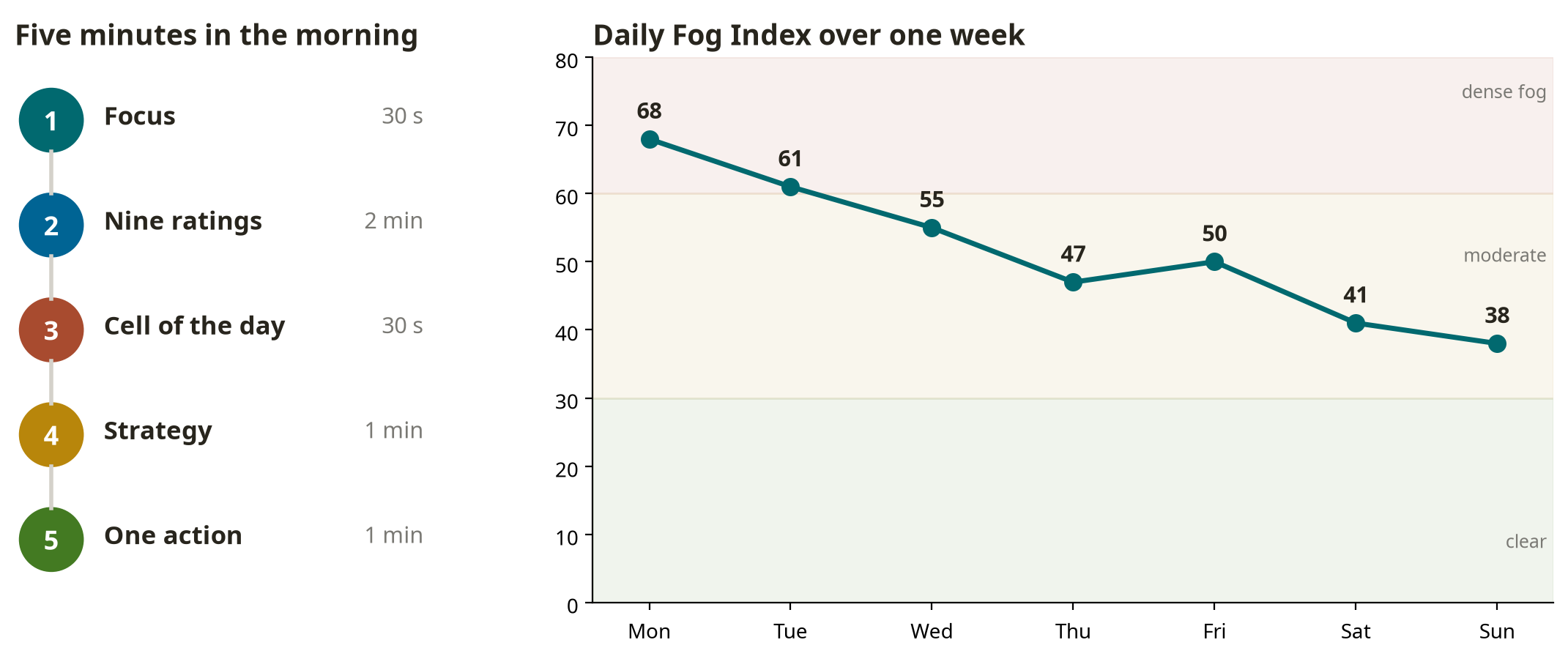
Fig. 12. The Express Hologram over time: the five steps and Marina's Daily Fog Index over a week
How to read this figure. On the left are the five steps of the protocol and how much time each takes. On the right is how Marina's Daily Fog Index changed over one week. The red band at the top is thick fog (above 60), the yellow one is moderate, the green one at the bottom is a clear day. The week starts in thick fog (68 on Monday) and gradually descends to 38 by Sunday. The small rise on Friday is an ordinary fluctuation: that day the company announced another meeting "with no details". What matters is not that the fog sometimes rises, but the overall downward direction.
How the express version connects to the full one
• Daily: the Express Hologram, five minutes, one action.
• Weekly: look at the DFI chart and at which cells most often became the "cell of the day". If the same cell repeats three or four times, that is a signal: the fog there is not situational but systemic.
• Monthly, or when DFI stays above 60 for three days in a row: the full 27-cell hologram with the third lens, SFD. It will show at which level (structure, function or development) the recurring unclarity lives.
|
A PSYCHOTHERAPIST'S COMMENT The strength of the express version lies not in precision but in regularity. Five minutes in the morning turn uncertainty from a background that "is just there" into an object you meet face to face. Within a week, many clients notice that the procedure itself lowers anxiety: unclarity that has an address is less frightening than unclarity without one. |
|---|
Applying the method in different areas
The same method looks different in different life situations. Here are a few examples.
 |
MANAGEMENT AND ORGANIZATIONS A manager announcing a reorganization can use the same triad. Reduce: give employees everything that is already known, plus a timeline for when the rest will be known. Insure: guarantees, transition terms, clear criteria. Endure: space for conversation and an acknowledgment that unclarity is hard. Teams endure bad news better than silence. Dave Snowden's Cynefin framework proposes a "probe — sense — respond" scheme for complex situations (SFiO). In the terms of our approach, this is the "reduce" strategy in small, safe steps. |
|---|
 |
FAMILY AND RELATIONSHIPS A couple who have lived for years in "maybe we'll move" mode can agree on three things: the date by which the decision will be made (reduce), the steps they will take in any case (insure), and how they will support each other while there is no answer (endure). The date alone already lifts part of the fog: "maybe, someday" turns into "we'll decide by March 1". |
|---|
 |
PSYCHOTHERAPY For a client with high intolerance of uncertainty, the S × C matrix is a visual tool. It often turns out that a significant share of the "catastrophes" are untested supports: strengths the person is simply unsure of. One checking action sometimes gives more than months of reflection. And the IUS-12 questionnaire, repeated a month later, shows the client that "I'm just an anxious person" is not a verdict but a trait that changes. |
|---|
Links with other articles in the series
 |
ONE MODEL, THREE TOPICS • Psychological charge and uncertainty are closely linked. Uncertainty works as a constant background leak of charge: unclarity about "Whither" dampens Energy, while the attempt to "think everything through" overloads Information. And to a discharged person any fog seems thicker: the resources R in the Load Index are largely the charge itself. • Digital sins (information obesity, the endless feed, anxious scrolling) make the fog denser. The twelve articles Marina read that night are exactly such a digital leak, disguised as the "reduce" strategy. • Uncertainty is the environment in which both of the previous topics live. Together, the three articles describe one system: charge is the fuel, uncertainty is the environment, digital sins are the leaks. |
|---|
Limitations of the method
An honest discussion of any method includes its limits.
The ratings are subjective. The numbers S, C, r, IM and PO are not measurements but structured judgments. Their value is that they make intuition visible and comparable over time, not in their "precision".
The output is a consensus, not a single rating. For organizations and complex cases, ratings are worth averaging: several experts, the person and their loved ones, as well as independent ratings from different AI models. This procedure can be called a triadic consensus: it does not deliver "the truth", but it reduces the randomness of a single view.
The formulas are models, not laws. They simplify reality. Their job is to show direction and logic, not to predict exact numbers.
The thresholds are tentative. The zone boundaries (20 for priority, 50 and 75 for harmony, 5 and 15 for load) are guidelines for initial work. They should be refined on real data.
The method does not replace professional help. If uncertainty is accompanied by pronounced anxiety, insomnia or thoughts of hopelessness, the hologram is a good reason to talk to a psychotherapist, not a substitute for that conversation.
Pause for a minute
Answer three questions for yourself.
1. Which uncertainty in your life currently takes up the most space in your head?
2. Which part of it is reducible: what could you find out or check this week? And which part is non-reducible, and what could you prepare for?
3. If you honestly divided your efforts between "reduce", "insure" and "endure", which of the three strategies would turn out to be the most neglected?
Write down your answers. Perhaps this is where your map begins.

What can be done next
• The web tool at alexz.us: an interactive hologram in which a person rates 27 cells on S and C, and the system builds a three-dimensional cube with a heat map, calculates HG, HGc, ULI and IUI, and suggests interventions. Developing it is the next step of this work.
• The Express Hologram on your phone. A five-minute morning ritual: nine ratings, the cell of the day, one action, and an automatic Daily Fog Index chart.
• A clarity journal. Monthly re-testing and a "before → after" chart for each index, to see progress and not only problems.
• A team hologram. A team's average hologram shows where uncertainty is organizational and where it is personal.
• Calibration on data. Comparing the indices with the IUS-12 questionnaire and anxiety scales is the path to a more rigorous test of the method.
We cannot choose whether there will be fog in our lives. But we can choose whether we will have a map.
Further reading
1. Zolotov, A. Triadic Intelligence: Designing Reality With the Lens Triad. Amazon
2. Knight, F. H. (1921). Risk, Uncertainty and Profit. Overview: Explained: Knightian uncertainty. MIT News
3. Ellsberg, D. (1961). Risk, ambiguity, and the Savage axioms. Quarterly Journal of Economics. Ellsberg paradox
4. Taleb, N. N. The Black Swan: The Impact of the Highly Improbable. Investopedia
5. de Berker, A. O., et al. (2016). Computations of uncertainty mediate acute stress responses in humans. Nature Communications. Nature
6. Dugas, M. J., et al. Further development of the intolerance of uncertainty model of GAD. The Cognitive Behaviour Therapist. Cambridge
7. Carleton, R. N., Norton, P. J., & Asmundson, G. J. G. (2007). Fearing the unknown: A short version of the Intolerance of Uncertainty Scale. Journal of Anxiety Disorders. PubMed
8. Carleton, R. N. (2016). Fear of the unknown: One fear to rule them all? Journal of Anxiety Disorders. PubMed
9. Kruglanski, A. W. Need for cognitive closure. Springer
10. Hirsh, J. B., Mar, R. A., & Peterson, J. B. (2012). Psychological entropy: A framework for understanding uncertainty-related anxiety. Psychological Review. ERIC
11. Grupe, D. W., & Nitschke, J. B. (2013). Uncertainty and anticipation in anxiety. Nature Reviews Neuroscience. PubMed
12. Beck, U. (1986). Risk Society: Towards a New Modernity. Risk society
13. Bauman, Z. Liquid Modernity; review in the British Journal of Social Work. Oxford Academic
14. VUCA: volatility, uncertainty, complexity, ambiguity. VUCA
15. Cascio, J. BANI: brittle, anxious, nonlinear, incomprehensible. Medium
16. Mullainathan, S., & Shafir, E. Scarcity: Why Having Too Little Means So Much. Overview. APA Monitor
17. Snowden, D. Complexity and Cynefin. SFiO
18. Single-session online training reduces intolerance of uncertainty and improves mental health in emerging adults. Psychological Medicine. Cambridge
Learn more about the approach in the book Dr. Alex Zolotov, Ph.D. «Triadic Intelligence: Designing Reality With the Lens Triad»